SecondLive and RD Technologies are the top two startups with the largest volume of fundraising for the week, the latest data shows.
While the amount of disclosed venture rounds this week was comparatively less than what was announced in recent weeks, crypto venture capital activity for the year is on pace to dethrone 2023’s total of $2.6 billion, according to PitchBook.
Some $2.2 billion had been raised as of July 30. The amount, raised across 24 funds, is still far behind 2022’s total of $22.7 billion.
Crypto.news compiled the data from Sept. 29 to Oct. 5 from Crypto Fundraising. Here’s what we found.
SecondLive, $12 million
SecondLive is a metaverse platform that lets users create their own avatars.
The firm has raised a total of $15 million so far.
The latest $12 million raised was in a private round led by Crypto.com.
RD Technologies is a fintech firm that has a primary focus on payments and commerce.
The firm has raised $7.8 million in a Series A round led by HongShan, HIVEMIND and Aptos Labs.
🚀Exciting news!
RD Technologies has successfully completed its Series A1 financing, securing US$7.8 million! In this funding round, RD Technologies has secured strategic investments from prominent industry players like HongShan, @HivemindCap, @AptosLabs, Hash Global, SNZ… pic.twitter.com/U8pTPtqQyu
Synnax is a platform that introduced AI credit intelligence for privacy-focused credit analysis.
The firm has raised a total of $2.55 million so far.
The latest fund raised was $1.55 million in a round led by WINTERMUTE and Ton Ventures.
🚀 Big News! 🚀
We’re excited to announce that #Synnax has secured strategic investment from Wintermute Ventures & TON Ventures, bringing our total funding to $1.55M! 💰
Popcat emerged as the top gainer this week, driven by improved trader sentiment and a sharp rise in its futures open interest.
Popcat (POPCAT) rose over 35% in the last seven days, hitting a new all-time high of $1.26 on Oct. 5. Most of these gains came within the last 24 hours. the token rose 20.6% from its intraday low of $0.98.
The Solana-based token was also up 112% over the past month, making it the second-largest gainer among the top 100 cryptocurrencies, boasting a market cap exceeding $1.2 billion, according to CoinGecko.
One of the key bullish arguments for Popcat is its widely distributed ownership, with large holders controlling just 17% of the total supply per CoinCarp data.
The same cannot be said for its competitors like Bonk (BONK) and Shiba Inu (SHIB), which are far more concentrated, with the top 10 wallets holding 52% and 61% of the supply, respectively.
This makes Popcat less vulnerable to “whale” manipulation and offers a more stable, balanced trading environment.
Bulls remain in control
The coin’s futures open interest is up 344% to a record $191.11 million, signaling that traders are heavily positioning for further price gains.
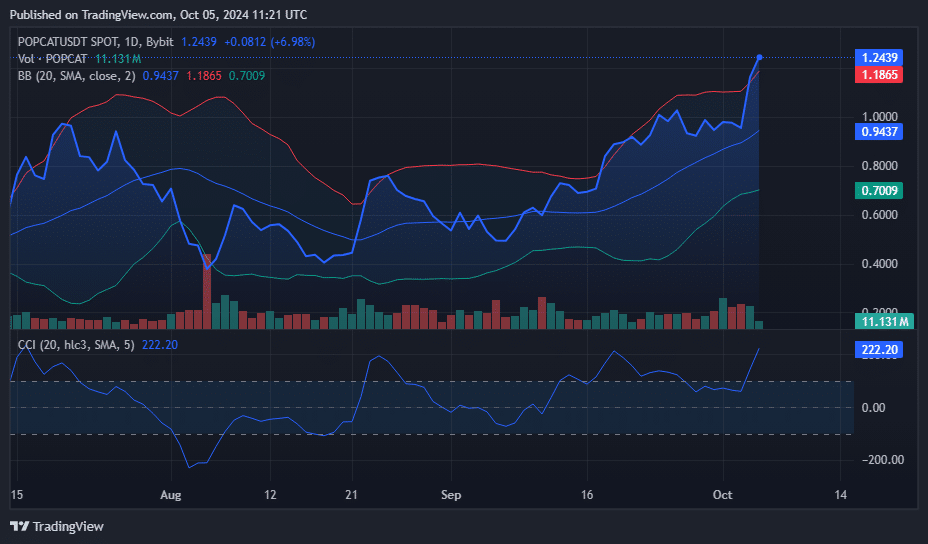
On the 1D POPCAT/USDT chart, the recent price action has pushed the token above the upper Bollinger Band, currently at $1.865, confirming the strong upward momentum.
However, this also means that the token has reached an overbought zone. This is reinforced by the Commodity Channel Index spiking to 222.2, well above the 100 threshold that indicates overbought conditions.
POPCAT price, Bollinger Bands and CCI chart | Source: crypto.news
Although these technical signals suggest the potential for a market correction, the token’s successful retest of the upper Bollinger Band earlier today reinforces the idea that bulls remain in control.
This could point to continued upward momentum in the short term, although traders should still exercise caution due to the overbought indicators.
Price predictions
Trader sentiment on X aligned with the technical outlook as market observers pointed out that Popcat was in price discovery, meaning the token could print new highs soon.
According to analyst Altcoin Sherpa, Popcat has broken out of a key trading range, adding that as long as the price of Bitcoin remains stable, the upward trend could continue, potentially targeting the $2 mark. See below.
once a coin breaks out of the range, you want to see continuation. Ofc this is going to depend on $BTC but I think that $POPCAT still looks strong. wouldn’t be surprised to see it go to like $2 or something to be honest pic.twitter.com/23EIHzmqsS
Another observer, Murad, offered an even more bullish outlook, predicting the meme coin could reach a price target of $5, a 300% surge from its current level of $1.24.
Meanwhile, another pseudonymous analyst, ‘TraderSz,’ noted that POPCAT breached a key resistance level of around $1.20 and is now heading towards the next major resistance at $1.50.
At the time of writing, Popcat was trading at $1.24. While it remains to be seen if the meme coin can hold this level, community sentiment appears optimistic, with data from CoinMarketCap showing that 69% of traders, out of 4,473 votes, are bullish on its future prospects.
As previously reported by crypto.news, crypto analysis firm Cryptonary predicted that Popcat could reach a price target of $40 during the current bull run, driven by strong community support, the so-called “meme coin supercycle,” and its growing prominence in the Solana ecosystem.
The creator of the Popcat meme coin hasn’t been explicitly named. The token’s popularity stems from a meme of a cat named Oatmeal chirping at a bug. The video, featuring alternating images of Oatmeal with its mouth open and closed, quickly turned into a GIF.
It eventually went viral. Students from the University of Sheffield in England created a Popcat-inspired game that revolves around clicking an image of Oatmeal to generate points.
Spot Bitcoin exchange-traded funds in the U.S. recorded outflows of over $300 million this week as global macroeconomic events sparked uncertainty over short-term direction.
After closing the historically bearish September with over $1.1 billion in inflows, roughly $388.4 million moved out of the 12-spot Bitcoin ETF funds between Oct. 1 and Oct. 3 coinciding with the escalating Iran-Israel conflict, which pushed Bitcoin’s price to a weekly low of $60,047.
On Oct. 4, better-than-expected U.S. payroll data brought some relief to the market, allowing Bitcoin to reclaim the $62,000 level, while ETF products saw $25.59 million in inflows.
However, this recovery wasn’t enough to fully offset the impact of the three-day outflow streak.
Since Sept. 13, three consecutive weeks of inflows brought in about $1.91 billion into spot Bitcoin ETFs, but this week’s outflows caused these funds to end the first week of October in negative territory, with $301.54 million flowing out, according to SoSoValue data.
Underlining the last trading day’s activity, Bitwise’s BITB saw the most inflows, while seven out of the twelve Bitcoin ETF products, including BlackRock’s IBIT, saw no movement.
Bitwise’s BITB led with inflows of $15.29 million.
Fidelity’s FBTC, $13.63 million.
ARK and 21Shares’ ARKB saw its first inflow this week, bringing in $5.29 million.
VanEck’s BTCW, $5.29 million.
Grayscale’s GBTC recorded outflows of $13.91.
Analysts point to key levels
Besides the ETF market, some selling pressure also came from Bitcoin miners, who, according to crypto analyst Ali, have offloaded approximately $143 million worth of Bitcoin (BTC) since Sept. 29. See below:
The selling activity could intensify, according to Ali, who pointed out in a subsequent X post that Bitcoin had been trading below the short-term holders’ realized price, which currently stands at $63,000.
This price represents the average cost at which short-term investors acquired their Bitcoin, and when the market dips below it, these holders are more inclined to sell in an attempt to minimize losses—risking a “cascading sell-off” that could exert further selling pressure.
As such, Ali advised investors to watch the $63,000 mark as the next key level that BTC needs to conquer to avoid further losses.
On the other hand, Crypto analyst Immortal pointed to a slightly higher short-term target of $64,000, adding that if the flagship cryptocurrency manages to break above this key resistance level, it could signal the beginning of a strong bullish move.
However, on a longer time frame, experts remain optimistic, citing Bitcoin’s historical Q4 performance and expectations of U.S. rate cuts, which could drive prices toward the $72,000 range despite short-term volatility.
At the time of writing, Bitcoin was hovering just above $62,200, marking a drop of over 5% in the past week.
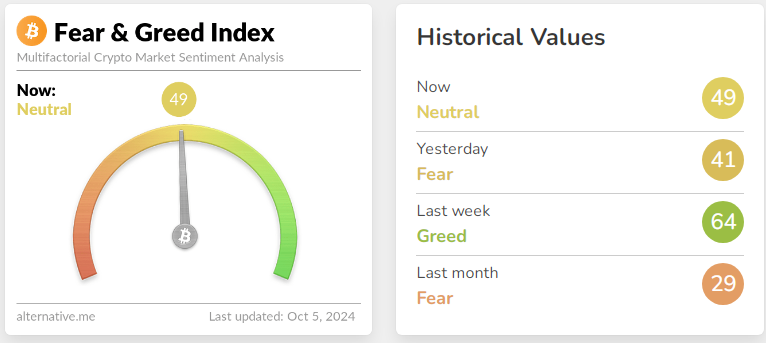
Meanwhile, market sentiment appears to be picking up, with the Fear and Greed Index nudging back to a neutral 49, up from a more cautious 41 the previous day, per data from Alternative.
Abdul Rafay Gadit made a move that is still seldom done in the banking world: He jumped from traditional finance, or TradFi, to decentralized finance, or DeFi.
TradFi is highly regulated and emphasizes protecting consumers. Yet, it can be slow, costly, and restricted to money movers with access to banking services. With DeFi, anyone with internet access can participate. And while it’s generally faster and more accessible, it carries risks such as smart contract bugs, hacking, and little to no regulation.
“I believe we’re at a pivotal moment where the two worlds are beginning to converge,” Gadit tells crypto.news.
After spending six years in corporate banking at Standard Chartered, Gadit launched Zignaly (ZIG) in 2018. Since then, the platform amassed over 500,000 users and 150-plus portfolio managers. It also has a decentralized blockchain called ZIGChain in the works.
Read on for Gadit’s thoughts about the latest trends in social trading and how it can bridge the divide between TradFi and DeFi.
How have your experiences in TradFi influenced your approach to ZIGChain?
Gadit: My transition from corporate banking to blockchain was driven by a desire to innovate and challenge the traditional financial systems I had been part of for six years. Working at Standard Chartered gave me deep insight into the inefficiencies and limitations within traditional finance, especially regarding accessibility, transparency, and opportunities for wealth generation.
Blockchain presented an entirely new paradigm — one that empowers individuals to control their assets, make decentralized decisions, and participate in open financial ecosystems. Co-founding Zignaly allowed me to bring my banking background into action, focusing on creating a platform where everyone, regardless of their background, could invest alongside experienced traders and benefit from the opportunities in web3.
My experiences in traditional finance significantly influenced our approach. We aimed to take the best practices from the banking world — like risk management, compliance, and user protection — and merge them with the innovation and openness of blockchain. Our goal was to create an infrastructure that enables wealth generation in a more democratized, transparent, and accessible way for all users.
What is your long-term vision for ZIGChain?
Our long-term vision is to create a robust, scalable Layer 1 blockchain that powers a truly decentralized wealth generation ecosystem — a platform where builders, fund managers, and users can collaborate to create and utilize next-generation DeFi tools, dApps, and infrastructure that promote financial inclusion and wealth creation.
Our goal is to not only drive adoption but also establish ZIGChain as a cornerstone of the web3 financial landscape — where builders, fund managers, and users alike can thrive in a transparent, secure, and high-performance environment. With the backing of industry leaders and a clear focus on sustainability and innovation, we’re well-positioned to make this vision a reality.
ZIGChain launched a $100-million ecosystem development fund in August. Where will that capital go?
The $100 Million Ecosystem Fund — backed by DWF Labs, UDHC Finance, and Disrupt — is critical to realizing our vision. We plan to deploy these funds to attract top-tier developers and projects, offering them the resources and support needed to build innovative tools natively on ZIGChain. This funding will help accelerate the growth of our ecosystem by fostering innovation, expanding our infrastructure, and creating incentives for key participants.
What are the most significant challenges in managing such a large social investment platform?
One of the key challenges we’ve faced with Zignaly is the limited access to asset classes. As of now, fund managers on our platform can only invest in tokens listed on centralized exchanges, which restricts the investment opportunities available to our users. However, with ZIGChain, we’re opening the doors to a much broader range of assets, including DeFi, real-world assets, NFTs, perpetual contracts, and tokens across multiple chains. This flexibility not only offers fund managers more options but also creates more diverse and profitable investment strategies for our users, ultimately increasing yield potential.
We’ve also encountered limitations within centralized finance, or CeFi, such as mandatory KYC processes and restricted access based on users’ nationality. These requirements can limit the participation of global users and create scalability concerns. ZIGChain, being a decentralized blockchain, circumvents many of these barriers. It enables a more inclusive and scalable system that allows users to participate without the stringent restrictions often imposed by centralized platforms. This makes ZIGChain accessible to a broader audience, ensuring that we can scale the platform to meet the growing demand.
Another limitation we’ve faced on Zignaly is the reliance on CeFi traders. Currently, we’re limited to fund managers and traders within centralized exchanges, but with ZIGChain, we unlock a whole new realm of DeFi traders. This opens up access to innovative DeFi strategies and products that weren’t previously available on Zignaly. By tapping into the DeFi space, we can significantly improve yield potential for our users, increase overall profitability, and diversify revenue streams for the business. This not only enhances the user experience but positions ZIGChain as a more dynamic and adaptable platform in the ever-evolving web3 landscape.
Given your background in corporate banking, how do you see the intersection of TradFi and DeFi evolving?
My background in corporate banking has given me a unique perspective on the potential synergy between traditional finance and decentralized finance. I believe we’re at a pivotal moment where the two worlds are beginning to converge, and this intersection presents immense opportunities for innovation and financial inclusion.
TradFi has long been the backbone of the global economy, with established frameworks for risk management, compliance, and trust. However, it also comes with limitations—restricted access to wealth-generating opportunities, high barriers to entry, and slow innovation. DeFi, on the other hand, offers openness, inclusivity, and decentralization, providing users with direct control over their assets and access to a broader array of financial products like staking, lending, and tokenized real-world assets.
As this synergy evolves, I see traditional institutions increasingly integrating DeFi solutions to improve efficiency and offer new services to their clients. This could include everything from tokenized assets and decentralized lending to programmable smart contracts for automating complex financial processes.
By building an ecosystem that combines the security and regulatory rigor of TradFi with the innovation and transparency of DeFi, we can create a more accessible and flexible financial system. I envision a future where users seamlessly move between traditional and decentralized financial products, unlocking new opportunities for wealth creation and financial empowerment on a global scale.
Does Zignaly compete with other social investing platforms?
At Zignaly, we don’t see ourselves in direct competition with other social investing platforms. Instead, we focus on competing with our vision to continually evolve and expand access to fund management for everyone. Our goal is to democratize wealth generation, ensuring that anyone, regardless of their financial background, can connect with professional fund managers and access a broad range of asset classes.
While other platforms may limit themselves to centralized systems or traditional investment assets, we’re pushing the boundaries by integrating DeFi, RWAs, NFTs, and more through ZIGChain. Our mission is to break down the barriers that have long excluded people from managing their wealth and open up a world of opportunity where access to financial growth is no longer a privilege, but a right for all.
So, in essence, our biggest competition is our own ambition to redefine what’s possible in the world of decentralized finance and fund management
What trends do you foresee in social investing?
Over the years, we’ve seen a strong demand for transparency, performance-driven strategies, and diversified asset classes. The key trend we’re observing in social investing is a shift toward decentralized platforms and more innovative investment opportunities, especially as users become increasingly aware of the benefits of DeFi and tokenized assets.
In the coming years, I foresee a growing demand for personalized investment strategies, where users won’t just follow a portfolio manager based on their past performance but will have access to real-time, dynamic strategies tailored to individual risk profiles, preferences, and goals. We also expect more integration with decentralized asset classes offering users an unprecedented level of diversification.
How does one stay ahead of the web3 curve?
To stay ahead in the web3 space, we’re constantly innovating. With ZIGChain, we’re creating a platform that not only offers access to a much wider range of assets beyond centralized exchanges but also introduces features like automated, trustless smart contract-based fund management, which significantly enhances security and transparency. We’re also building our infrastructure to accommodate more DeFi portfolio managers, allowing them to bring strategies and tools to our users. This will not only improve profitability for our users but also attract a new generation of traders to the platform.
Our goal is to lead the way in the evolution of social investing by staying decentralized, offering access to new and diverse asset classes, and continuing to prioritize security, transparency, and user experience.
Gần sáu tháng sau khi ra mắt Bitcoin Core 27.0, nhóm phát triển Bitcoin đã công bố bản cập nhật mới nhất mang tên Bitcoin Core 28.0. Phiên bản này không chỉ sửa lỗi mà còn cải thiện đáng kể chức năng và tính bảo mật của mạng Bitcoin.
Trong tuần này, nhóm phát triển đã chia sẻ các ghi chú cập nhật, nhấn mạnh những cải tiến nhằm tăng cường bảo mật và bảo vệ quyền riêng tư cho người dùng. Đặc biệt, Bitcoin Core 28.0 cung cấp các tính năng bảo mật nâng cao, phản ánh cam kết của nhóm đối với việc tạo ra một môi trường an toàn hơn cho tất cả người dùng.
Bản cập nhật này diễn ra chỉ vài tuần sau khi nhóm phát triển công bố về sự xuất hiện của một lỗ hổng nghiêm trọng ảnh hưởng đến một trong sáu node Bitcoin. Những lỗ hổng này đã khiến các node dễ bị tấn công từ chối dịch vụ (DoS) do tài nguyên bị rút cạn xuất phát từ các chain tiêu đề có độ khó thấp. Tuy nhiên, với sự ra mắt của Bitcoin Core 28.0 và các cải tiến bảo mật đi kèm, những thách thức này đã được giải quyết.
Ngoài ra, phiên bản mới cũng hỗ trợ các bản dựng có thể tái tạo, cho phép người dùng có kinh nghiệm biên dịch các tệp nhị phân giống hệt nhau với các tệp phân phối từ trang web chính thức của Bitcoin Core. Điều này không chỉ tăng cường tính minh bạch mà còn củng cố lòng tin trong cộng đồng người dùng Bitcoin.
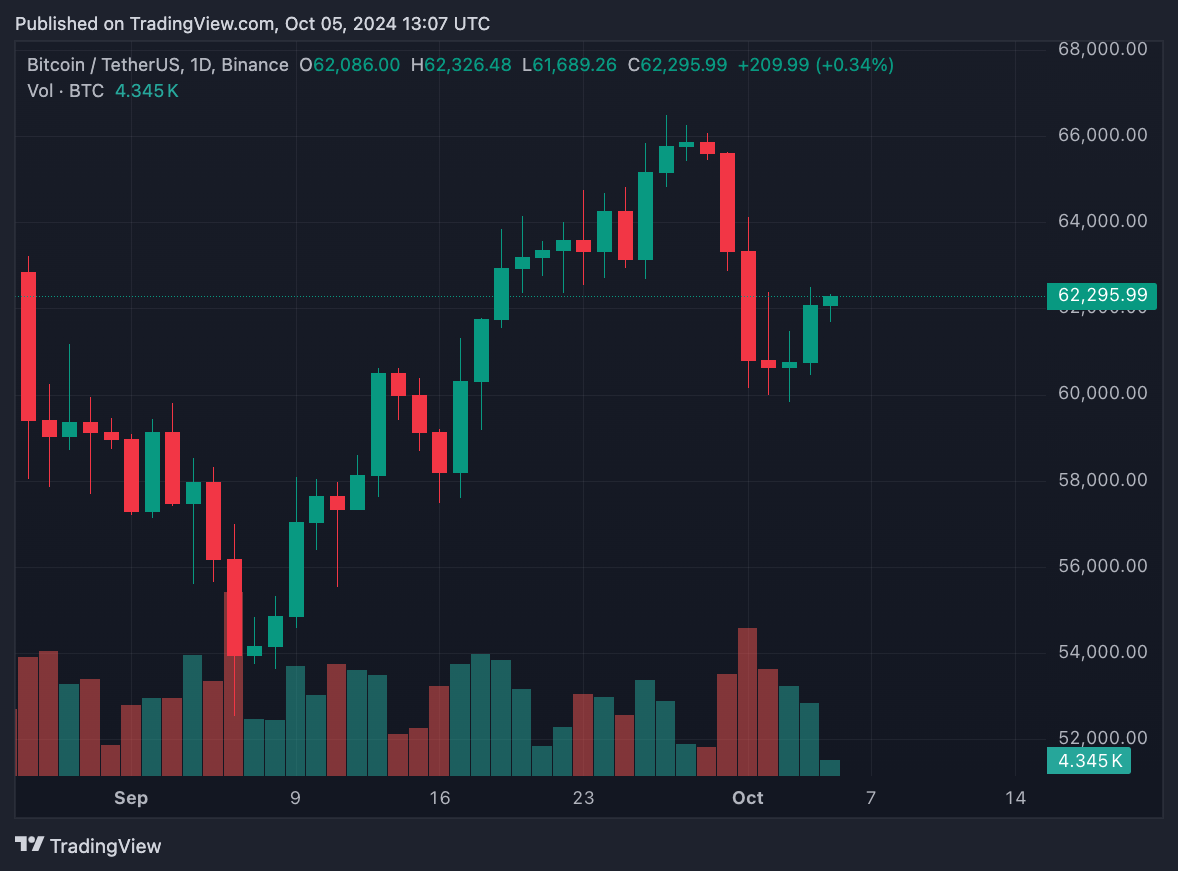
Thị trường Bitcoin đã có những biến chuyển đáng kể kể từ ngày 18 tháng 9, khi Cục Dự trữ Liên bang Hoa Kỳ (Fed) công bố cắt giảm lãi suất 50 điểm cơ bản. Đồng tiền này đã vượt mốc 60.000 đô la sau khi trải qua giai đoạn giảm giá kéo dài. Tuy nhiên, giá Bitcoin sau đó đã trải qua những đợt điều chỉnh và hiện đang giao dịch ở mức 62.295 đô la, tăng 1% trong 24 giờ qua.
Nguồn: TradingView
Mặc dù hiệu ứng từ bản cập nhật Bitcoin Core 28.0 có thể không ngay lập tức thể hiện rõ rệt, nhưng nó có thể sẽ góp phần tích cực vào hiệu suất tổng thể của Bitcoin khi các nhà đầu tư xem xét và định giá hợp lý.
Người đứng đầu bộ phận điều tra tội phạm tài chính của Binance cho biết công ty không tuân thủ các yêu cầu từ quân đội Israel về việc đóng băng ví tiền điện tử thuộc sở hữu của người Palestine và những người khác một cách mù quáng.
“Chúng tôi không chỉ dựa vào một nguồn duy nhất hoặc một công cụ duy nhất,” Nils Anderson Röed, người đứng đầu bộ phận điều tra tài chính toàn cầu của Binance, cho biết về cách mà nhóm của ông xử lý các yêu cầu từ Lực lượng Phòng vệ Israel (IDF).
Vào cuối tháng 8, Giám đốc điều hành Binance – Richard Teng – đã mạnh mẽ phủ nhận cáo buộc rằng sàn giao dịch tiền điện tử lớn nhất thế giới đã đóng băng ví của tất cả khách hàng Palestine theo lệnh của IDF.
Teng cho biết trong một cuộc phỏng vấn sau đó rằng, trong trường hợp này, IDF đã yêu cầu Binance đóng băng hơn 1.500 ví thuộc về người Palestine. Theo Teng, Binance phát hiện ra rằng chỉ có khoảng 220 trong số những ví này, tương ứng 14%, có dấu hiệu liên quan đến các giao dịch bất hợp pháp theo luật quốc tế. Chỉ những ví được chọn mới bị chặn giao dịch trên Binance.
Phát biểu tại hội nghị Messari Mainnet ở New York trong tuần này, Röed giải thích rằng đội ngũ của ông thực hiện nghiên cứu tình báo độc lập song song với các chính phủ như Israel để kiểm tra chéo trong trường hợp có bất đồng về những hành vi cấu thành hoạt động “bất hợp pháp.”
Chẳng hạn, IDF từng tuyên bố một ví tiền điện tử có liên quan đến tài trợ khủng bố, trong khi nhóm nội bộ của Binance lại có “thông tin xác nhận rằng nó có thể liên quan đến một tổ chức từ thiện.”
Theo Röed, trong những trường hợp như vậy, nhóm điều tra tài chính sẽ tham khảo ý kiến luật sư của Binance và sau đó lại tham khảo ý kiến cơ quan thực thi pháp luật có liên quan để xác định các bước tiếp theo nhằm tuân thủ luật pháp quốc tế mà không xâm phạm quyền của người dùng.
Những lần tham khảo này là lý do khiến Binance từ chối 86% yêu cầu đóng băng ví gần đây từ Israel.
Röed, cựu chuyên gia an ninh mạng từng điều tra tội phạm trên dark web cho cả Europol và chính phủ Hà Lan, cho biết Binance đã phân bổ thêm nguồn lực để đảm bảo các cuộc điều tra của mình ở các khu vực nóng như Trung Đông đều đáp ứng đầy đủ tiêu chuẩn và thoả đáng.
“Sàn giao dịch đang thực hiện rất nhiều cuộc kiểm tra bổ sung, đặc biệt là với những vấn đề nhạy cảm như thế này,” ông cho biết.
Spot On Chain mới đây đã báo cáo rằng Vitalik Buterin, đồng sáng lập Ethereum, đã quyết định bán một số memecoin cũng như USDT mà anh đang nắm giữ. Theo thông tin từ nhà báo và blogger tiền điện tử Trung Quốc Colin Wu, số lượng cụ thể mà Buterin đã bán trên các sàn giao dịch bao gồm: 70,71 triệu Neiro, 11,76 tỷ MOODENG, 7,8 triệu DEGEN và 16,03 tỷ KABOSU cùng 100.000 USDT – số tiền này được quyên góp từ dự án CATE. Tổng giá trị của các memecoin và USDT mà Buterin đã bán ước tính khoảng 360.000 đô la, được đổi lấy 140,6 ETH, diễn ra chỉ trong vòng nửa giờ.
Tài khoản Lookonchain bổ sung rằng Buterin đã nhận được toàn bộ số memecoin này miễn phí từ các nhà phát triển. Bên cạnh đó, Spot On Chain cũng thông báo rằng Buterin đã gửi 100 ETH (trị giá khoảng 242.000 đô la) cho chiến dịch “Giải cứu Alexey & Roman”, nhằm hỗ trợ pháp lý cho hai nhà phát triển TornadoCash đang bị giam giữ, Alexey Pertsev và Roman Storm. Tuy nhiên, không rõ liệu số ETH này có được kiếm từ việc bán memecoin hay không.
Cũng trong tuần này, một ví liên kết với Buterin đã chuyển 649 ETH tới Paxos, tương đương 1,79 triệu đô la tại thời điểm giao dịch, diễn ra trong bối cảnh giá ETH giảm nhẹ.
Trong một diễn biến đáng chú ý khác, Buterin đã ủng hộ một bản cập nhật quan trọng cho giao thức SuperchainERC20, như được nêu trong pull request trên GitHub của Optimism. Bản cập nhật này giới thiệu giao diện crosschain mới, SuperchainERC20Bridge và ICrosschainERC20, nhằm tăng cường khả năng mở rộng và tương tác cho Ethereum trên nhiều giải pháp layer 2, từ đó cải thiện hiệu quả và tốc độ giao dịch.
Buterin ca ngợi tinh thần hợp tác trong cộng đồng Ethereum, nhấn mạnh rằng nhiều giao thức đang thể hiện khả năng hợp nhất mà không cần sự hợp tác chặt chẽ. Hơn nữa, anh cũng nêu bật tầm quan trọng của việc chuẩn hóa ở cấp độ ví, đặc biệt là đối với các token ERC20 và NFT ít phổ biến hơn.
Giá trị nền kinh tế tiền điện tử hiện đang dao động quanh mức 2,15 nghìn tỷ đô la, sau đợt tăng khiêm tốn vào sáng thứ 6. Như vậy, chỉ còn 88 ngày nữa là hết năm dương lịch, 32 ngày nữa là đến Ngày bầu cử Hoa Kỳ năm 2024 và 34 ngày nữa là đến cuộc họp tiếp theo của Cục Dự trữ Liên bang Hoa Kỳ (Fed). Với nhiều diễn biến đang xảy ra như căng thẳng gia tăng ở Trung Đông, nhiều yếu tố có thể thúc đẩy hoặc ngăn chặn đà tăng giá của Bitcoin. Bài viết sẽ phân tích chi tiết 4 vấn đề chính có thể định hình giá BTC trong những tháng tới.
Triển vọng năm 2024 của Bitcoin và các sự kiện có thể định hình thời gian còn lại của năm
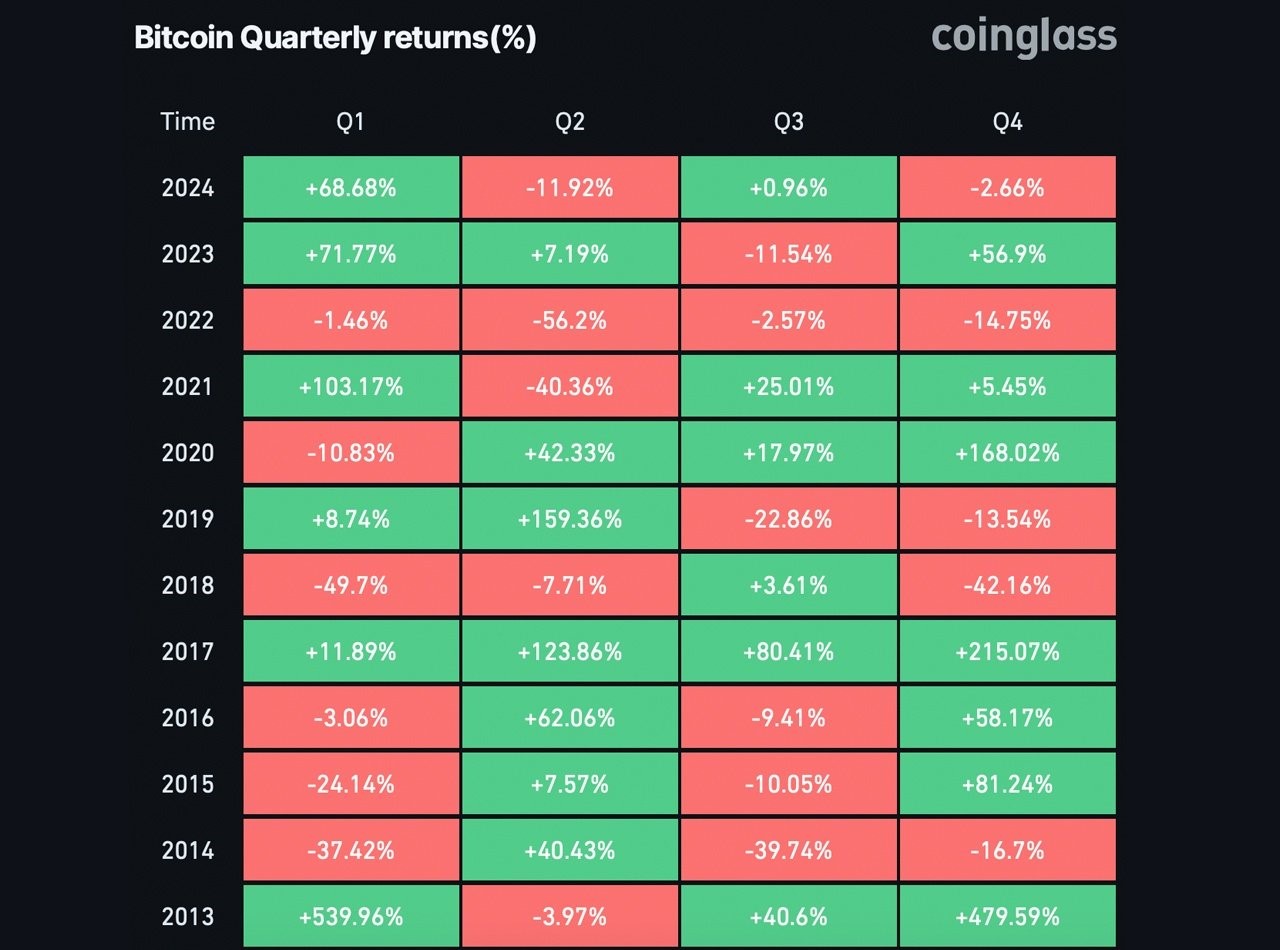
Hiện tại, những người đam mê tiền điện tử đang đoán xem đà tăng giá của BTC sẽ duy trì mạnh mẽ hay lắng xuống trong phần còn lại của năm 2024. Theo truyền thống, Bitcoin hoạt động tốt trong quý cuối cùng của năm. Tuy nhiên, tháng 9 đã vượt qua mọi kỳ vọng và tháng 10 bắt đầu là “Downtober” (tháng suy thoái) thay vì “Uptober” (tháng tăng trưởng) như mong đợi từ lâu, nhắc nhở mọi người rằng các mô hình của quá khứ không đảm bảo kết quả tương lai. Một số người trong cộng đồng đang cảm thấy ảm đạm, tin rằng bullrun có vẻ đã kết thúc.
Mặt khác, nhiều người ví BTC như một quả bóng trên bãi biển được thúc đẩy ngay dưới mặt nước, lắc lư dưới mức cao nhất mọi thời đại 73.000 đô la và sẵn sàng bật lên, có khả năng đạt giá cao mới. Hiện tại, một số diễn biến có thể ảnh hưởng đến giá Bitcoin trong thời gian sắp tới của năm 2024 và nhiều người tham gia thị trường sẽ theo dõi những sự kiện này để xem liệu chúng có gây ra biến động cho giá trị của BTC hay không.
Cuộc bầu cử Hoa Kỳ
Cộng đồng tiền điện tử đang xôn xao về tác động tiềm tàng của cuộc bầu cử Hoa Kỳ năm 2024 giữa Kamala Harris và Donald Trump. Tuy nhiên, rất nhiều nhà đầu tư và nhà phân tích tin rằng giá BTC sẽ tăng vào năm 2024, bất kể ai sẽ vào Nhà Trắng, mặc dù giá dự kiến sẽ có những biến động ngắn hạn quanh thời điểm bầu cử. Gã khổng lồ tài chính Standard Chartered dự đoán BTC có thể đạt 125.000 đô la dưới thời chính quyền Trump, trong khi nhiệm kỳ tổng thống của Harris có thể khiến giá đạt 75.000 đô la. Mặt khác, công ty môi giới và nghiên cứu Bernstein cho rằng Trump sẽ đẩy BTC lên 90.000 đô la, nhưng giảm xuống 35.000 đô la dưới thời Harris.
Các cuộc họp của Ủy ban Thị trường mở Liên bang Hoa Kỳ
Nhiều nhà đầu tư và nhà phân tích dự đoán việc Fed cắt giảm lãi suất tiềm năng có thể thúc đẩy Bitcoin vì những lý do chính đáng. Lãi suất thấp hơn thường khiến việc vay mượn trở nên dễ dàng hơn, tăng thanh khoản trên thị trường tài chính và thúc đẩy nhà đầu tư theo đuổi lợi nhuận cao hơn ở các tài sản rủi ro hơn như tiền kỹ thuật số. Thường được coi là tài sản rủi ro, Bitcoin có xu hướng phát triển mạnh trong thời kỳ chính sách tiền tệ nới lỏng. Fed còn hai cuộc họp nữa của Ủy ban Thị trường mở Liên bang (FOMC) vào năm 2024: ngày 8/11 và 18/12.
Chiến tranh và căng thẳng ở Trung Đông
Trung Đông hiện đang phải đối mặt với tình hình căng thẳng leo thang sau một loạt các sự kiện thù địch. Vào thứ 3, Iran đã phát động một cuộc tấn công quân sự trực tiếp vào Israel, sử dụng cả tên lửa và máy bay không người lái. Các nhà lãnh đạo G7 đã nhanh chóng lên án cuộc tấn công, gọi đây là mối đe dọa nghiêm trọng đối với sự ổn định của khu vực. Sự cố này đã làm gia tăng xung đột đang diễn ra giữa Israel và Hezbollah ở Lebanon, làm dấy lên nỗi lo về một cuộc chiến tranh lớn hơn trong khu vực.
Israel đã tuyên bố sẽ trả đũa, làm tăng sự thận trọng của các nhà đầu tư và đẩy thị trường từ trạng thái chấp nhận rủi ro sang không chấp nhận rủi ro. Theo truyền thống, trong thời kỳ bất ổn địa chính trị, các nhà đầu tư thường tránh xa tài sản rủi ro hơn. Sự thay đổi thận trọng này thường dẫn đến bán tháo các tài sản như tiền điện tử do trader chuyển tiền vào nơi trú ẩn an toàn hơn theo truyền thống. Các cuộc tấn công bằng tên lửa mới nhất của Iran đã đẩy giá Bitcoin trượt dưới 60.500 đô la.
Quyền chọn Bitcoin ETF
Quyền chọn Bitcoin ETF có thể mang lại một số lợi ích cho giá BTC, bao gồm cải thiện khả năng khám phá giá, tăng cường sự tham gia của các tổ chức và mở rộng cơ hội phòng ngừa rủi ro. Việc ra mắt các quyền chọn gắn liền với Bitcoin ETF có thể thúc đẩy đáng kể thanh khoản của thị trường. Bằng cách cho phép trader nắm giữ nhiều vị thế chiến lược hơn, các quyền chọn thu hút nhiều nhà đầu tư hơn. Dòng hoạt động này dự kiến làm tăng khối lượng giao dịch, thúc đẩy nhu cầu đối với các Bitcoin ETF và theo đó là bản thân BTC. Các quyền chọn cũng cung cấp đòn bẩy, cho phép nhà đầu tư tiếp cận với lượng BTC lớn hơn với ít vốn ban đầu hơn. Đòn bẩy sẽ khuếch đại các biến động của thị trường, có khả năng dẫn đến mức tăng giá mạnh hơn khi tâm lý thuận lợi.
Chỉ số sợ hãi và tham lam tiền điện tử | Nguồn: alternative.me
Cân bằng giữa biến động thị trường tức thời với tiềm năng tăng trưởng dài hạn
Trong năm qua, quỹ đạo của Bitcoin vẫn không chắc chắn, bị ảnh hưởng bởi các lực lượng bên ngoài như bất ổn địa chính trị và thay đổi chính sách tài chính. Những người tham gia thị trường đang theo dõi chặt chẽ các biến số này, nhận ra rằng hiệu suất trong tương lai của vua coin không chỉ phụ thuộc vào xu hướng lịch sử mà còn phụ thuộc vào bối cảnh toàn cầu đang thay đổi. Đỉnh điểm của những sự kiện này có khả năng sẽ quyết định hướng đi của thị trường.
Với cả sự lạc quan và hoài nghi về tiềm năng của Bitcoin, cộng đồng tiền kỹ thuật số đang phải đối mặt với một giai đoạn quan trọng. Các nhà đầu tư phải cân nhắc giữa biến động ngắn hạn với triển vọng tăng trưởng dài hạn, nhận thức rằng các quyết định được đưa ra ngay bây giờ sẽ định hình tương lai của tài sản trong một thị trường khó lường vào năm 2024.
In mid-August 2024, Ethereum (ETH) gas fees dipped to 0.6 gwei—a record low since 2019. While some see this as a concerning drop, it is symptomatic of broader, healthier shifts within the ecosystem.
Lower gas fees reflect decreased mainnet transaction volume, which has, in turn, led to reduced staking yields for validators. Simultaneously, the slow adoption of Ethereum exchange-traded funds in the US adds to the market’s uncertainty. These recent events have prompted some to question Ethereum’s viability and long-term future. But rather than signaling a crisis, these developments point to a new chapter in Ethereum’s evolution—one that marks a transition to a more mature and sustainable ecosystem.
The reduced yields should not be viewed as a sign of diminished activity or liquidity but as a result of Ethereum’s success in scaling and distributing its load across layer-2 solutions. This shift, alongside new investment vehicles like spot ETH ETFs, is creating a more efficient and accessible market, bringing long-term benefits to Ethereum and decentralized finance as a whole.
Ethereum’s paradoxical growth
Ethereum is currently experiencing what can best be described as paradoxical growth. On the one hand, its mainnet is seeing reduced transaction activity and lower yields. On the other hand, L2 solutions—designed to reduce transaction congestion—are flourishing. Daily transactions across L2 ecosystems surged to an all-time high of 12.42 million in mid-August, coinciding with the lowest gas fees seen on the Ethereum mainnet in years. These dynamics reveal that rather than a slowdown in the ecosystem, Ethereum is shifting its activity to more scalable, efficient layers.
The lowered staking yields for validators, which many are concerned about, are a natural consequence of this migration of activity from the mainnet to L2s. Over time, Ethereum’s mainnet may evolve into a settlement layer reserved for high-value transactions, allowing the bulk of lower-value activity to be handled by L2s. This isn’t a sign of decline but of a maturing market capable of meeting the demands of a growing user base while optimizing costs and efficiency.
Instead of focusing narrowly on the mainnet’s yield, stakeholders would do well to consider Ethereum’s ecosystem as a whole. Attracting more users to the protocol, enhancing accessibility, and rolling out initiatives like incentivized airdrops and points systems could help Ethereum further solidify its position as the go-to platform for decentralized applications and DeFi innovations.
The expanding influence of DeFi
Ethereum’s role as the foundational layer of DeFi continues to shape the broader blockchain space. Despite current concerns, Ethereum’s growth remains a powerful driver of innovation, and this evolution is crucial for the future of decentralized finance.
On the protocol level, Ethereum’s continued development and expansion create a more competitive and accessible network for users and developers alike. As Ethereum scales, its capability to support new dApps and financial products increases, further contributing to DeFi’s success. This, in turn, drives network effects, where increased participation enhances security, utility, and, ultimately, adoption.
Ethereum’s influence is also spreading to traditional finance, most notably through the introduction of spot ETH ETFs, which provide a more familiar and regulated entry point for institutional and retail investors alike. These ETFs lower the entry barrier for those unfamiliar with blockchain technology but eager to invest in the space. By offering a regulated framework and a product perceived as safer than direct token purchases, spot ETH ETFs are attracting traditional investors to the Ethereum ecosystem. This not only expands Ethereum’s reach but also positions ETH as more than just a tech-driven asset—transforming it into a recognized store of value.
As this trend continues, we can expect further integration between Ethereum and real-world assets, enhancing the network’s utility and long-term potential.
Supporting ecosystem transitions
As Ethereum navigates this paradigm shift, it’s important to recognize that these changes are a natural part of the ecosystem’s evolution. Lowered staking yields and gas fees are not indications of failure but reflections of Ethereum’s capacity to adapt and scale. Supporting this transition is crucial for the network’s long-term success, and this can be achieved through initiatives that prioritize user engagement and developer incentives.
For instance, platforms like Base—an L2 solution—handled over 109 million transactions in the past 30 days compared to Ethereum’s 33 million. This is a clear sign that L2s play a critical role in the network’s growth. However, acknowledging this shift isn’t enough; the ecosystem must prioritize collaboration among DeFi protocols to build dApps that maximize Ethereum’s potential. This is the only way for Ethereum to achieve its actual goal of serving the masses with decentralized technology.
A new dawn for Ethereum
The Ethereum mainnet’s lower yields and gas fees may appear to signal a slowdown, but they are, in fact, signs of Ethereum’s growing scalability and efficiency. As L2 networks take on more transaction activity and new financial products like spot ETH ETFs open the door for traditional investors, Ethereum is evolving into a more robust and versatile platform.
The ebbs and flows of market dynamics—like the recent yield reductions—are part of a larger shift that strengthens Ethereum’s role as the backbone of DeFi. The future of Ethereum lies in its ability to scale, integrate real-world assets, and foster a thriving community across its ecosystem. Far from being a calamity, the lower yields signal a new dawn in which Ethereum continues to lead the way in decentralized innovation.