Inflation and a lifeline for millions: What is known about the Tether’s documentary?

Tether will release a documentary about USDT and its impact on the fight against inflation in honor of its tenth anniversary.

The documentary “Stability and Freedom in Chaos” tells the story of how USDT has become “a lifeline” for those who fight inflation and promote “financial freedom worldwide”.

Commenting on the documentary’s release, Tether CEO Paolo Ardoino claimed that the company’s mission is to provide access to finance to billions of people in developing countries who cannot have bank accounts.

“Tether has built its company on a simple mission: bring financial inclusion to the billions of people, primarily living in developing countries, that can’t have bank accounts (because they’re not generating enough revenues for the traditional banking industry) or live in high inflation countries.”

According to him, Tether has become “a symbol of disintermediation, sustainability, and stability” that helps empower “individuals, communities, cities, and entire countries”.

10 years towards financial freedom

In 2014, Brock Pierce, Reeve Collins, and Craig Sellars founded the Realcoin project, later known as Tether. The main idea was to create a digital currency pegged to fiat money to provide stable value and simplify cryptocurrency trading.

In October 2014, USDT was introduced as a stablecoin pegged to the U.S. dollar. Since that time, Tether was actively working to expand its ecosystem. Later, USDT was launched on the Ethereum, TRON, and TON blockchains, allowing the tokens to be used on various decentralized platforms.

In addition, USDT has been widely integrated into various dapps and smart contracts, strengthening its role in decentralized finance.

USDT has become a must-have coin for key areas in crypto and blockchain

Tether quickly became a popular currency for traders, as it allowed them to access stable funds during times of high volatility in the crypto market. It was integrated into many cryptocurrency exchanges, which increased its liquidity.

Tether and its stability have greatly influenced the development of the crypto market, allowing traders and investors to quickly move funds between cryptocurrencies and fiat without great losses due to price fluctuations.

Throughout its history, Tether has remained the main stablecoin actively used throughout the crypto space. In the ten years since its launch, USDT has grown to a market capitalization of almost $120 billion, making it one of the largest cryptocurrencies ever.

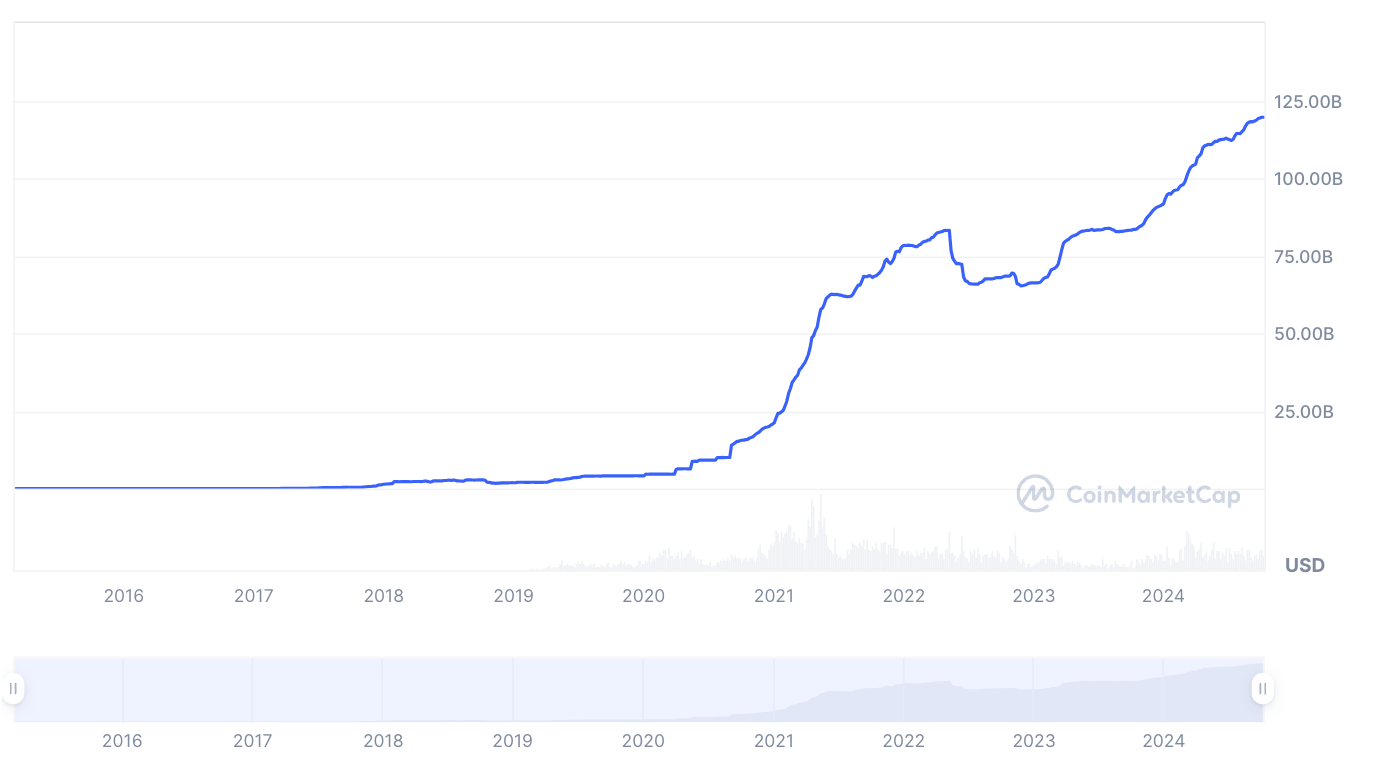
Tether market capitalization | Source: CoinMarketCap

A lifeline for developing countries

Commenting on the documentary release, Ardoino said that USDT has become “a symbol of disintermediation, resilience, and stability.” The film explores the adoption of USDT in three countries: Argentina, Turkey, and Brazil.

Why these countries? There are several reasons for this, but all of them share one key factor: economic instability.

These countries experience high inflation and instability of their national currencies. Additionally, developing countries often need more access to traditional banking services. Cryptocurrencies like Tether allow people to conduct financial transactions without banks, which is especially important in countries with low banking literacy.

For example, Argentina faces economic problems such as high inflation, devaluation of the national currency, peso, and restrictions on foreign exchange transactions. People are looking for ways to protect their savings, and cryptocurrencies can be an alternative. The country’s new president, Javier Milei, has also supported the use of BTC along with other units of payment as part of a strategy to develop free competition in the local currency market.

A similar situation is happening in Turkey, where people face economic instability, including high inflation and depreciation of lira. Cryptocurrencies are also seen as a way to protect savings from inflation.

In addition to economic problems, a significant number of people in Brazil do not have access to banking services. USDT allows these people to participate in the financial system and make transactions without opening a bank account.

Thus, in its ten years, USDT has become an essential asset in trading and a popular alternative to the dollar, giving people in developing countries access to the crypto market, allowing them to invest, trade, and make payments.

Despite its success, there are still many unclear moments in the history of Tether

However, there are still dark moments in Tether’s history. In the past, Tether has faced criticism for possible market manipulation and for possibly supporting the prices of Bitcoin (BTC) and other cryptocurrencies.

In addition, although Tether claims that each USDT is backed by one U.S. dollar, many critics point to the lack of regular and independent audits that could confirm this claim. This raises questions about how secure and liquid the reserve is and whether these assets can provide full coverage for USDT.

Tổng hợp và chỉnh sửa: ThS Phạm Mạnh Cường
Theo Crypto News

EIGEN has formed a bullish pattern, but two risks remain

EigenLayer’s token continued its strong recovery as investors bought the dip following last week’s airdrop.

EIGEN unlocks and TVL retreat

The EigenLayer (EIGEN) token rebounded, reaching a high of $3.86, its highest level since Oct. 2, and 26% above its all-time low.

EIGEN’s rebound occurred after the founder announced that the network was shifting focus to Web3 applications post-airdrop. This is important since EigenLayer does not have a consumer-facing application. Instead, it secures several actively validated services like AltLayer, Ethos, and Lagrange.

The rebound also came after a hacker stole 1,673,645 tokens valued at over $6.8 million. The hacker moved these tokens through a decentralized swap platform and then transferred the stablecoins to centralized exchanges.

EIGEN token holders face two significant risks ahead. First, there is a dilution risk since EigenLayer has 187 million tokens in circulation against a maximum cap of over 1.6 billion tokens.

According to the developers, the network will unlock and distribute 67 million tokens, or 4% of the initial supply, in the first year. These unlocks will happen every Tuesday over the next 12 months, with 3% going to Ethereum and liquid staking token stakers. 1% of the tokens will go to EIGEN stakers and operators.

Token unlocks are typically bearish because they increase the number of tokens in circulation, diluting existing holders.

The second risk is that demand for restaking is waning. According to DeFi Llama, EigenLayer’s total value locked has dropped to $10.7 billion, down from over $20 billion earlier this year. In Ethereum terms, the network secures 4.43 million Ethereum, down from the year-to-date high of 5.34 million.

A likely reason for this is that Ethereum (ETH) staking market cap has fallen in the past few weeks. It has retreated by almost 8% in the last 24 hours to $83 billion, according to StakingRewards.

EIGEN forms an inverse H&S pattern

EIGEN chart by TradingView

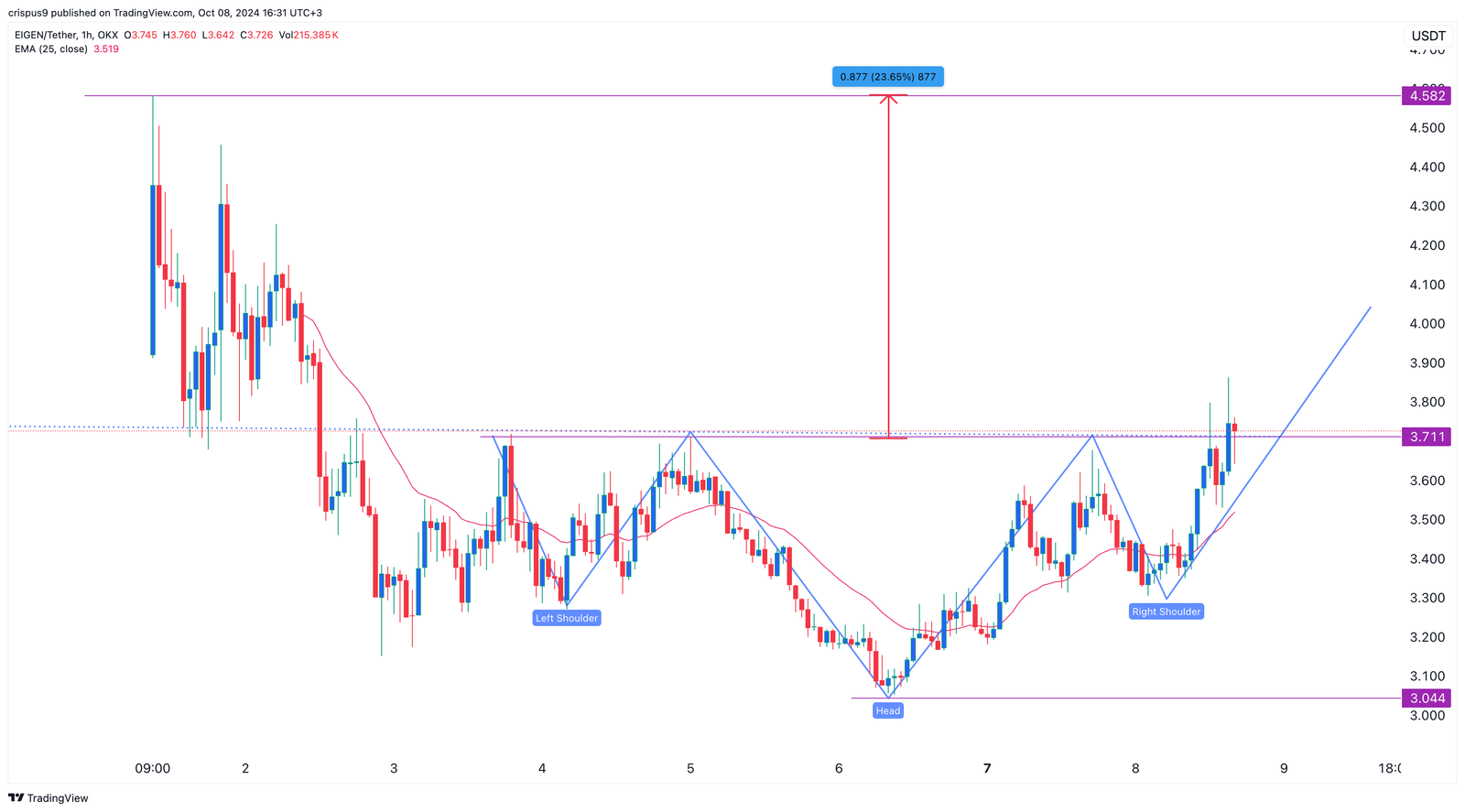
On the hourly chart, the EIGEN token bottomed at $3.04 on Oct. 6 and then bounced back to $3.8, its highest point since Oct. 2.

It has risen above the 25-period moving average, and most importantly, it has formed a bullish inverse head and shoulders pattern. In price action analysis, this is one of the most bullish signals in the market.

Therefore, there is a likelihood that EigenLayer’s token will bounce back and possibly retest the all-time high of $4.58, up by 23% from the current level.

Tổng hợp và chỉnh sửa: ThS Phạm Mạnh Cường
Theo Crypto News

Report: State Street enters tokenized bonds and digital money funds

American financial giant State Street is exploring blockchain technology to tokenize bonds and money market funds for enhanced collateral management.

State Street, the largest custodian bank in the world, is leveraging blockchain to explore the tokenization of bonds and money market funds, joining a growing number of firms adopting distributed ledger technology in traditional finance.

In an Oct. 8 interview with Financial News, State Street chief product officer Donna Milrod said the firm has two ongoing projects focused on tokenizing collateral linked to money market funds and bonds, adding that the pilot “will take us through part of next year.”

She explained that the Boston-headquartered banking institution aims to develop tokenized collateral that can be used as variation or initial margin for trading.

State Street does not rule out stablecoin launch

Currently, trading firms are required to liquidate their holdings in money market funds to post cash as margin for trades. However, with digitalized funds, tokens could serve as collateral, eliminating the need for redemption altogether, Milrod explained.

State Street is not the first institution experimenting with the tokenization of money market funds. BlackRock, for example, launched a blockchain-based fund earlier in March. JPMorgan is also exploring the use of tokenized money market funds as collateral and has already tokenized real-world money through its stablecoin.

Although Milrod noted State Street’s current focus does not include launching a stablecoin, she acknowledged the potential for future developments, saying, “That does not mean we will not [launch a stablecoin] at some point, but we do not feel the need to do that right now.”

Tổng hợp và chỉnh sửa: ThS Phạm Mạnh Cường
Theo Crypto News

Bitcoin price stuck in a range as balances on exchanges plunge

Bitcoin price remained in a consolidation phase even as the amount held on exchanges continued to decline.

Bitcoin (BTC) was seen trading at $62,540 on Oct. 8, slightly below this week’s high of $64,500. It remains in a correction after falling 15% from its highest point this year.

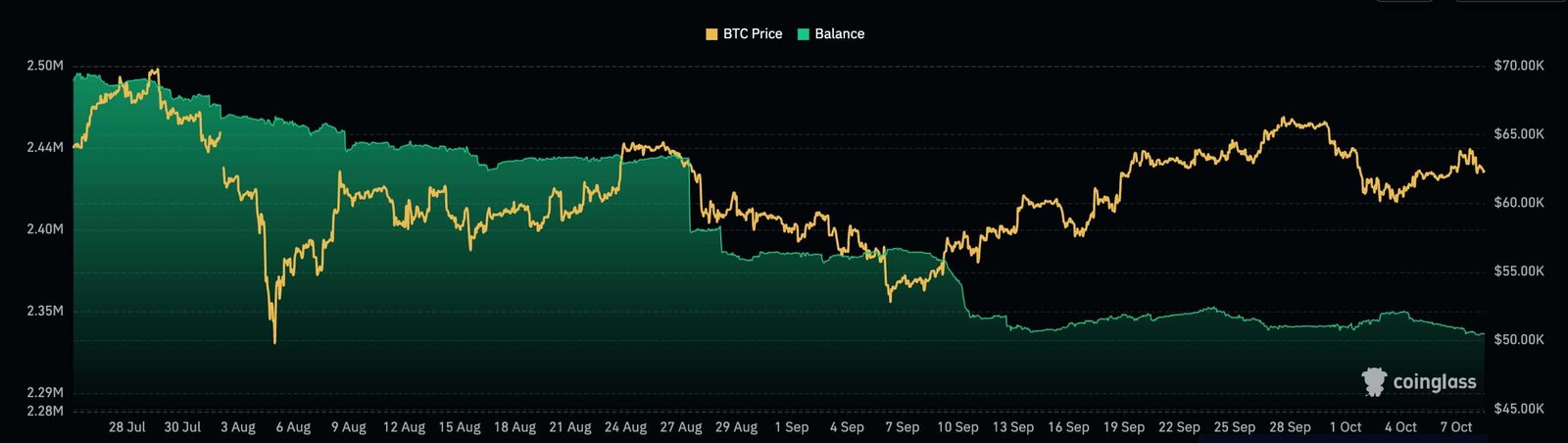
Bitcoin still has some potential catalysts that could push its price higher in the coming months. Data from CoinGlass shows that Bitcoin reserves on exchanges have continued to fall, reaching a year-to-date low of 2.34 million.

Bitcoin balances on exchanges | Source: CoinGlass

It is estimated that Bitcoins worth over $31 billion have been removed from exchanges since February. Most of these coins have moved to self-custody wallets, while others have been transferred to exchange-traded funds.

Flows from exchanges to wallets are often a sign that most holders are bullish. Some prominent companies, such as MicroStrategy, Marathon Digital, Block, and Tesla, are among the most bullish in the industry.

MicroStrategy has accumulated over 252,000 worth of Bitcoins while Marathon holds 26,842 coins. Tesla and Block, formerly known as Square, hold 9,720 and 8,211 coins, respectively.

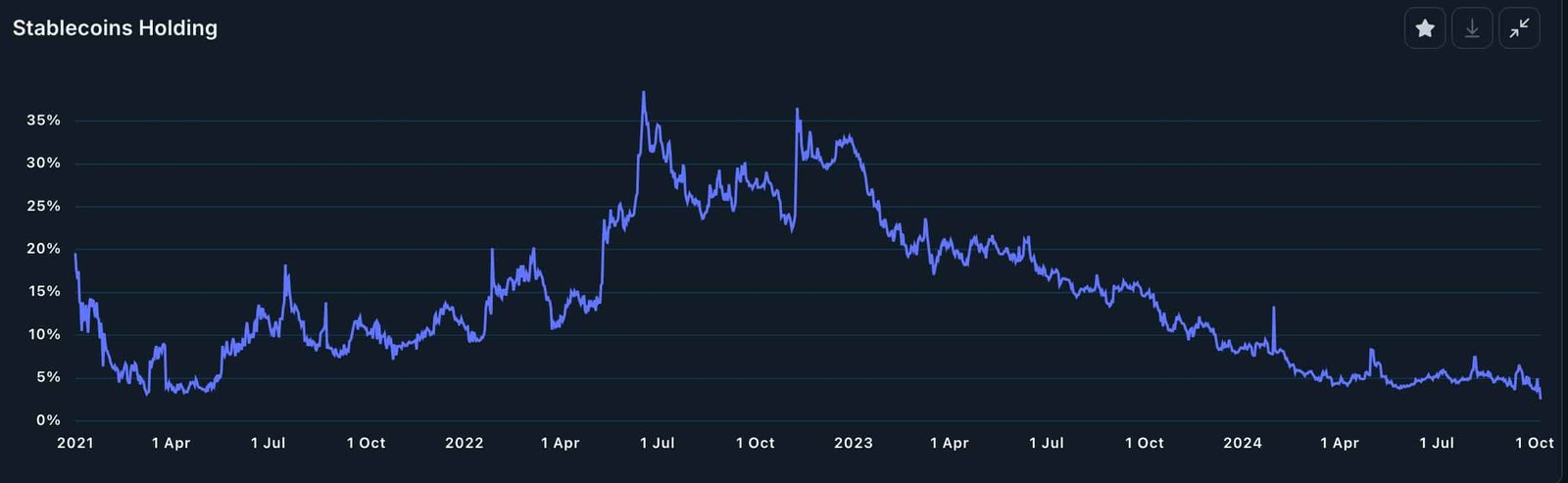
Additional data from Nansen shows that smart money holdings of stablecoins have dropped to their lowest level in years.

The figure peaked at 38.5% in May 2022 when Terra collapsed and rebounded to 35.7% in November of the same year after FTX collapsed. It has been in a strong downtrend since then, suggesting that smart money is mostly bullish on cryptocurrencies.

Stablecoin holdings by smart money | Source: Nansen

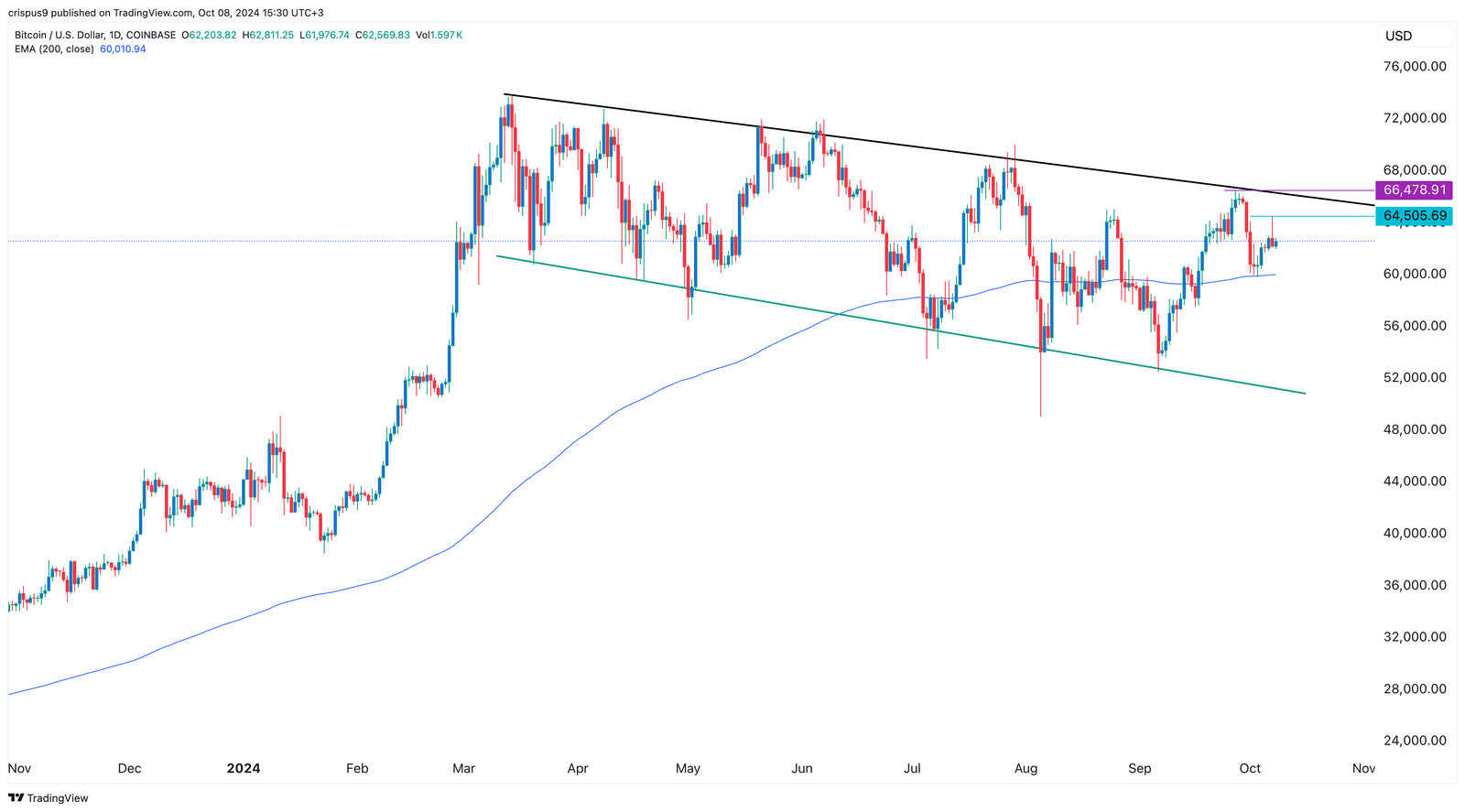
Bitcoin has found support at the 200 EMA

Bitcoin price chart by TradingView

On the daily chart, Bitcoin has remained within the descending black channel that connects the highest and lowest swings since March. This channel can be viewed as a falling broadening wedge, a popular bullish sign.

It has also found support at the 200-day Exponential Moving Average, which is a positive sign. However, Bitcoin has formed a small evening star candlestick pattern, characterized by a small red body and a long upper shadow.

Therefore, Bitcoin will need to rise above the upper side of the shadow pattern at $64,500. After that, bulls will need to push it above the descending trendline and then the all-time high of $73,800 to continue the uptrend.

The alternative scenario is where Bitcoin drops below the 200-day EMA at $60,000. If this happens, it will increase the chances of a drop to the lower side of the wedge at $52,000.

Tổng hợp và chỉnh sửa: ThS Phạm Mạnh Cường
Theo Crypto News
Bitcoin sẽ được ‘tái phân bổ vốn’ khi Trung Quốc dừng kích thích: QCP Capital

Đợt tăng giá cổ phiếu Trung Quốc trong tháng 9 đã nhanh chóng biến mất vào thứ Ba khi các trader trở lại thị trường sau kỳ nghỉ lễ dài một tuần. Giá Bitcoin (BTC) đã ghi nhận sự sụt giảm trong phiên giao dịch hôm nay, phản ánh tâm lý thận trọng của các nhà đầu tư trên thị trường.

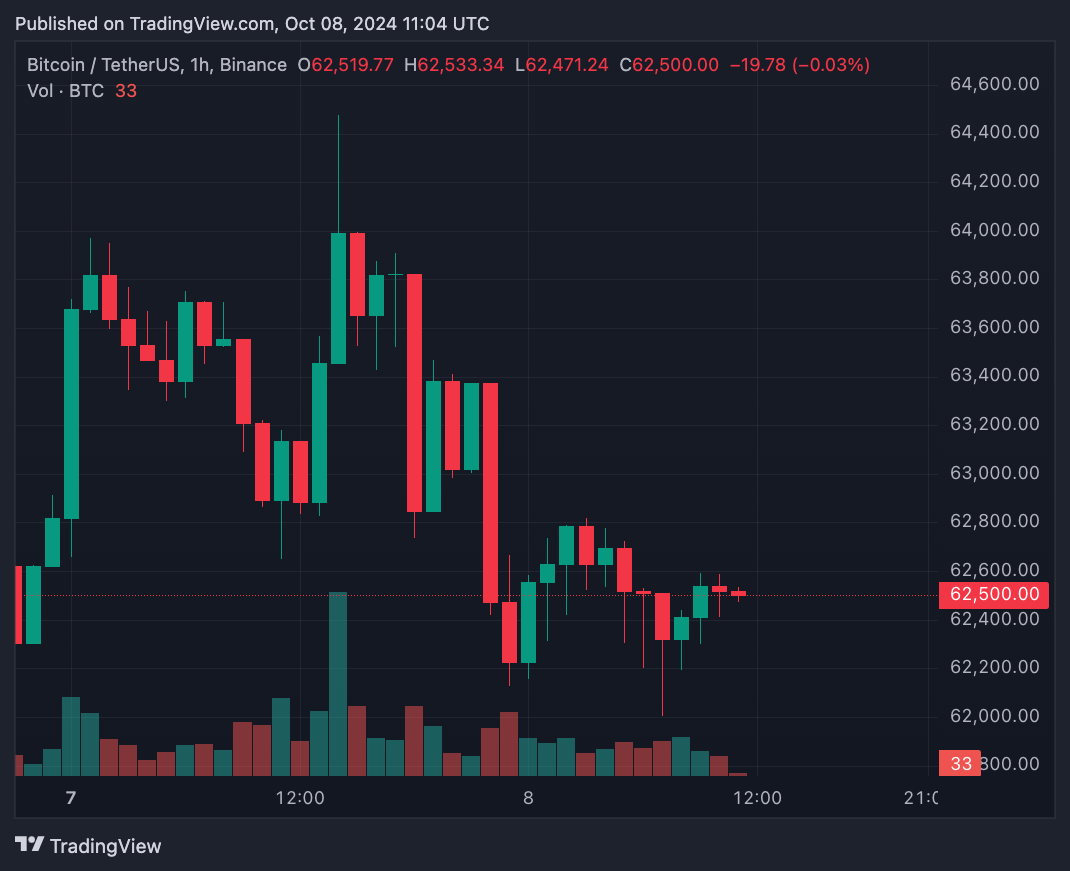
Tại thời điểm viết bài, Bitcoin đã giảm xuống mức thấp nhất là 62.000 đô la trước khi phục hồi nhẹ lên 62.400 đô la, dẫn đến khoản lỗ hơn 2% trong tuần qua. Các loại token lớn như Solana (SOL), Ether (ETH), XRP và BNB cũng chứng kiến mức giảm từ 0,5% đến 1,5%, xóa nhòa phần lớn đà tăng của ngày thứ Hai.

Biểu đồ giá Bitcoin 1 giờ | Nguồn: TradingView

Công ty giao dịch QCP Capital dự đoán rằng thị trường tiền điện tử, đặc biệt là Bitcoin, sẽ được “tái phân bổ vốn” bất chấp việc Trung Quốc ngừng các biện pháp kích thích kinh tế – một kết quả đáng thất vọng đối với các tài sản rủi ro.

Trịnh Thiện Kiệt, Chủ tịch Ủy ban Cải cách và Phát triển Quốc gia Trung Quốc, đã cam kết thực hiện một loạt hành động để thúc đẩy nền kinh tế nước này trong một cuộc họp báo rất được mong đợi.

Ông Kiệt cho biết Trung Quốc sẽ đẩy nhanh việc phát hành trái phiếu có mục đích đặc biệt cho các chính quyền địa phương để hỗ trợ tăng trưởng kinh tế khu vực. Một quan chức cấp cao cho biết thêm rằng chính quyền trung ương sẽ công bố kế hoạch đầu tư 100 tỷ nhân dân tệ cho năm tới vào cuối tháng này, sớm hơn dự kiến.

Tuy nhiên, ông đã không công bố bất kỳ kế hoạch kích thích kinh tế lớn nào, khiến các nhà đầu tư thất vọng và làm suy yếu đà tăng trưởng trên thị trường Trung Quốc đại lục.

Bất chấp “rủi ro giảm giá trong ngắn hạn” đối với cổ phiếu do dữ liệu kinh tế vĩ mô của Hoa Kỳ trong tuần này giảm, QCP vẫn thấy điều kiện cho tiền điện tử sẽ sớm được cải thiện.

“Khi đợt phục hồi của cổ phiếu Trung Quốc suy yếu, chúng tôi dự đoán vốn sẽ được tái phân bổ vào tiền điện tử, phản ánh sự trưởng thành ngày càng tăng của ngành này như một tài sản rủi ro thay thế”, báo cáo cho biết.

Triển vọng đó phù hợp với quan điểm lạc quan hơn của các nhà quan sát thị trường tiền điện tử về thời gian còn lại của tháng 10 và quý 4. Một số người vẫn thấy Bitcoin sẽ mang lại mức tăng trưởng vững chắc trong “Uptober” kinh điển, trong khi xu hướng thanh khoản toàn cầu cũng sẽ thúc đẩy các tài sản rủi ro cho đến cuối năm.

“Chúng tôi dự đoán rủi ro giảm giá trong ngắn hạn đối với cổ phiếu do mùa báo cáo thu nhập sắp tới và việc công bố CPI, điều này có thể thách thức định giá cao của chúng. Căng thẳng địa chính trị làm phức tạp thêm triển vọng. Tuy nhiên, chúng tôi vẫn duy trì lập trường lạc quan trong trung hạn, kỳ vọng các tiêu đề về cuộc bầu cử sẽ tiếp tục thúc đẩy phong trào tiền điện tử”, QCP Capital nhận định.

Các trader tiền điện tử đang theo dõi sát sao các cuộc họp của Cục Dự trữ Liên bang Hoa Kỳ vào cuối tuần này để tìm kiếm manh mối về định hướng tiếp theo. Cơ quan này dự kiến sẽ công bố biên bản cuộc họp FOMC và các số liệu kinh tế quan trọng từ tháng 8 để theo dõi tình hình tăng trưởng.

Bạn có thể xem giá BTC ở đây.


Itadori

Tạp chí Bitcoin

RedStone brings oracles for Bitcoin staking to expand use cases in defi

Blockchain oracle provider RedStone has announced the launch of oracles designed specifically for Bitcoin staking.

RedStone, a modular oracle provider, is expanding the list of its available oracles across multiple networks by introducing oracles tailored for Bitcoin (BTC) staking, now available on the staking platform Lombard. The Switzerland-based company’s oracles are built to supply real-time data for Bitcoin staking, allowing users to stake their Bitcoin and receive Liquid Staking Tokens on the Ethereum blockchain.

According to a press release shared with crypto.news, the solution is already live on Lombard, a restaking protocol managing over $500 million in total value locked. The oracles are designed to track and report key metrics such as staked Bitcoin amounts, LST issuance, and net asset value calculations.

RedStone plans further expansion of Bitcoin-focused oracles

Beyond Lombard, RedStone plans to integrate its oracles into additional platforms, including pumpBTC and Solv. In the coming months, further expansions are expected to reach Arbitrum, Base, and BNB Chain. RedStone’s chief executive, Jakub Wojciechowski, said the latest solution will provide Lombard with the infrastructure “needed to bridge Bitcoin and DeFi seamlessly.”

This isn’t RedStone’s first venture into blockchain oracle services. The company has previously rolled out similar products across various blockchain networks, including Ethereum and The Open Network. Founded in 2021, RedStone raised $15 million in Series A funding, led by Arrington Capital. Other investors include HTX Ventures, Amber Group, and Spartan.

Tổng hợp và chỉnh sửa: ThS Phạm Mạnh Cường
Theo Crypto News
CATS see 691% surge ahead of major exchange listings

CATS, a meme coin based on the TON blockchain, has witnessed a remarkable surge in its price over the past 24 hours, ahead of its listing on multiple major cryptocurrency exchanges.

Cats (CATS) has skyrocketed by 691%, climbing from $0.000067 to an intraday high of $0.00053, according to CoinMarketCap data. At press time, CATS was trading at $0.000223, still maintaining a 259% gain within a single day.

The surge in CATS’ value coincides with a massive uptick in its trading activity. Daily trading volume increased by 13-fold, reaching approximately $267,000, while the token’s market capitalization hovered around $294.4 million.

The hype surrounding CATS has pushed the token to trend on Google, driven by its popularity as a Telegram mini-app with millions of active users. It’s gaining momentum alongside other Telegram-based games like Hamster Kombat (HMSTR) and Notcoin (NOT).

Cats’ price rally came ahead of the meme coin being listed on multiple exchanges, including Bybit, KuCoin, Bitget, and Haskey, on Oct. 8 at 10:00 UTC. With these listings, community members can now withdraw the airdropped tokens they received during Season 1 of the project. The airdrop distribution was determined by various Telegram account metrics, including the age of the account, premium status, and user activity.

This event also marks the official launch of CATS’ Season 2, which is expected to bring additional developments to the memecoin ecosystem. Season 2 will introduce innovative features such as AI photo farming and unique CAT-themed profile pictures, offering further engagement opportunities for users.

Airdrop distribution and community involvement

CATS has a total supply of 600 billion tokens, with a significant portion allocated for airdrops across Seasons 1 and 2. Specifically, 55% of the total supply has been reserved for distribution, with Season 1 already allocating 30%, 180 billion tokens to active community members. 

Rewards have been structured to prioritize users with OG passes and those who engage in daily transactions, ensuring that the most dedicated participants benefit from the airdrop.

As part of its community-building strategy, the project encourages users to boost their token earnings by inviting friends and completing simple tasks, such as joining the official CATS Telegram channel.

Despite the recent rally, CATS holders could soon face a potential price drop as a large number of airdropped tokens enter circulation. Similar to other meme coins based on the TON blockchain, such as Hamster Kombat’s HMSTR, which saw a 54% price decline after its launch, CATS may experience selling pressure as users begin offloading their tokens.

Tổng hợp và chỉnh sửa: ThS Phạm Mạnh Cường
Theo Crypto News
Tòa án Tối cao bật đèn xanh cho Chính phủ Mỹ bán 4,4 tỷ USD Bitcoin tịch thu từ Silk Road

Tòa án Tối cao Mỹ đã từ chối việc xem xét một vụ án liên quan đến quyền sở hữu 69.370 Bitcoin bị tịch thu từ chợ đen Silk Road, điều này dường như bật đèn xanh cho chính phủ Mỹ bán số Bitcoin trị giá 4,4 tỷ USD này.

Vào năm 2022, một tòa án liên bang tại California đã đưa ra phán quyết chống lại Battle Born Investments, công ty tuyên bố đã mua quyền sở hữu đối với số Bitcoin bị tịch thu thông qua một tài sản phá sản. Battle Born lập luận rằng người nợ trong vụ phá sản, Raymond Ngan, chính là “Cá nhân X” bí ẩn đã đánh cắp hàng tỷ USD Bitcoin từ Silk Road, sau đó bị chính phủ Mỹ tịch thu.

Tòa án liên bang không bị thuyết phục rằng Ngan thực sự là “Cá nhân X,” và do đó đã phán quyết rằng Battle Born không có quyền hợp lệ đối với số Bitcoin bị tịch thu. Năm sau, một tòa phúc thẩm liên bang ở San Francisco đã xác nhận phán quyết này.

Giờ đây, với việc Tòa án Tối cao từ chối xem xét vụ Battle Born, vấn đề này gần như đã đi đến hồi kết. Điều này có nghĩa là chính phủ hiện có ít rào cản trong việc thực hiện các kế hoạch với số tiền bị tịch thu – đặc biệt là việc bán chúng.

Trong những tháng gần đây, chính phủ Hoa Kỳ đã di chuyển một khối lượng lớn Bitcoin bị tịch thu từ Silk Road. Trong khoảng thời gian hai tuần vào tháng 7 và tháng 8, chính phủ đã chuyển khoảng 2,6 tỷ USD Bitcoin vào các ví mới. Những động thái này thường được thực hiện để chuẩn bị cho việc bán các khoản tiền này. Tuy nhiên, Cơ quan Marshals Hoa Kỳ đã ký một thỏa thuận lưu giữ tài sản với Coinbase Prime, do đó sàn giao dịch có thể chỉ đơn giản là giữ các tài sản này cho chính phủ.

Khi các chính phủ trên toàn thế giới tiếp tục thanh lý những khoản tiền lớn tiền điện tử bị tịch thu trong các hành động thực thi pháp luật, điều này đã tạo ra những lo ngại về sự biến động của thị trường.

Câu hỏi về cách chính phủ Mỹ nên xử lý Bitcoin bị tịch thu đã trở thành một vấn đề nóng trong chu kỳ bầu cử hiện tại. Vào tháng 7, tại một hội nghị tiền điện tử ở Nashville, cựu Tổng thống Donald Trump đã cam kết xây dựng một “kho Bitcoin chiến lược” nếu ông được tái bầu.

“Tôi xin thông báo rằng nếu tôi được bầu, chính sách của chính quyền tôi, của Hoa Kỳ, sẽ là giữ 100% tất cả Bitcoin mà chính phủ Mỹ hiện đang nắm giữ hoặc có được trong tương lai,” Trump phát biểu vào thời điểm đó.

Silk Road là chợ đen trực tuyến được Ross Ulbricht thành lập vào năm 2011, cho phép mua bán hàng hóa và dịch vụ bất hợp pháp, chủ yếu là ma túy, bằng Bitcoin. Nền tảng bảo đảm ẩn danh cho người dùng và sử dụng mạng Tor để ngăn chặn theo dõi. Người dùng có thể đăng bán sản phẩm và đánh giá lẫn nhau, tạo hệ thống độ tin cậy.

Silk Road thu hút sự chú ý của chính quyền vào năm 2013, dẫn đến việc FBI đóng cửa vào tháng 10 cùng năm và bắt giữ Ulbricht. Tại thời điểm đó, Silk Road đã xử lý khoảng 1,2 tỷ USD giao dịch, trở thành biểu tượng của rủi ro trong kiểm soát hoạt động trực tuyến bất hợp pháp. Ross Ulbricht cũng bị bắt và bị kết án chung thân không ân xá. Gần đây cựu tổng thống Donald Trump hứa sẽ ân xá ngay lập tức cho ông vào ngày đầu tiên nhậm chức, nếu ông tái đắc cử.


Thạch Sanh

Theo Decrypt

Korea eyes FX rules for stablecoins used in cross-border trade: report

South Korea is planning to impose foreign exchange controls on stablecoins, underscoring the government’s concerns over their growing use in cross-border trade.

South Korea is weighing the introduction of foreign exchange controls on stablecoins, reflecting government concerns over their growing use in cross-border trade, The Korea Economic Daily has learned. The Ministry of Economy and Finance is reportedly reviewing measures to enhance the stability of crypto transactions, particularly those involving stablecoins.

While stablecoins have been widely used only within the cryptocurrency ecosystem, the ministry believes that they may soon function as a payment and transaction method in the real economy. Concerns have been raised that these assets are operating outside government oversight, posing risks to the stability of South Korea’s foreign exchange market, the report reads.

Though no specific timeline has been announced, the Financial Services Commission is expected to prioritize discussions on stablecoin regulation in its forthcoming legislative efforts, drawing from regulatory frameworks established in Japan and the European Union.

The potential regulatory shift follows the South Korean government’s broader efforts to tighten oversight of the local crypto market. As crypto.news reported, Korean crypto exchanges, such as UpbitBithumb, and Coinone, will soon be obligated to pay an oversight fee to the Financial Supervisory Service of South Korea beginning next year as the country steps up its regulatory framework for the crypto sector.

Local industry representatives initially suggested delaying the imposition of supervisory fees on crypto operators. However, the decision to implement these fees was expedited due to upcoming inspections by the FSS following the enforcement of the Virtual Asset User Protection Act.

The new law introduces several requirements for crypto exchanges, including a mandate to keep at least 80% of users’ assets in cold storage. These assets must be kept separate from company funds and invested in “risk-free” assets to generate a yield. Additionally, exchanges must reassess listed assets by verifying their circulation and reviewing their whitepapers, with any assets that fail to meet the criteria required to be delisted.

The recent enforcement follows the postponement of a 20% crypto gains tax by South Korea’s Ministry of Economy and Finance, with reports indicating that the ruling party may delay the tax until 2028.

Tổng hợp và chỉnh sửa: ThS Phạm Mạnh Cường
Theo Crypto News

Exit mobile version