Solana có 100 triệu ví đang hoạt động, nhưng hầu hết đều trống rỗng

Theo nền tảng dữ liệu blockchain Artemis Terminal, số lượng địa chỉ hoạt động hàng tháng của Solana đã tăng vọt lên hơn 100 triệu, đánh dấu mức cao kỷ lục mới của mạng.

Nguồn: SolanaFloor

Con số này cao hơn đáng kể so với 509.000 địa chỉ hoạt động hàng tháng được Artemis ghi nhận vào đầu năm 2024.

Tuy nhiên, các số liệu hỗ trợ cho thấy hầu hết ví hoạt động trên Solana không nắm giữ bất kỳ SOL nào. Theo đó, những người hoài nghi cho rằng sự tăng trưởng bùng nổ này là do các bot làm tăng số liệu một cách giả tạo — một lời chỉ trích thường gắn liền với những câu chuyện thành công của Solana.

Theo nhà cung cấp dữ liệu Solana Hello Moon, hơn 86 triệu người dùng nắm giữ 0 SOL trong ví của họ trong tháng qua, khoảng 15,5 triệu người dùng nắm giữ ít hơn 1 SOL và khoảng 1,5 triệu người dùng nắm giữ ít hơn 10 SOL.

Số lượng người dùng hoạt động của Solana và số dư trong ví SOL | Nguồn: Hello Moon

“Hầu hết các địa chỉ Solana đều có giá trị dưới 10 đô la từ lúc được lập, điều này cho thấy có điều gì đó không hoàn toàn hợp lý hoặc tự nhiên, mặc dù hệ sinh thái thực sự rất năng động và token này hoạt động rất tốt”, Justin d’Anethan, trưởng bộ phận phát triển kinh doanh APAC tại công ty tạo lập thị trường Keyrock, cho biết.

Dan Hughes, nhà sáng lập nền tảng DeFi Radix DLT, cho rằng các tương tác với sàn giao dịch tập trung (CEX) hoặc ứng dụng DeFi có thể là lý do tại sao có nhiều ví hoạt động không có số dư.

“Khi bạn gửi đến một CEX, bạn có một địa chỉ proxy do sàn giao dịch tạo ra. Ngoài ra, một số dịch vụ DeFi cũng có thể sử dụng các địa chỉ trung gian. Bạn gửi token của mình đến địa chỉ đó và sàn giao dịch ngay lập tức chuyển các token đến một ví nóng, ghi lại token của ai ở Backend”.

Gia tăng các ví hoạt động trên Solana trùng với phục hồi tốc độ phát hành token mới trên mạng, cũng như gia tăng các tài khoản mới.

Tốc độ bổ sung token SPL hàng ngày vào mạng đã chậm lại trong suốt tháng 9 nhưng tăng trở lại vào cuối tháng. Kể từ ngày 26/9, mạng tiếp nhận ​​ít nhất 17.000 token mới được tạo ra mỗi ngày, theo dữ liệu của Solscan.

Số lượng tài khoản mới trên mạng cũng đang phục hồi. Vào ngày 8/10, Solana có ​​hơn 10 triệu tài khoản mới, gấp đôi số liệu của ngày 7/10.

Tranh luận về tính hợp lệ của số liệu Solana

Hiệu suất của Solana thường bị chỉ trích bởi những người cho rằng mạng tràn ngập bot làm tăng số lượng giả tạo bằng cách tương tác với nhau.

“Rất dễ dàng và ít tốn kém để làm cho Solana có vẻ như nhiều người dùng đang hoạt động khi thực tế không phải vậy, chỉ bằng cách liên tục wash trading* giữa các địa chỉ mới hoặc thực hiện nhiều tương tác nhỏ với các dịch vụ sử dụng địa chỉ proxy”, Hughes cho biết.

Trong một cuộc phỏng vấn trước đó, giám đốc chiến lược Austin Federa tại Solana Foundation lập luận rằng các giao dịch bot tuy có giá trị kinh tế thấp hơn so với các giao dịch của con người nhưng vẫn là giao dịch.

“Đó là nét nổi bật của một mạng như Solana — có rất nhiều thứ không tồn tại về mặt kinh tế và không khả thi về mặt kinh tế trong hệ sinh thái Ethereum hiện nay”, Federa cho biết.

Solana được quảng bá là blockchain hiệu quả, cung cấp các giao dịch nhanh với mức phí thấp so với đối thủ.

Vào cuối tháng 9, phí giao dịch trung bình trên Solana đã tăng gấp đôi nhưng vẫn ở mức thấp khoảng 0,02 đô la, theo dữ liệu từ Dune Analytics. Con số này chỉ bằng khoảng 0,67% phí gas trung vị của Ethereum là 3 đô la.
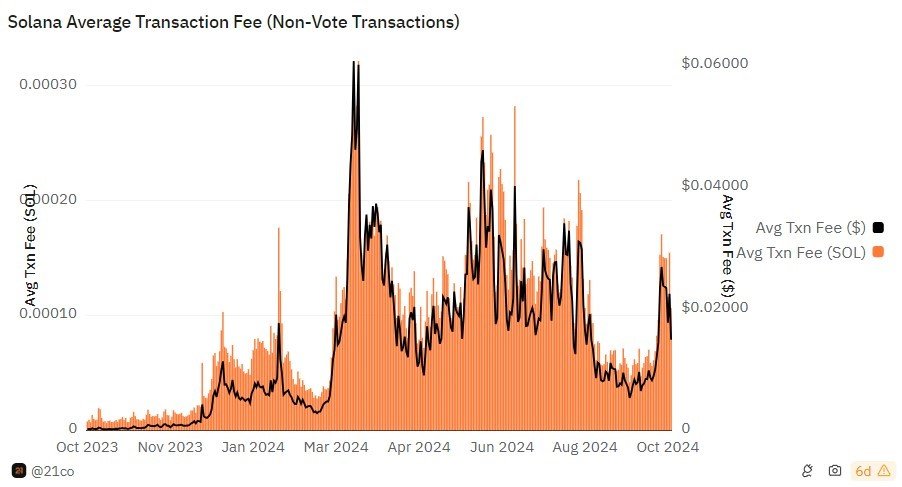
Phí giao dịch trung bình trên Solana (không phải giao dịch bỏ phiếu) | Nguồn: Dune Analytics

Tính đến ngày 9/10, Solana là blockchain lớn thứ ba cho DeFi, với tổng giá trị bị khóa (TVL) là 5,38 tỷ đô la, theo DefiLlama.

Để so sánh, Ethereum (dẫn đầu ngành DeFi) có TVL là 44,56 tỷ đô la vào cùng ngày, trong khi Tron đứng thứ hai với 7,4 tỷ đô la.

Con dao hai lưỡi của Solana

Hiệu quả của Solana được cho là con dao hai lưỡi, vì một số người cho rằng mức phí thấp của mạng và thông lượng giao dịch cao tạo ra môi trường hấp dẫn và thường có lợi nhuận cho bot. Điều này có thể thổi phồng hoạt động của mạng vượt quá các tương tác thực tế của con người.

Tuy nhiên, không nhất thiết có nghĩa là bot không mang lại giá trị cho mạng.

Federa nói rõ:

“Bot cũng trả phí “.

Cơ chế phí của Solana đóng vai trò quan trọng trong việc quản lý các mục tiêu lạm phát dài hạn của mạng.

Lạm phát của mạng được tạo ra bởi lượng phát hành cho trình xác thực, sẽ giảm dần theo thời gian, trong khi 50% phí kiếm được sẽ bị đốt để quản lý lạm phát.
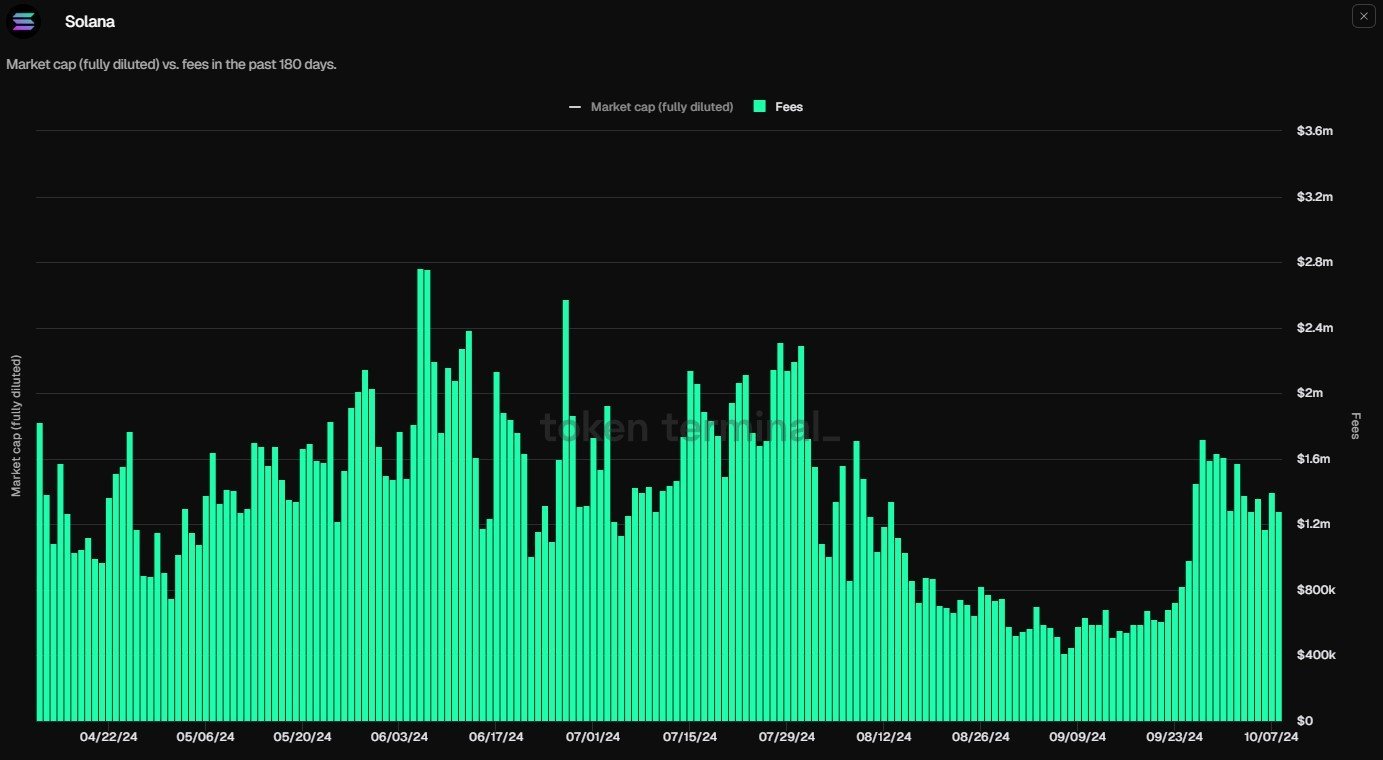
Doanh thu phí của Solana cũng đã phục hồi nhờ tăng số lượng ví hoạt động | Nguồn: Token Terminal

Về lý thuyết, nếu nhu cầu mạng tiếp tục tăng, lạm phát sẽ giảm theo thời gian khi phí bị đốt nhiều hơn và tỷ lệ phát hành giảm.

Với số lượng ví hoạt động và số lượng token SPL mới gia tăng gần đây, phí mạng cũng tăng, theo dữ liệu của Token Terminal.

*Wash trading là một hành vi gian lận thị trường trong đó một người mua và bán cùng một tài sản tài chính (như cổ phiếu, tiền điện tử) để tạo ra vẻ thị trường hoạt động nhưng thực tế không có sự thay đổi thực sự trong sở hữu hoặc giá trị của tài sản đó. Mục đích của việc wash trading là tạo ra cảm giác đông đúc và sôi động trên thị trường để thu hút các nhà đầu tư khác hoặc tạo ra sự biến động giá để lợi dụng từ giao dịch đó. Tuy nhiên, hành vi wash trading là bất hợp pháp và có thể bị xem xét và xử lý bởi các cơ quan quản lý thị trường tài chính.

Bạn có thể xem giá SOL ở đây.


Đình Đình

Theo Cointelegraph

Chiliz token pops as fan tokens jump ahead of Pepper airdrop

Chiliz, the largest blockchain network for sports and entertainment, surged to its highest point in three months.

The Chiliz (CHZ) token broke a crucial resistance, reaching an intraday high of $0.072, its highest level since July 22. It has risen by over 66.50% from its lowest point this year.

Its rebound has coincided with the resurgence of most fan tokens. OG Fan Token (OG), the largest fan token, has surged by over 213% in the last seven days, giving it a market cap of $33.42 million.

Alpine F1 Team Fan Token (ALPINE) has rallied by 43%, while the Santos FC Fan Token (SANTOS) has jumped by 41% in the same period. According to FanMarketCap, all fan tokens have accumulated over $313 million in market cap.

The CHZ token also rose as investors awaited the upcoming Pepper airdrop, scheduled for Oct. 10.

Pepper will be the first meme coin on the Chiliz Blockchain. According to its website, its purpose and utility remain a mystery. Instead, it has been created by the community to “take the reins and ride.”

The airdrop comes at a time when the meme coin industry is booming, with all tokens tracked by CoinGecko having a market cap of over $53 billion. Some of the most notable performers are Popcat (POPCAT), whose market cap rose to $1 billion recently, and Neiro (NEIRO), which has surged by over 7,000% in the past few weeks.

Chiliz token flips key resistance

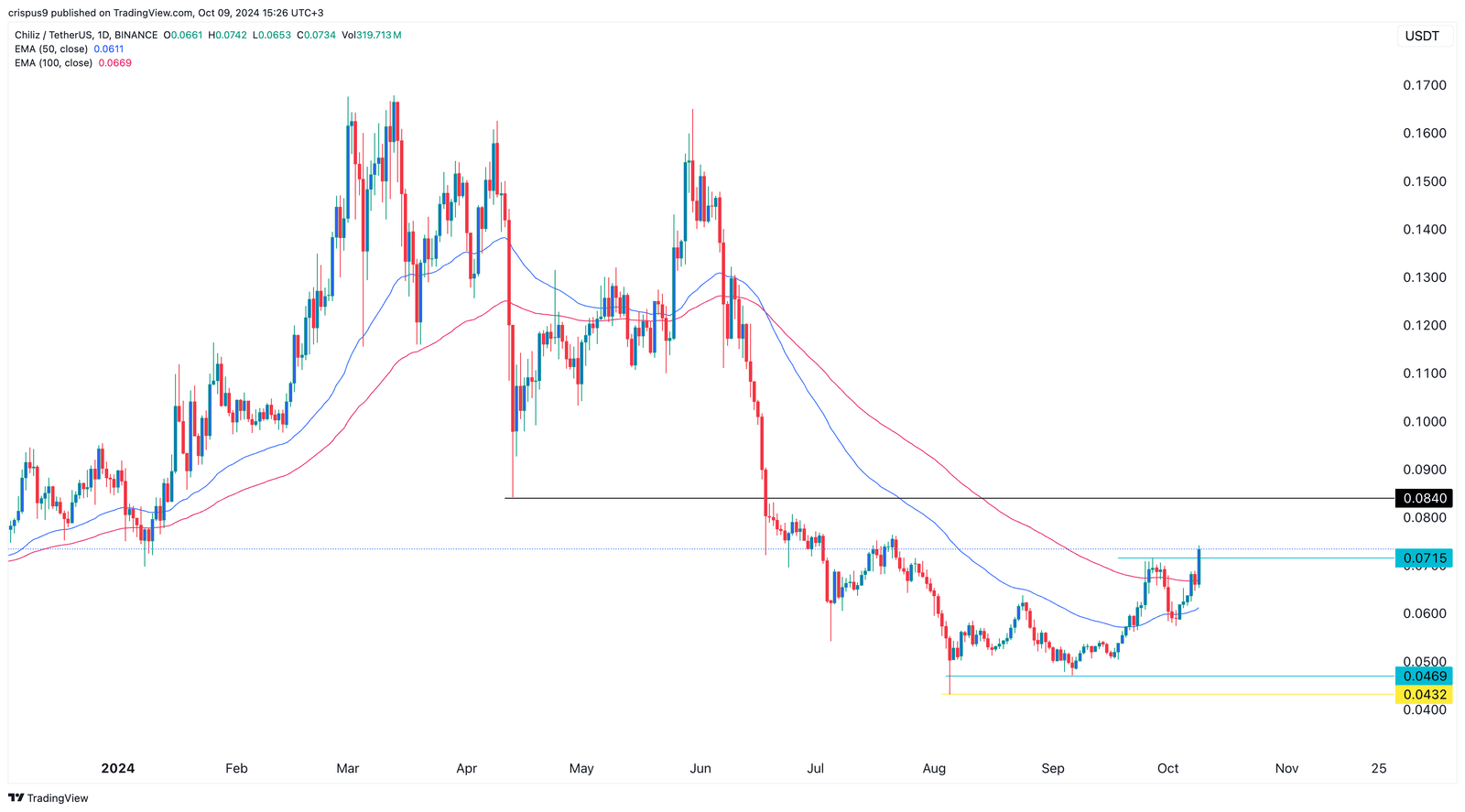
Chiliz price chart | Source: TradingView

The Chiliz token has bounced back from $0.043 in August to $0.07. It flipped the important resistance point at $0.0715, its highest swing on Sept. 27, into a support level. By doing so, it invalidated the double-top chart pattern that had been forming.

CHZ has also risen above the 50-day and 100-day Exponential Moving Averages, indicating that bulls are gaining control.

Therefore, Chiliz may continue rising, with the next reference level to watch being $0.084, its lowest swing on April 13.

Tổng hợp và chỉnh sửa: ThS Phạm Mạnh Cường
Theo Crypto News

Will Trump’s SEC pick be crypto’s savior? All eyes on Dan Gallagher

Is the SEC about to get a crypto-friendly makeover with Dan Gallagher at the helm? How would his approach differ from Gensler’s crackdown?

Crypto’s Robinhood in the making?

Rumors are swirling that Dan Gallagher, Robinhood‘s Chief Legal Officer and a former U.S. Securities and Exchange Commission commissioner, may be tapped to lead the SEC if Donald Trump wins the 2024 election.

Gallagher’s name emerges at a time when tensions between the SEC and the crypto industry are already at an all-time high. Under the leadership of SEC Chair Gary Gensler, the SEC has been cracking down on crypto exchanges like Coinbase, Kraken, and Binance, arguing that many cryptocurrencies should be classified as securities.

Moreover, in recent months, Robinhood’s crypto division has found itself in the SEC’s crosshairs, receiving a Wells Notice in May — an indicator that charges could be forthcoming.

Not just Robinhood, but OpenSea, the largest non-fungible tokens marketplace, also received a Wells Notice from the SEC in August, alleging that certain NFTs on the platform may be classified as securities — a claim that could have serious repercussions for the entire NFT space.

Meanwhile, the crypto industry argues that the current SEC framework doesn’t fit digital assets, creating a regulatory headache for companies trying to comply.

If Gallagher does step into the chair position, his background in both traditional finance and digital assets could offer a new approach to regulating the evolving crypto market.

But what exactly does this mean for the future of the industry? Let’s dive deeper into what a Gallagher-led SEC might look like and how it could shape the crypto space.

Who is Dan Gallagher?

Dan Gallagher’s career in financial regulation is both extensive and diverse, making him a compelling candidate for the SEC chair position, should Donald Trump return to office.

Gallagher has held various key roles that have shaped his approach to securities law, market regulation, and, more recently, the crypto industry.

He first gained recognition as a Republican SEC commissioner from 2011 to 2015, where he advocated for a regulatory environment that balanced oversight and innovation.

His time at the SEC coincided with implementing the Dodd-Frank Act, a sweeping piece of legislation aimed at reforming the financial system following the 2008 crisis. 

While Gallagher supported certain aspects of the law, he often voiced concerns about overregulation, criticizing how excessive rules could hinder market growth and innovation, particularly for smaller firms.

Before his time as commissioner, Gallagher had already accumulated considerable experience within the SEC. He worked as counsel to SEC Commissioner Paul Atkins, which exposed him to critical regulatory issues, including enforcement actions and market structure.

In 2020, Gallagher joined Robinhood as Chief Legal Officer, a move that thrust him into the spotlight once again, particularly as Robinhood rapidly expanded its role in both traditional finance and crypto markets.

His tenure at Robinhood has not been without controversy. In early 2021, Robinhood faced intense public scrutiny during the GameStop short squeeze when the platform temporarily halted trading of certain stocks. 

This move led to allegations of market manipulation and calls for regulatory investigations. Although Gallagher wasn’t directly responsible for the decision, his role as legal chief required him to manage the legal and reputational fallout.

What to expect from a Gallagher led SEC?

Dan Gallagher’s public statements and tweets reveal much about his views on the intersection of regulation, innovation, and government oversight in both crypto and broader financial markets.

Gallagher has consistently criticized what he sees as the SEC’s failure to establish a clear and workable regulatory framework for digital assets, often pointing to the agency’s reliance on enforcement actions rather than setting clear rules.

In response to a May 2024 tweet about the FIT21 Act, Gallagher critiqued the SEC, stating, “The SEC is clearly not going to step in and provide a working regulatory framework for crypto. I’m happy to see Congress filling the void.”

The FIT21 Act, which passed the House despite opposition from President Biden and current SEC Chair Gensler, aims to delineate responsibilities between the SEC and the CFTC, with the goal of offering regulatory clarity and consumer protections.

Gallagher’s vocal support for the legislation suggests that, under his leadership, the SEC could be more open to collaborating with Congress to develop comprehensive rules for digital assets—rules that don’t rely solely on enforcement but instead provide businesses with a clear path to compliance.

One of the most critical aspects of this potential shift could be how crypto firms are regulated. Gallagher has advocated for the idea that the existing regulatory framework, designed for traditional financial institutions, doesn’t suit the decentralized and fast-evolving nature of crypto assets.

This suggests that a Gallagher-led SEC would push for clearer distinctions between digital assets that qualify as securities and those that fall under the CFTC’s purview, such as commodities. The current ambiguity has left companies facing legal uncertainty, and Gallagher’s approach would likely aim to eliminate this confusion.

Gallagher’s tweets also offer insight into his broader regulatory philosophy. In December 2023, he criticized the SEC’s new “predictive data analytics” proposal, calling it “unreasonably broad and burdensome.” He warned that such rules would lead to “higher costs and less technology and access for investors.”

His stance suggests that, if he were to lead the SEC, he would advocate for a more hands-off approach to regulating emerging technologies, especially those that improve market access and efficiency.

However, while his vision for a more innovation-friendly regulatory environment may resonate with industry players, it could face opposition from consumer advocacy groups or those pushing for stricter oversight of digital assets.

The game of odds

As the 2024 presidential election approaches, the odds of Donald Trump returning to the White House are gaining momentum. 

Data from Polymarket, a popular prediction platform, shows Trump’s chances of reclaiming the presidency have risen to 52.8%, marking his largest lead over Democratic contender Kamala Harris since she entered the race. 

With over $1.46 billion in total bets placed on the election, Trump has attracted the lion’s share of betting volume, raking in $366 million compared to Harris’ $285 million.

Trump’s recent surge in the polls, particularly after his October rally in Butler, Pennsylvania, has bolstered speculation about what his return to power could mean for various industries, including the crypto space. 

During the rally, Trump stopped short of making any direct promises regarding cryptocurrency, but he did hint at revisiting the case of Ross Ulbricht, the founder of the Silk Road.

If Trump returns to the White House, the SEC is likely to experience a leadership shakeup, with Gary Gensler possibly being replaced by a new face — Dan Gallagher.

Gallagher’s appointment would likely lead to clearer rules for crypto, and a friendlier environment for digital asset companies to thrive. 

But as with anything in both politics and markets, nothing is set in stone. The upcoming election remains a tight race, and the future of the SEC — and by extension, the future of crypto regulation—hinges on who will sit in the Oval Office come 2025.

Tổng hợp và chỉnh sửa: ThS Phạm Mạnh Cường
Theo Crypto News

Peter Todd là ai và tại sao HBO lại kết luận anh là Satoshi Nakomoto dù đã phủ nhận?

Phim tài liệu của HBO “Money Electric: The Bitcoin Mystery” đã gây thất vọng khi đưa ra những bằng chứng không nhất quán và kết luận “Peter Todd là Satoshi Nakamoto” khá kỳ lạ từ đạo diễn Hoback.

Peter Todd là ai?

Peter Todd, sinh ra và lớn lên tại Canada, là một nhà phát triển nổi bật của Bitcoin và nhà mật mã học nổi tiếng, được công nhận rộng rãi nhờ những đóng góp của anh cho hệ sinh thái Bitcoin. Anh là một trong những người đóng góp sớm nhất cho mã nguồn Bitcoin và từng có liên hệ trực tiếp với Satoshi trước khi người này biến mất vào năm 2011. Todd đã xác nhận rằng anh chỉ mới là một thiếu niên khi bắt đầu giao tiếp với Hal Finney và Adam Back, hai nhân vật tiên phong trong lĩnh vực Bitcoin.

Chỉ mới 39 tuổi nhưng Todd đã đảm nhận nhiều vai trò quan trọng trong ngành, nổi bật nhất là vị trí nhà phát triển Bitcoin Core tại Coinkite từ năm 2014. Anh còn là Nhà khoa học trưởng tại Mastercoin và Dark Wallet, và đã sáng lập OpenTimestamps, một dự án cung cấp dịch vụ đóng dấu thời gian phi tập trung. Mặc dù đã tham gia lễ khởi đầu trong quy trình tạo khóa bảo mật cho mạng lưới Zcash vào năm 2016 nhưng sau đó anh đã chỉ trích quá trình này.

Tại sao HBO chọn Peter Todd là Satoshi?

Trong bộ phim tài liệu, Len Sassaman và Nick Szabo không được xác định là Satoshi. Thay vào đó, sự chú ý dồn vào Peter Todd, một ứng viên bất ngờ được giới thiệu chỉ vài giờ trước khi phát hành. HBO đã chỉ ra một câu trả lời vào năm 2010 khi Todd vô tình phản hồi một bài đăng rằng Satoshi Nakamoto đã bắt đầu trên diễn đàn Bitcointalk bằng tài khoản của chính mình.

Nguồn: Bitcointalk

Tuy nhiên, nhiều thành viên trong cộng đồng tiền điện tử đã làm rõ rằng Todd chỉ đang sửa hoặc làm rõ một bài đăng của Satoshi, không phải mạo danh ông.

“Đây là lập luận thuyết phục nhất của họ, nhưng không hề thuyết phục chút nào. Peter không mở rộng hay phát triển các ý tưởng của Satoshi mà chỉ là đang chỉ ra các sai sót hoặc khác biệt trong cách hiểu,” một người dùng X cho biết.

Phim tài liệu cũng đề cập đến khái niệm “thay thế bằng phí” mà Todd đã triển khai, cho rằng anh đã sử dụng bút danh “John Dillon” để quảng bá ý tưởng này, một bút danh có liên hệ với Satoshi. Ngoài ra, bộ phim nêu rõ rằng cả Satoshi và Todd đều sử dụng cách viết tiếng Anh/Canada, làm tăng thêm khả năng kết nối giữa họ.

Chương trình còn sử dụng cuộc thảo luận trước đó của Todd về việc ‘hy sinh’ Bitcoin như bằng chứng cho rằng anh có thể là Satoshi, diễn giải điều này như việc ‘hủy diệt’ đồng coin.

“Nhưng, một lần nữa, điều này không chứng minh được điều gì. Chỉ là những gợi ý không có tính thuyết phục mà thôi,” Pledditor nói thêm.

Phản ứng và chỉ trích

Mặc dù Todd đã nhiều lần phủ nhận mình là Satoshi nhưng anh đã phải đối mặt với nhiều đồn đoán xung quanh danh tính của mình. Nhà phát triển thực sự đã tuyên bố trước và sau khi phát hành bộ phim rằng anh không phải là Satoshi.

Lý thuyết của Cullen Hoback đã gây ra nhiều chỉ trích từ cộng đồng tiền điện tử. Những nhân vật có tiếng trong ngành đã bảo vệ Todd, chỉ trích tính suy đoán của bộ phim và những nguy cơ mà nó gây ra cho sự an toàn của anh. Cobra, quản trị viên của BitcoinTalk, và Adam Cochran từ Cinneamhain Ventures đã lên án những hành vi báo chí vô trách nhiệm.

Adam Cochran mạnh mẽ chỉ trích:

“Thật đáng thất vọng.

Bộ phim chỉ dựa trên những suy đoán hoang đường, thiếu hiểu biết về công nghệ, khiến những giả thuyết này trở nên không khả thi, và không có bằng chứng rõ ràng.

Hơn nữa, việc người làm phim một cách vô trách nhiệm chỉ đích danh một người là Satoshi, mặc dù người đó đã khẳng định rằng họ không phải là Satoshi, thật sự rất đáng lên án, đặc biệt là khi không có bằng chứng vững chắc.

Bộ phim thậm chí còn ghi sai thời gian mà Todd tham gia vào Bitcoin.

Toàn bộ nội dung dường như được xây dựng dựa trên sự hiểu lầm về cách thức tương tác của mọi người trên internet, với giả định rằng hai phản ứng châm biếm có thể chứng minh Todd chính là Satoshi.”

Cộng đồng cá cược tại Polymarket đã chính xác khi dự đoán rằng Satoshi Nakamoto không phải là những tên tuổi được đề cập trong bộ phim. Trước khi phát hành, các trader đã nghiêng về Len Sassaman, nhưng sau đó đã chuyển hướng sang Nick Szabo. Cuối cùng, phần lớn cược tin rằng Satoshi là một ứng viên chưa từng được xem xét trước đó.

Nguồn: Polymarket

Tóm lại, bộ phim tài liệu của HBO đã tạo nên làn sóng tranh cãi và thảo luận xung quanh danh tính của Satoshi Nakamoto. Dù Peter Todd đã nhiều lần phủ nhận mình là Satoshi, sự tò mò về danh tính thực sự của nhà sáng lập Bitcoin vẫn tiếp tục thu hút sự quan tâm của cộng đồng.


Itadori

Theo Cryptobriefing

Hamster Kombat cung cấp bonus cho mùa tiếp theo của game

Gần 130 triệu người chơi Hamster Kombat đủ điều kiện nhận airdrop token HMSTR trên The Open Network (TON) vào cuối tháng trước. Nhiều người trong số họ có thể đã chuyển tiền thưởng vào ví tự lưu ký hoặc sàn giao dịch tập trung. Tuy nhiên, những người chưa chuyển token có thể nhận được bonus cho mùa tiếp theo của game.

Trong thông báo hôm thứ Ba, các nhà phát triển game tiền điện tử lớn nhất từ trước đến nay của Telegram cho biết rằng những người nhận airdrop giữ token trong game sẽ nhận được phần thưởng khi mùa thứ hai bắt đầu.

“Hãy giữ token của bạn, và sẽ có nhiều bất ngờ thú vị! Mùa 2 sẽ mang lại lợi ích cho hodler token!”

Lợi ích dành cho người chơi

Mặc dù chưa rõ thời gian cụ thể khi nào lợi ích sẽ đến, nhưng cách tiếp cận này tương tự như game Notcoin của Telegram, đã được thực hiện vào đầu năm nay. Trước đợt airdrop, Notcoin thông báo rằng người chơi có thể giữ token trong game để nâng cấp trạng thái, từ đó đủ điều kiện kiếm nhiều phần thưởng hơn từ các đợt drop token trong tương lai.

Tính năng của Hamster Kombat có điểm tương đồng với staking, một tính năng phổ biến trong các dự án tiền điện tử cho phép người dùng thu lợi từ token của họ, có thể là thông qua lãi suất hoặc các quyền lợi khác. Tuy nhiên, các nhà phát triển không gọi tính năng này là staking. 

Hamster Kombat đã chứng kiến sự gia tăng số lượng người dùng vào cuối mùa xuân và mùa hè, với game tap-to-earn này thu hút hơn 300 triệu người dùng nhờ lời hứa về phần thưởng token. Token HMSTR được ra mắt vào ngày 26 tháng 9.

Mùa thứ hai sẽ sớm bắt đầu, với đợt airdrop thứ hai dự kiến vào mùa hè năm sau. Trong thời gian chờ đợi, Hamster Kombat đang tổ chức một “interlude season” ngắn, cũng hứa hẹn những lợi ích cho mùa đầy đủ tiếp theo dành cho những người chơi tích lũy kim cương trong game.


Annie

Theo

Peter Todd-inspired meme coin YOURMOM skyrockets over 4000% in live trading

Bitcoin developer Peter Todd’s snarky reply to an X user’s post asking about the name of his pets has been turned into a viral meme coin that has soared past 130% in the past 24 hours. Todd was recently claimed to be Satoshi Nakamoto, the creator of Bitcoin, by an HBO documentary.

Contrary to the HBO documentary’s claims, Canadian Bitcoin developer Peter Todd has denied the fact that he is Satoshi Nakamato. But that didn’t stop the crypto enthusiasts from making various meme coins linked to him.

The meme token with the ticker $YOURMOM, inspired by Todd’s post on X, has surged past 4000% according to data on GeckoTerminal. The Solana-powered token is currently trading at $0.002647 with a market cap of $2.4 million in mere hours since its launch on Oct. 9.

The birth of the $YOURMOM token started when one X user told Todd that he was “all over the Solana memesphere”. The user with the handle @iwantitmore_sol then proceeded to ask the developer if he had any pets and what their names are, with the intent of feeding the meme token trend of naming coins after animals.

Todd responded sarcastically by telling the X user that the name of his pet was “your mom”. Meme token creators saw his post and ran with it. At the time of writing, there have been a total of four Solana tokens made in the past 16 hours with the ticker YourMom, some even bearing Todd’s picture as the coin’s icon.

In a similar fashion, Solana meme coin creators were quick to create tokens based on Len Sassaman and his two cats, Odin and Sasha, when he was the Polymarket bettors’ top pick for Satoshi’s true identity.

After the HBO documentary named Peter Todd as Satoshi and not Sassaman, prices for memecoins created in honor of the cryptographer took a nosedive. According to data on CoinMarketCap, the token SASHA, named after Sassaman’s orange cat, has dropped 88.21% in the past 24 hours.

The same can be said about Odin, Sassaman’s other cat-inspired meme token, that saw its price plummet by nearly 90% in the hours following the release of the HBO documentary, based on GeckoTerminal.

On Oct. 8, HBO’s documentary “Money Electric: The Bitcoin Mystery” claimed that Canadian Bitcoin developer Peter Todd was Satoshi Nakamoto.

One of the main reasons mentioned by documentary producer Cullen Hobak is a series of cryptic online posts, one of which Todd called himself “the world’s leading expert on how to sacrifice your Bitcoins”. This was interpreted as a veiled admission that alluded to him destroying access to the estimated 1.1 million BTC attributed to Nakamoto.

The documentary further fueled speculation with claims that Todd once accidentally posted from Satoshi’s account on the BitcoinTalk forum in 2010.

Even before the documentary aired, Todd has been adamant in denying theories that point to him as Bitcoin’s true creator. On Oct. 8, he responded to a comment on X asking him to come out and deny HBO’s claim, to which the developer wrote “I am not Satoshi.”

Tổng hợp và chỉnh sửa: ThS Phạm Mạnh Cường
Theo Crypto News

Maximizing returns in a volatile market: The role of Bitcoin yields | Opinion

One of Bitcoin’s (BTC) most attractive features is its volatility, which is also its most daunting aspect. Managing this volatility is key, and native Bitcoin yields can help achieve this. These yields allow investors to build up their portfolios while protecting them from the worst of market movements.

But volatility is by no means a flaw; it’s a feature of decentralized and permissionless crypto markets. After all, Bitcoin’s high volatility leads to high returns. However, it can’t be denied that this volatility loses its charm when prices are not consistently rising (or falling) but instead fluctuate frequently in both directions.

Volatility, in fact, has also been identified as a critical barrier that keeps institutional investors from allocating to Bitcoin, as revealed by a Fidelity survey. Large swings in price, in either direction, render an asset highly volatile and thus riskier. This is because volatility makes prices less predictable. 

So, on the one hand, we have periods between broader bull and bear trends, like we are experiencing right now, that make volatility unbearable. On the other hand, as Bitcoin matures, its volatility is shrinking each cycle. The approval of spot Bitcoin exchange-traded funds has the asset’s volatility hitting its 2024 peak at 40%, far lower than 2021’s 106% record highs. While it’s too early to say if this is the new normal, the lower volatility means we won’t be seeing a high percentage of gains going forward.

It is time for Bitcoin yields

In a highly volatile market like crypto, Bitcoin yield gives the opportunity to earn consistent and stable returns, hedging some of the price volatility. This steady stream of passive income can be earned without needing to sell BTC. In this way, a BTC holder can finally put their asset, which has been sitting idle for years, to good use.

Having access to yield-generating opportunities further promotes broader acceptance and use of Bitcoin, especially among institutional investors who are always looking for yield strategies. 

Even short-term holders may get inclined to HODL their BTC for a longer time period if they have an opportunity to increase their investment over time as they get to benefit from both price increases and a constant supply of income. This, in turn, can reduce market selling pressure, and as demand increases for yield-generating assets, it can further help the asset enjoy a more positive price performance. 

There’s clearly a strong case for Bitcoin yield but where is this yield exactly coming from? 

The growth of DeFi on Bitcoin

So, in the Bitcoin realm, there hasn’t really been any development to expand the ecosystem, with the trillion-dollar crypto asset only being utilized as a passive store of value. But now, times have changed, and both developers and users want to have fun and do exciting things with Bitcoin. This has led to a new wave of development on Bitcoin, which has given rise to BTC DeFi. The growth of decentralized finance on Bitcoin has resulted in varied sources of Bitcoin yields. 

These yield sources include Bitcoin layer-2 solutions that enable BTC holders to enjoy staking rewards, which are determined by market dynamics. Babylon is another Bitcoin staking protocol built on Cosmos that allows BTC holders to stake their Bitcoin on PoS chains without giving up the custody of their assets. 

We at pSTAKE Finance also offer Bitcoin liquid staking, for which we have collaborated with Babylon to offer boosted yields. While we are starting with Babylon to provide the primary source of liquid staking yields, which is generated through economic security, we will eventually introduce yBTC as well as multiple avenues for yield to offer a diverse range of earning opportunities.

All these different solutions not only enable BTC holders to earn yields but also offer Bitcoin miners an additional source of revenue. On top of that, Bitcoin’s decade and a half long resilience and trillion-dollar security can be utilized to secure other chains. 

In the future, Bitcoin yields, which are determined by the market instead of a central bank, may even be used to set the base rate of return for crypto markets, much like how US T-bills are used to set a base rate of return for financial markets.

So, the yield has far greater and broader implications that go beyond Bitcoin holders and the ecosystem. All this activity and investment into enabling native yield generation on Bitcoin can also lead to a resurgence of DeFi, which took a bigger hit during the 2022 bear market compared to the rest of the industry. Moreover, Bitcoin, which is a distributed, battle-tested, and censorship-resistance peer-to-peer network, can lay the foundation for a robust DeFi sector. With Bitcoin being the most accessible and universal asset class that has a capped supply and can’t be printed endlessly, all this innovation can finally lead to the truest version of DeFi.

Now, to conclude, we are clearly at the beginning of a stellar journey, but for this to become a reality, we need to focus on continued development and innovation in order to build a better future for our financial and economic systems. 

Tổng hợp và chỉnh sửa: ThS Phạm Mạnh Cường
Theo Crypto News

Ethiopian Bitcoin mining gets 600MW boost as country signals support for industry

Ethiopia is emerging as a fast-growing Bitcoin mining hub, with local miners already consuming 600MW of power and more capacity expected to come online this year.

Ethiopia’s Bitcoin (BTC) mining industry is gaining momentum, with crypto miners currently consuming 600MW of power, Ethan Vera, the co-founder and COO of Luxor Mining, said in an X thread, citing data from Ethiopian Electric Power.

The country, which has approximately 5,200 MW of installed generation capacity, predominantly from hydropower, with wind and thermal sources making up the remainder, is expected to add several hundred more megawatts of capacity by the end of the year as part of its rapid expansion in the global mining market, Vera says.

The Luxor Mining co-founder noted that most mining operations are using mid-generation machines such as Bitmain’s S19J Pro and Canaan’s A1346 models. These machines, typically more affordable and less power-hungry, benefit from Ethiopia’s low electricity costs, making it a “great place to use this class of machine,” Vera notes.

“Most mining farms had evaporative cooling (water walls) set up, although its not needed for the majority of the year given the cold climate.”

Ethan Vera

Ethiopia’s strategic move into Bitcoin mining aligns with its broader push to develop infrastructure for data mining and artificial intelligence training.

In February, Ethiopian Investment Holdings announced a preliminary agreement to support a $250 million project with Hong Kong-based West Data Group to enhance the country’s digital infrastructure. While the details of the deal remain unclear, the government has consistently referred to such initiatives as part of its high-performance computing strategy, which includes Bitcoin mining.

China’s 2021 ban on crypto mining, combined with Ethiopia’s government-authorized push into the sector in 2022, has led to increasing interest from miners seeking new opportunities in regions with lower electricity costs. Despite progress in expanding its electricity supply, around half of Ethiopia’s 120 million people still lack access to electricity.

Tổng hợp và chỉnh sửa: ThS Phạm Mạnh Cường
Theo Crypto News

CEO Tether tuyên bố stablecoin USDT được hỗ trợ 104%

Trong một cuộc phỏng vấn gần đây với Fox Business, Giám đốc điều hành Tether, Paolo Ardoino, đã xác nhận rằng stablecoin USDT được hỗ trợ tới 104%. Điều này có nghĩa là giá trị tài sản thế chấp mà công ty nắm giữ vượt xa tổng nguồn cung của đồng tiền này. Ardoino nhấn mạnh rằng việc đảm bảo tính an toàn của sản phẩm stablecoin vẫn là “ưu tiên hàng đầu” của Tether.

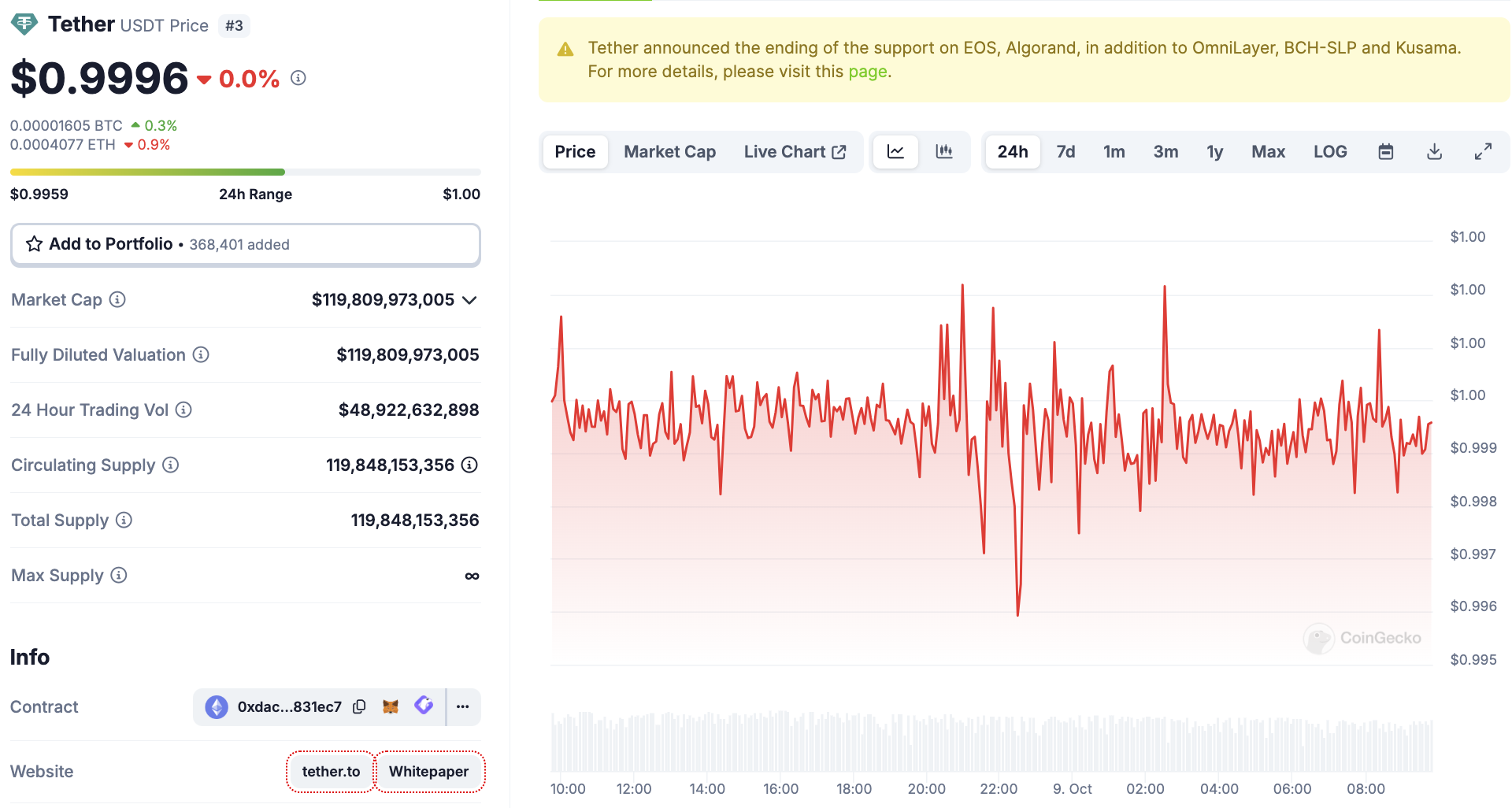
Vốn hóa thị trường của USDT hiện đang tiến gần mốc 120 tỷ đô la. Vào năm 2021, công ty đã bị CFTC phạt 41 triệu đô la vì đưa ra tuyên bố sai lệch về dự trữ của mình. Để minh bạch hơn, Tether đã công bố các chứng thực hàng quý về trữ lượng của mình.

Nguồn: Coingecko

Năm ngoái, công ty dịch vụ tài chính Cantor Fitzgerald đã xác nhận rằng họ chịu trách nhiệm giám sát trái phiếu kho bạc của Tether, với giá trị lên tới 97 tỷ đô la. Theo Ardoino, Cantor có kết nối trực tiếp với Fed, cho phép họ thực hiện các giao dịch thông qua cơ sở đó trong mọi trường hợp.

Đầu năm nay, CEO của Ripple, Brad Garlinghouse, đã gây tranh cãi khi ám chỉ rằng chính phủ Hoa Kỳ đang nhắm mục tiêu vào Tether. Tuyên bố này được đưa ra ngay sau khi Ripple công bố stablecoin của riêng mình. Tuy nhiên, Ardoino đã chỉ trích Garlinghouse vì phát tán thông tin không chính xác và nhấn mạnh sự hợp tác của Tether với các cơ quan thực thi pháp luật trên toàn cầu.


Annie

Theo U.today

Exit mobile version