Tất cả bài viết của Phạm Mạnh Cường

Phạm Mạnh Cường là một doanh nhân và nhà đầu tư Tiền mã hoá. Tác giả đã từng tiên phong giảng dạy Blockchain ở Trường Đại học Kinh tế - Luật, Đại học Quốc gia Hồ Chí Minh. Hiện tại đang là Giám đốc công ty Wischain và Giảng viên công nghệ Blockchain tại Đại học Hutech, Đại học Tài chính-Marketing và nhiều trường ĐH tại Việt Nam. Tác giả đã có bằng Thạc sĩ Khoa học máy tính từ năm 2011 tại Đại học Bách Khoa Hồ Chí Minh. Tính đến nay tác giả đã có kinh nghiệm 7 năm giảng dạy cho sinh viên về công nghệ Blockchain và hơn 9 năm đầu tư trong lĩnh vực Tiền mã hoá từ 2016. Tác giả đã tham gia diễn giả tại hàng trăm hội thảo chất lượng và hiện sở hữu hàng nghìn bài viết tổng hợp, nhận định và chỉnh sửa về Tiền mã hoá và Tiền điện tử chất lượng trên Website và ở nhiều kênh khác.

Tòa án Tối cao bật đèn xanh cho Chính phủ Mỹ bán 4,4 tỷ USD Bitcoin tịch thu từ Silk Road

Tòa án Tối cao Mỹ đã từ chối việc xem xét một vụ án liên quan đến quyền sở hữu 69.370 Bitcoin bị tịch thu từ chợ đen Silk Road, điều này dường như bật đèn xanh cho chính phủ Mỹ bán số Bitcoin trị giá 4,4 tỷ USD này.

Vào năm 2022, một tòa án liên bang tại California đã đưa ra phán quyết chống lại Battle Born Investments, công ty tuyên bố đã mua quyền sở hữu đối với số Bitcoin bị tịch thu thông qua một tài sản phá sản. Battle Born lập luận rằng người nợ trong vụ phá sản, Raymond Ngan, chính là “Cá nhân X” bí ẩn đã đánh cắp hàng tỷ USD Bitcoin từ Silk Road, sau đó bị chính phủ Mỹ tịch thu.

Tòa án liên bang không bị thuyết phục rằng Ngan thực sự là “Cá nhân X,” và do đó đã phán quyết rằng Battle Born không có quyền hợp lệ đối với số Bitcoin bị tịch thu. Năm sau, một tòa phúc thẩm liên bang ở San Francisco đã xác nhận phán quyết này.

Giờ đây, với việc Tòa án Tối cao từ chối xem xét vụ Battle Born, vấn đề này gần như đã đi đến hồi kết. Điều này có nghĩa là chính phủ hiện có ít rào cản trong việc thực hiện các kế hoạch với số tiền bị tịch thu – đặc biệt là việc bán chúng.

Trong những tháng gần đây, chính phủ Hoa Kỳ đã di chuyển một khối lượng lớn Bitcoin bị tịch thu từ Silk Road. Trong khoảng thời gian hai tuần vào tháng 7 và tháng 8, chính phủ đã chuyển khoảng 2,6 tỷ USD Bitcoin vào các ví mới. Những động thái này thường được thực hiện để chuẩn bị cho việc bán các khoản tiền này. Tuy nhiên, Cơ quan Marshals Hoa Kỳ đã ký một thỏa thuận lưu giữ tài sản với Coinbase Prime, do đó sàn giao dịch có thể chỉ đơn giản là giữ các tài sản này cho chính phủ.

Khi các chính phủ trên toàn thế giới tiếp tục thanh lý những khoản tiền lớn tiền điện tử bị tịch thu trong các hành động thực thi pháp luật, điều này đã tạo ra những lo ngại về sự biến động của thị trường.

Câu hỏi về cách chính phủ Mỹ nên xử lý Bitcoin bị tịch thu đã trở thành một vấn đề nóng trong chu kỳ bầu cử hiện tại. Vào tháng 7, tại một hội nghị tiền điện tử ở Nashville, cựu Tổng thống Donald Trump đã cam kết xây dựng một “kho Bitcoin chiến lược” nếu ông được tái bầu.

“Tôi xin thông báo rằng nếu tôi được bầu, chính sách của chính quyền tôi, của Hoa Kỳ, sẽ là giữ 100% tất cả Bitcoin mà chính phủ Mỹ hiện đang nắm giữ hoặc có được trong tương lai,” Trump phát biểu vào thời điểm đó.

Silk Road là chợ đen trực tuyến được Ross Ulbricht thành lập vào năm 2011, cho phép mua bán hàng hóa và dịch vụ bất hợp pháp, chủ yếu là ma túy, bằng Bitcoin. Nền tảng bảo đảm ẩn danh cho người dùng và sử dụng mạng Tor để ngăn chặn theo dõi. Người dùng có thể đăng bán sản phẩm và đánh giá lẫn nhau, tạo hệ thống độ tin cậy.

Silk Road thu hút sự chú ý của chính quyền vào năm 2013, dẫn đến việc FBI đóng cửa vào tháng 10 cùng năm và bắt giữ Ulbricht. Tại thời điểm đó, Silk Road đã xử lý khoảng 1,2 tỷ USD giao dịch, trở thành biểu tượng của rủi ro trong kiểm soát hoạt động trực tuyến bất hợp pháp. Ross Ulbricht cũng bị bắt và bị kết án chung thân không ân xá. Gần đây cựu tổng thống Donald Trump hứa sẽ ân xá ngay lập tức cho ông vào ngày đầu tiên nhậm chức, nếu ông tái đắc cử.


Thạch Sanh

Theo Decrypt

Korea eyes FX rules for stablecoins used in cross-border trade: report

South Korea is planning to impose foreign exchange controls on stablecoins, underscoring the government’s concerns over their growing use in cross-border trade.

South Korea is weighing the introduction of foreign exchange controls on stablecoins, reflecting government concerns over their growing use in cross-border trade, The Korea Economic Daily has learned. The Ministry of Economy and Finance is reportedly reviewing measures to enhance the stability of crypto transactions, particularly those involving stablecoins.

While stablecoins have been widely used only within the cryptocurrency ecosystem, the ministry believes that they may soon function as a payment and transaction method in the real economy. Concerns have been raised that these assets are operating outside government oversight, posing risks to the stability of South Korea’s foreign exchange market, the report reads.

Though no specific timeline has been announced, the Financial Services Commission is expected to prioritize discussions on stablecoin regulation in its forthcoming legislative efforts, drawing from regulatory frameworks established in Japan and the European Union.

The potential regulatory shift follows the South Korean government’s broader efforts to tighten oversight of the local crypto market. As crypto.news reported, Korean crypto exchanges, such as UpbitBithumb, and Coinone, will soon be obligated to pay an oversight fee to the Financial Supervisory Service of South Korea beginning next year as the country steps up its regulatory framework for the crypto sector.

Local industry representatives initially suggested delaying the imposition of supervisory fees on crypto operators. However, the decision to implement these fees was expedited due to upcoming inspections by the FSS following the enforcement of the Virtual Asset User Protection Act.

The new law introduces several requirements for crypto exchanges, including a mandate to keep at least 80% of users’ assets in cold storage. These assets must be kept separate from company funds and invested in “risk-free” assets to generate a yield. Additionally, exchanges must reassess listed assets by verifying their circulation and reviewing their whitepapers, with any assets that fail to meet the criteria required to be delisted.

The recent enforcement follows the postponement of a 20% crypto gains tax by South Korea’s Ministry of Economy and Finance, with reports indicating that the ruling party may delay the tax until 2028.

Tổng hợp và chỉnh sửa: ThS Phạm Mạnh Cường
Theo Crypto News

Linea công bố lộ trình phân quyền mới với mô hình PoS

Linea, một dự án ZK Rollup Layer 2 được phát triển bởi Consensys, đã đưa ra một đề xuất quan trọng như một phần của thiết kế giao thức, nêu chi tiết các bước cần thiết cho quá trình phân quyền vào tuần trước.

Đề xuất mang tên “Hướng tới sự phi tập trung của Linea,” do Florian Huc, kiến trúc sư phần mềm tại Linea, soạn thảo, trình bày một khuôn khổ tổng thể nhằm chuyển đổi zkEVM sang một hệ thống không cần cấp phép và thiết lập quản trị phi tập trung thông qua việc sửa đổi các quy trình xác thực block, đề xuất block và finality hiện tại.

Mục tiêu của đề xuất là cho phép các block đạt được finality (tính không thể đảo ngược khi giao dịch đã được xác nhận và thêm vào một block) ở cả cấp độ Layer 2 và Layer 1. Trong cấu trúc này, trình sắp xếp của Linea sẽ xác nhận finality cho Layer 2, trong khi finality của Layer 1 sẽ được bảo đảm khi dữ liệu và bằng chứng từ các block Layer 2 được đăng trên Ethereum.

Ngoài ra, những người đóng góp cho Linea cũng đã đề xuất thay thế hệ thống xác thực Layer 2 hiện tại bằng mô hình PoS. Điều này sẽ yêu cầu các trình xác thực stake token và tham gia vào thuật toán đồng thuận QBFT. Đề xuất nhấn mạnh rằng các trình xác thực có hành vi sai trái sẽ bị xử lý, bao gồm việc giảm cổ phần của họ.

Một hệ thống đấu giá onchain sẽ được triển khai, cho phép các node tham gia đấu giá để giành quyền đề xuất block tạo ra một cơ chế dựa trên thị trường, khuyến khích sự tham gia và đầu tư vào mạng lưới.

Chế độ phục hồi được thiết lập để đảm bảo rằng hệ thống tiếp tục hoạt động ngay cả khi bộ xác thực không hoạt động trong sáu tháng. Trong trường hợp này, bất kỳ node nào cũng có thể bắt đầu hoàn thiện các block.

Đề xuất này được đưa ra sau thông báo trước đó của dự án về kế hoạch phân cấp mạng lưới, sau một thời gian tạm dừng sản xuất block do phát hiện lỗ hổng bảo mật trên Velocore, một sàn giao dịch phi tập trung thuộc mạng lưới của họ.


Annie

Theo The Block

Palau debuts blockchain-based savings bonds by CBDC developer Soramitsu

Palau’s government in partnership with Soramitsu and Japan’s ministry has launched a blockchain-based savings bond prototype aimed at enhancing domestic investment growth.

Palau is launching a blockchain-based savings bond system developed in collaboration with Japanese blockchain firm Soramitsu and Japan‘s Ministry of Economy, Trade and Industry to provide citizens with investment opportunities in domestic infrastructure projects.

In a Tuesday press release on Oct. 8, Soramitsu said the so-called “Palau Invest” initiative seeks to empower citizens by providing them with a new means to invest in national projects while earning yields from those investments.

Based on the SORA v3 Hub Chain’s Hyperledger Iroha 2-based network, the program is part of METI’s “Global South Future-Oriented Co-Creation Project,” Japan’s commitment to supporting emerging economies through technological innovation. Funds generated from the digital savings bonds are said to be allocated for critical infrastructure projects such as housing, roads, and public facilities.

President of Palau Surangel Whipps, Jr. highlighted the initiative’s significance, saying it can help “stimulate job creation, enhance business opportunities, and foster a vibrant economy.”

As of press time, a public demonstration phase has been launched to familiarize citizens with the savings bond system before formal issuance begins. Once finalized, bonds will be available for purchase through a mobile app, allowing citizens to invest from their smartphones, though no exact timeline was revealed.

For Soramitsu, this launch represents another milestone in its efforts, having previously implemented blockchain-based financial systems in the Asia-Pacific region, including central bank digital currency initiatives in Cambodia and Papua New Guinea.

Tổng hợp và chỉnh sửa: ThS Phạm Mạnh Cường
Theo Crypto News

ZachXBT giúp một khách hàng Coinbase thu hồi 275.000 USD sau khi bị tấn công phi kỹ thuật

Thám tử blockchain ZachXBT cho biết anh đã giúp thu hồi khoảng 275.000 đô la tiền điện tử cho một khách hàng của Coinbase, nạn nhân của một vụ tấn công phi kỹ thuật (Social engineering)*. Trong quá trình điều tra, chuyên gia bảo mật ẩn danh này phát hiện thêm khoảng 5 triệu đô la Bitcoin và Ether bị đánh cắp liên quan đến vụ lừa đảo.

“Vào tháng 4 năm 2024, một nạn nhân lớn tuổi từ Hoa Kỳ đã bị những kẻ lừa đảo, giả danh nhân viên hỗ trợ của Coinbase, tấn công và lấy đi một khoản tiền tiết kiệm lớn.”

Nạn nhân này đã giữ tiền trên thiết bị phần cứng Ledger nhưng bị thuyết phục chuyển đi sau khi bị thông báo rằng tài khoản sàn giao dịch của họ đã bị xâm phạm.

Tuy nhiên, việc xác minh thực tế cho thấy Coinbase không gửi bất kỳ cảnh báo bảo mật nào.

Theo điều tra của ZachXBT, khoảng 15 BTC đã được chuyển đến một sàn giao dịch tập trung không có nhãn vào ngày 10 tháng 8, ngay sau khi vụ lừa đảo diễn ra, và sau đó được chuyển sang blockchain Tron. Gần 200.000 đô la tiền điện tử cũng đã được gửi đến quầy OTC.

Công ty phân tích Chainalysis cho biết hoạt động bất hợp pháp onchain đã giảm trong hai quý đầu năm 2024 so với năm trước, tuy nhiên, số tiền bị đánh cắp và ransomware đang gia tăng. Dòng tiền bị đánh cắp đã tăng gần gấp đôi, từ 857 triệu đô la lên 1,58 tỷ đô la, trong khi dòng tiền ransomware tăng khoảng 2%, từ 449,1 triệu đô la lên 459,8 triệu đô la.

*Social engineering (hay tấn công phi kỹ thuật) là hình thức tấn công mà đối tượng tấn công tác động trực tiếp đến tâm lý con người (kỹ năng xã hội) để đánh cắp thông tin, dữ liệu của cá nhân và tổ chức. Đối tượng tấn công có thể mạo danh là nhân viên, kỹ thuật viên, công an, hay các nhà nghiên cứu,… và đề nghị bạn cung cấp thông tin xác thực để thực hiện một công việc nào đó.


Annie

Theo The Block

Bahamas students each win $10k in NFT competition sponsored by Snoop Dogg’s son

Five students from the University of The Bahamas each won $10,000 for their digital music and art creations as part of the university’s NFT Digital Arts Project, sponsored by Snoop Dogg’s son Cordell Broadus.

According to a report by Bahamas media Eyewitness News, the University of The Bahamas announced the student winners of its Non-fungible token Digital Arts Projects on Oct. 7. Each student receives a prize of $10,000 for their NFT creations.

Three students won awards in the Visual Art category, while two other students won in the Music category.

The project is funded by the Champ Medici Arts Fund Scholarship Award at UB. The collaboration involved Cordell Broadus, son of American rapper Snoop Dogg, and the Tezos(XTZ) Foundation. The award was first established in March 2024 with an initial donation of $100,000.

In an interview with Eyewitness News, one of the students who won in the Music category said that he was able to learn more about NFT technology by participating in the competition.

The CMAF is a $1 million philanthropic fund started by Cordell Broadus in partnership with the Tezos Foundation. Their goal was to support emerging musicians and artists across the globe who want to build and create new creative and cultural works on the Tezos blockchain.

In a report by OurNews media, the CMAF said that the NFT competition was only the beginning of their contribution towards the university’s art and music programs. CMAF and Tezos Foundation will also give educational tutorials, materials and guidance for students on how they can use the Tezos blockchain to mint, market and sell their NFT works.

The joint initiative also plans to supply the university with relevant equipment and technology for the students so that they can pursue digital art and music initiatives in the future.

Tezos is a smart contracts proof-of-stake blockchain platform that launched in 2017 after a $232 million initial coin offering.

In June 2024, it announced a new upgrade labeled “Tezos X”, which enables an integrated blockchain ecosystem that boasts greater performance, composability and interoperability compared to the old model.

Tổng hợp và chỉnh sửa: ThS Phạm Mạnh Cường
Theo Crypto News

Bhutan’s path to economic self-reliance is Bitcoin mining | Opinion

It’s time to start learning Dzongkha. That’s the language of Bhutan, a South Asian country on the Himalayas’ eastern edge that is one of two confirmed nation-states mining Bitcoin (BTC) today (the other being El Salvador).

Bhutan made the fateful decision to build out a world-class hydroelectric power production infrastructure in order to leverage one of the largest water reserves in the world, as well as the country’s dramatic attitudinal change, which creates swift-flowing rivers and makes Bhutan a natural haven for hydroelectric. 

With so much abundant electricity, much of which is sent to neighboring and energy-deficient India, the nation decided to begin building bitcoin mines with the official goal of ensuring the nation’s economic self-reliance and socio-economic development. 

Indeed, by leveraging its hydropower infrastructure to mine Bitcoin, Bhutan ensures its own self-reliance and socio-economic development. It can ensure these even further by being the first nation on planet Earth to adopt a Bitcoin standard.

Mining Bitcoin now creates new currency possibilities

Bhutan today holds over 13,000 BTC, according to Arkham Intelligence, which first identified Bhutan’s Bitcoin addresses. 

The holdings make Bhutan the fourth-largest government holder of Bitcoin in the world behind nations which confiscated their BTC during law enforcement busts: US, China, and UK. Bhutan is, in fact, ahead of El Salvador’s holdings. And since 2023, Bhutan has only increased its Bitcoin mining capabilities.

One million people make up the population of Bhutan, from the tropical southern plains to the brutal winters and cool summers of the northern Himalayas. And so, at the time of writing, the nation’s holdings from Bitcoin equals approximately 0.122 BTC per person or nearly $8,000.

As Bhutan’s Bitcoin holdings and mining infrastructure gain more domestic and geopolitical relevance with the devaluation of fiat currencies worldwide, Bhutan will find itself in a prime position to innovate in the realm of monetary policy and Bitcoin. 

On a Bitcoin standard, Bhutan could keep its monetary unit, Ngultrum. That would be in keeping with countries pegging their own individual national currencies to gold under the gold standard of the nineteenth and early twentieth century, while keeping their own currencies.

Thus, Bhutan’s currency would circulate alongside Bitcoin, whilst simultaneously pegged to Bitcoin. In other words, the notes would be redeemable for BTC. The currency would remain fiduciary, since it is not fully backed by bitcoin. 

Under the gold standard, central banks partially backed the issued notes with gold. Bhutan’s monetary authority would presumably define the amount of bitcoin to peg to the monetary unit. 

However, there would be sacrifice on the side of the state under a Bitcoin standard. If it were to adopt a Bitcoin standard, Bhutan would not be able to conduct an interest rate policy to change domestic economic conditions without depegging from Bitcoin—something any nation-state might eventually be tempted to do.

The times are changing in Bhutan

Bhutan didn’t have electricity until 1966. For comparison, England opened its first hydroelectric plant in 1878, and the US opened its first power plant in 1882. Despite being ranked 133rd in terms of land area and 160th in population today, Bhutan is proving itself a 21st-century leader. 

The nation’s investment in hydropower has fueled economic growth already. Bhutan’s decision to exploit its water resources for the production of electric, and the decision to use some of this electricity to mine Bitcoin, could drastically change the economic outlook of the landlocked country based on its Bitcoin accumulation alone.

By backing the Ngultrum with Bitcoin, Bhutan would shock the known universe by going on a bitcoin standard just like the world used to be on the Classical Gold Standard. Bhutan could draw up the Bitcoin standard  “rules of the game” that countries will follow as they too adopt a better way of life than central bank fiat currencies. 

If Bhutan adopts a Bitcoin standard, it might one day act as a lender of last resort for countries and institutions facing acute crises. Under a Bitcoin standard, as argued by Warren E. Weber for the Bank of Canada in his 2015 thought experiment, Bhutan might expect “mild deflation, low nominal interest rates, and good output growth under the Bitcoin standard.”

Tổng hợp và chỉnh sửa: ThS Phạm Mạnh Cường
Theo Crypto News

NEIRO surges 15%, further rally could be on the way

Neiro, an Ethereum-based meme coin, recorded a strong bullish momentum over the past day despite the market-wide turbulence. 

Neiro (NEIRO) has surged 15% in the last 24 hours despite the market witnessing a period of lackluster performance. This uptrend follows a massive 36% gain on Oct. 6, which overshadowed the 9.23% loss NEIRO encountered the previous day.

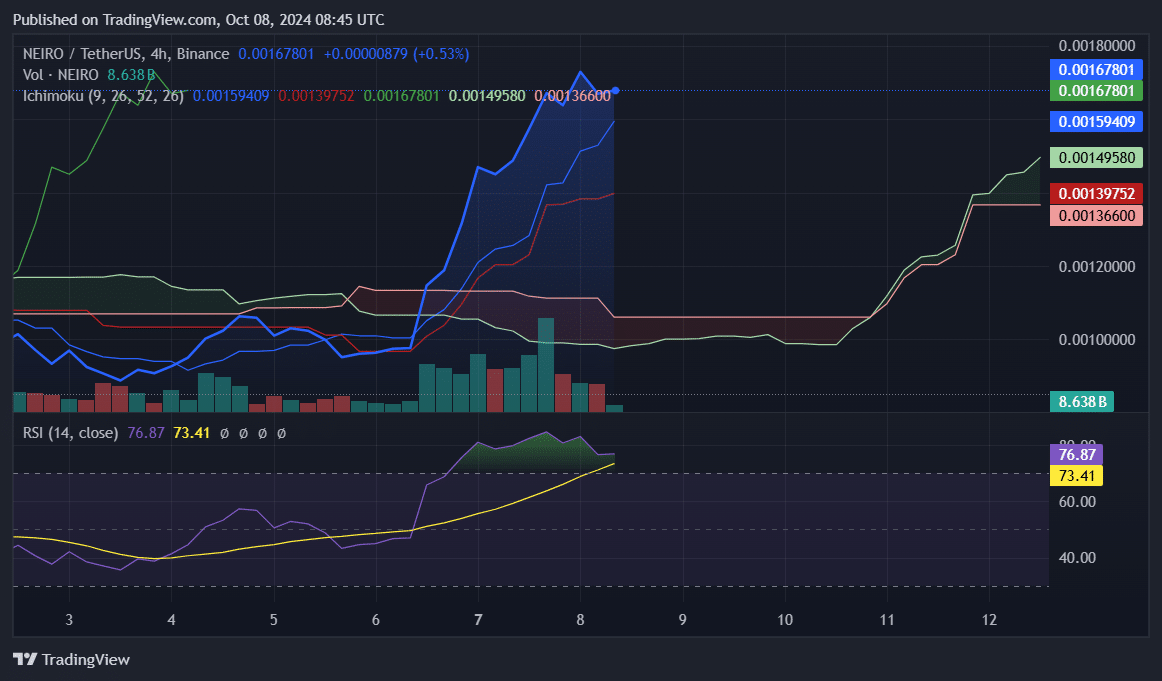
NEIRO 4H chart – Oct. 8 | Source: crypto.news

The bullish momentum continued with a 24.51% rally on Oct. 7. An additional 2.42% increase this morning helped push NEIRO into the top spot on the gainers list.

NEIRO is up by 15.3% in the past 24 hours and is trading at $0.001678 at the time of writing. Its market cap reached $714 million with a daily trading volume of $1.17 billion.

On the four-hour chart, NEIRO has broken above the Ichimoku Cloud, signaling a potential continuation of its bullish run. Notably, the Ichimoku Cloud indicators show strong support levels amid the upsurge.

The Base Line, currently at $0.001397, is far below NEIRO’s current price, suggesting that the asset has solidified a higher floor. 

Meanwhile, Leading Span A at $0.001495 highlights the cloud’s support level. This confirms the potential for further upward movement if the support holds. If the price consolidates around these levels without falling back into the cloud, the token may see even greater gains.

The RSI, now at 77.55, indicates that NEIRO is in overbought territory. Further, buying pressure remains high, as suggested by the Signal Line at 73.46. While this is bullish, it also signals that a correction could spring up as the token becomes overextended.

Investors should keep an eye out for a potential retracement, especially given the overbought signals on the RSI. A pullback toward the Base Line around $0.001397 could present an opportunity for buyers looking to re-enter the market.

Tổng hợp và chỉnh sửa: ThS Phạm Mạnh Cường
Theo Crypto News

SUI leads top gainers as open interest hits all-time high

Sui, often dubbed the Solana-killer, continued rising on Oct. 8 amid a record surge in its futures market.

Sui (SUI) jumped to an intraday high of $2.14, its highest price level in six months, and 181% above its lowest point last month. This recovery made it the leading gainer among the top 100 cryptocurrencies by market cap on Oct. 8.

At press time, Sui’s market cap stood at $5.46 billion, while its daily trading volume had more than doubled to $2.26 billion.

Key developments fuelling growth

A key catalyst for Sui’s recovery has been the significant demand in the futures market. Data from CoinGlass reveals that Sui’s open interest soared to an all-time high of $564 million on Oct. 8, surpassing the previous record of $502 million. This is a dramatic rise from September’s lows, where open interest hovered below $140 million, suggesting a substantial influx of speculative capital.

Futures open interest measures the volume of outstanding contracts—both buy and sell orders—that have yet to be executed. A surge in this metric typically signals heightened interest and confidence among traders.

Most of Sui’s futures activity has been driven by Bybit, followed closely by Binance and Bitget. Notably, Bybit’s decision to incorporate SUI into its Launchpool, marking the first time a non-Mantle token has been included, has helped bolster market activity.

Beyond the futures market, Sui’s fundamentals are also improving. The total value locked in Sui’s decentralized finance protocols surged by over 61.2% in the last 30 days, reaching $1.089 million, placing Sui among the top seven chains by value.

Further, the Sui network recently surpassed Solana in terms of daily transaction volume, a key metric for measuring network activity. As of Oct. 8, Sui recorded 58.37 million daily transactions compared to Solana’s 35.41 million, underscoring its growing user base and adoption.

Grayscale’s launch of the SUI Trust in September has added another layer of momentum to the token’s recent rally. The trust allows accredited investors to gain exposure to the SUI token, which has likely contributed to the token’s price appreciation by expanding its reach to institutional players.

Technical indicators signal sustained bullish momentum

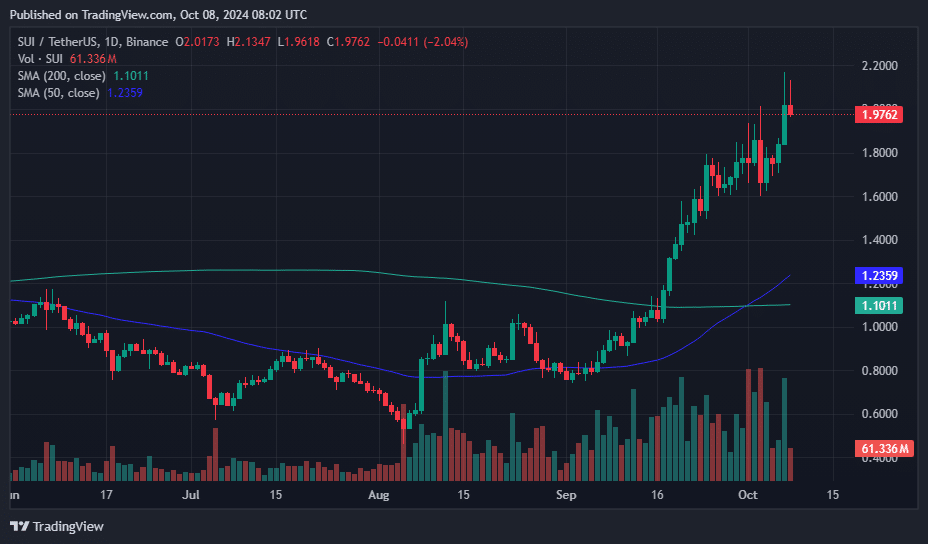
From a technical perspective, Sui’s price action is signaling continued strength. The token is currently trading above its 50-day and 200-day moving averages, which formed a golden cross—a classic bullish indicator—on Sept. 22. This pattern suggests that the short-term trend has overtaken the long-term trend, often leading to further upward momentum.

SUI 50-day and 200-day SMA – Oct. 8 | Source: crypto.news

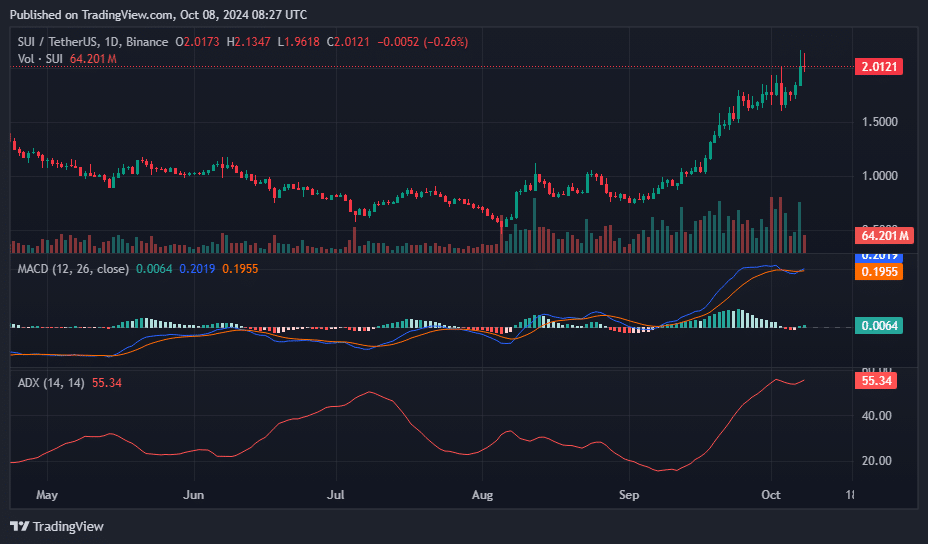
The Average Directional Index, which measures the strength of a trend, has surged to 55, well above the threshold of 25 that denotes a strong trend. The Moving Average Convergence Divergence indicator is also flashing bullish signals, with both the MACD line and its signal line trending upwards. These technical metrics suggest that Sui’s rally still has room to run.

SUI ADX and MACD chart – Oct. 8 | Source: crypto.news

As Sui approaches its previous all-time high of $2.17, this level now serves as a key resistance point. If the token can break through this barrier, it could set the stage for further gains.

Tổng hợp và chỉnh sửa: ThS Phạm Mạnh Cường
Theo Crypto News