Những altcoin tăng mạnh nhất trong tuần đầu tiên của tháng 10 năm 2024

Bước vào tháng 10 và quý 4, thị trường đã bắt đầu phục hồi, mang lại lợi nhuận cho nhiều tài sản tiền điện tử, với một số altcoin thậm chí còn đạt mức cao kỷ lục mới.

Tạp chí Bitcoin đã phân tích ba altcoin có hiệu suất tốt nhất trong bảy ngày qua, bao gồm đồng meme Solana POPCAT, đã thiết lập mức ATH mới trong tuần này.

FTX Token (FTT)

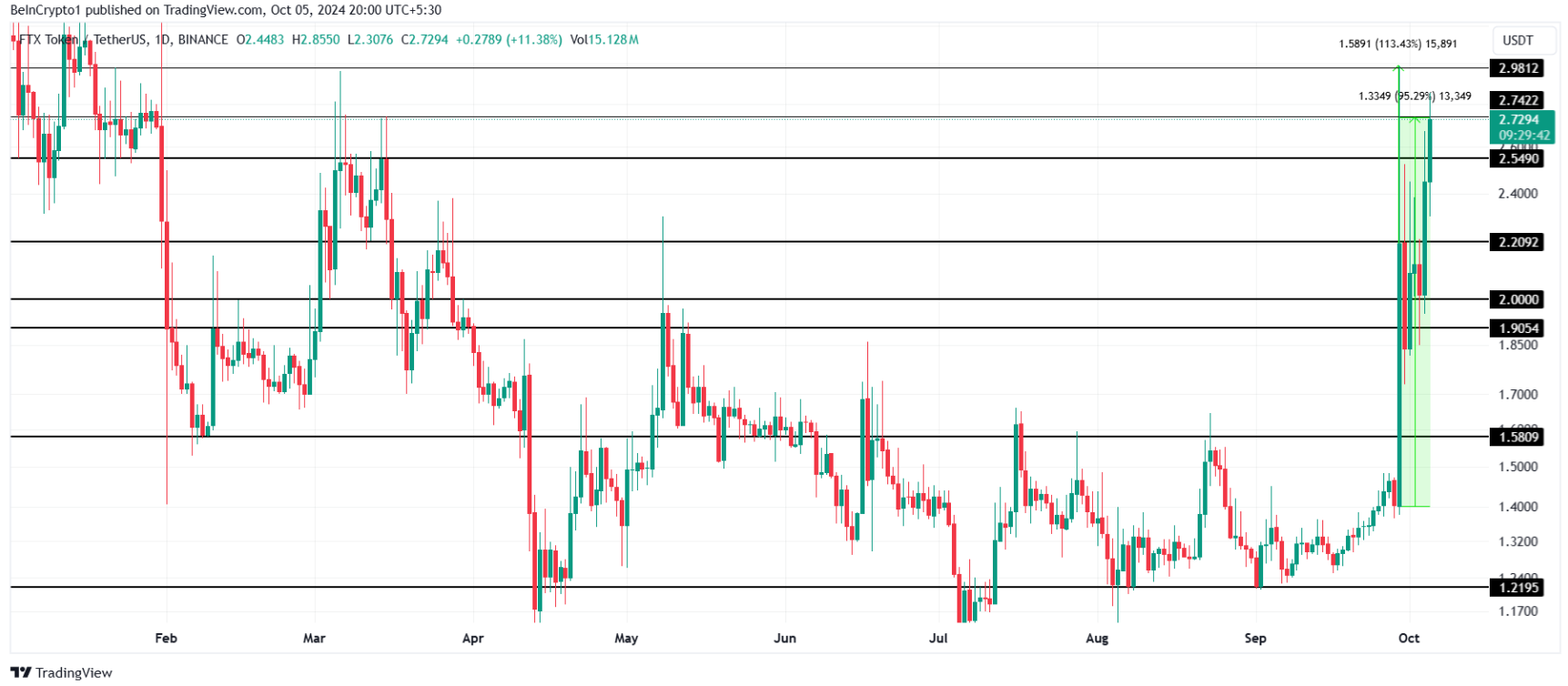
Token gốc của FTX, FTT, đã gây bất ngờ cho thị trường khi vượt trội hơn so với mọi altcoin lớn trong top 100 tiền điện tử. FTT đã tăng 95% trong tuần qua và hiện đang giao dịch ở mức $2,72. Mức tăng đột ngột này đã thu hút sự chú ý của cả các trader và nhà đầu tư.

alt-tang

Biểu đồ GTT/USDT hàng ngày | Nguồn: TradingView

Đợt tăng giá này chủ yếu được thúc đẩy bởi tin đồn về việc bắt đầu hoàn trả cho các chủ nợ. Với phiên điều trần về kế hoạch phân phối được lên lịch vào ngày 7 tháng 10, tâm lý lạc quan dự kiến sẽ tiếp tục, có thể đẩy giá tăng thêm.

Nếu động lực tiếp tục duy trì, FTT có thể tăng lên mức $2,98. Tuy nhiên, token này có thể chứng kiến một đợt giảm xuống $2,54 hoặc thậm chí $2,20 nếu động lực suy yếu, khiến các nhà đầu tư thận trọng với những rủi ro tiềm ẩn.

Popcat (POPCAT)

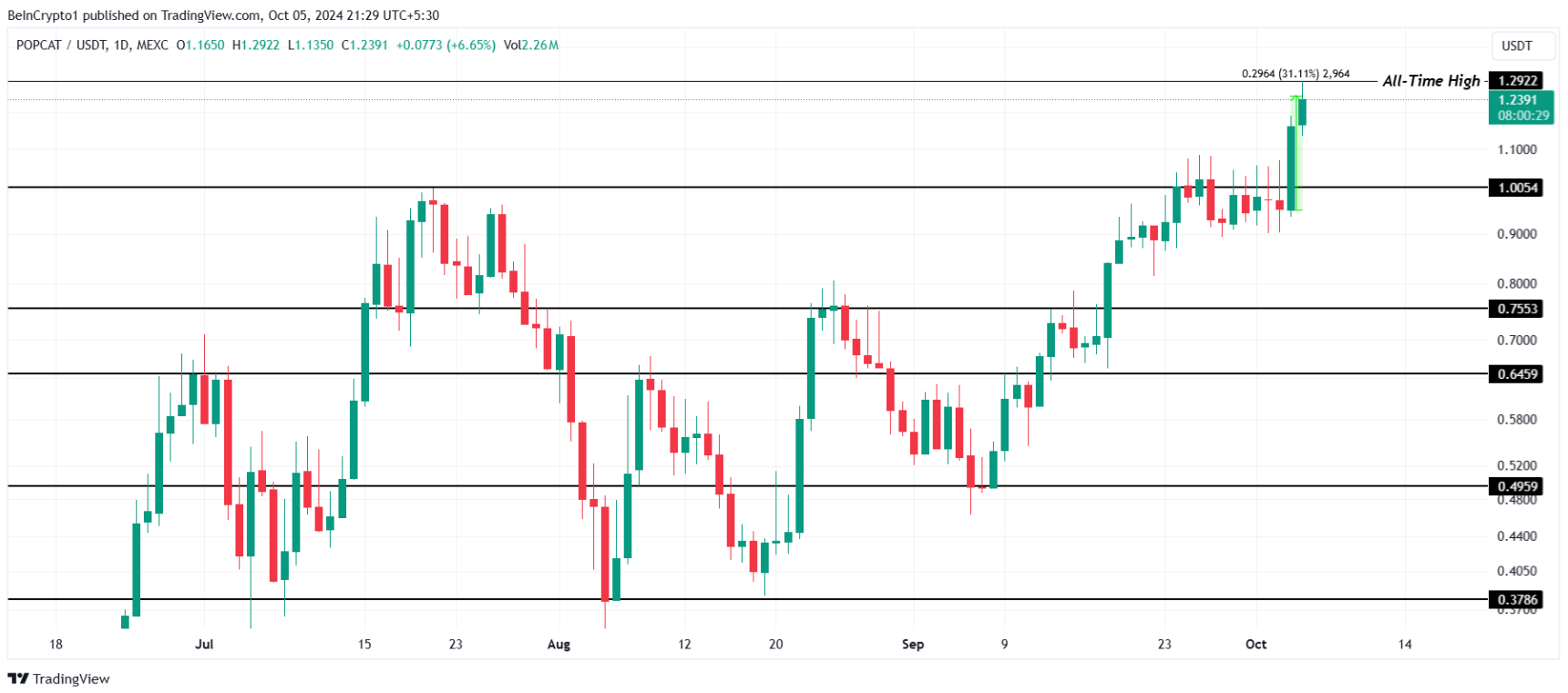
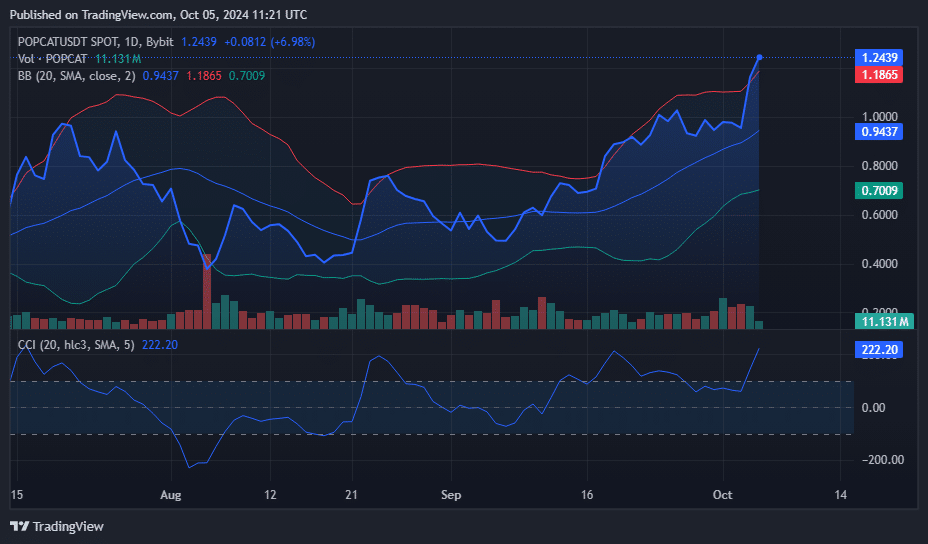
Giá POPCAT đã đạt mức cao kỷ lục mới trong tuần này, tăng 31% trong 24 giờ qua. Đồng meme dựa trên Solana này đã vượt qua ngưỡng kháng cự $1, thiết lập mức ATH mới ở mức $1,29 sau khi gặp khó khăn trong việc vượt qua ngưỡng này suốt cả tuần.

Biểu đồ POPCAT/USDT hàng ngày | Nguồn: TradingView

Động lực cho đợt tăng đột ngột này vẫn chưa rõ ràng, nhưng nếu các nhà đầu tư POPCAT tránh bán ra, đồng coin này có thể tiếp tục xu hướng tăng. Điều này có thể dẫn đến việc hình thành một mức đỉnh mới, càng thúc đẩy tâm lý thị trường.

Tuy nhiên, nếu việc chốt lời diễn ra, nó có thể chặn đứng đà tăng và đẩy giá xuống $1. Việc để mất ngưỡng hỗ trợ quan trọng này sẽ làm mất hiệu lực của triển vọng tăng giá.

Wormhole (W)

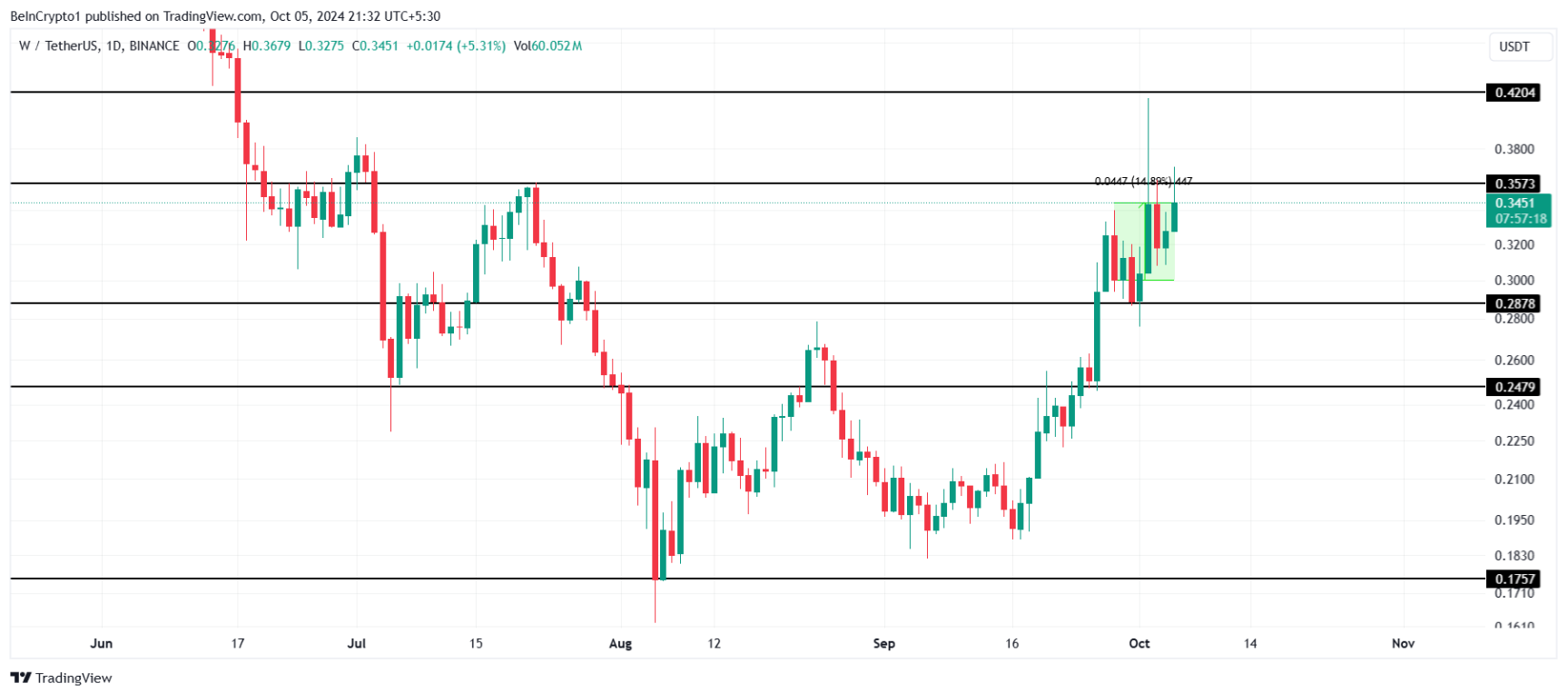
Giá Wormhole có thể không tăng mạnh như các token khác, nhưng vẫn gây ấn tượng với mức tăng 14,8%. Hiện đang giao dịch ở mức $0,34, altcoin này đã thu hút sự chú ý của các nhà đầu tư.

Biểu đồ W/USDT hàng ngày | Nguồn: TradingView

Wormhole đã gần đạt mức cao trong tuần ở $0,42 nhưng lại giảm xuống dưới ngưỡng kháng cự $0,35. Rào cản này đã tồn tại từ giữa tháng 7, và nếu vượt qua, giá có thể tăng lên $0,42 một lần nữa.

Việc kiểm tra ngưỡng kháng cự $0,42 sẽ đánh dấu mức cao trong gần bốn tháng. Tuy nhiên, nếu Wormhole không thể vượt qua mức $0,35, nó có thể tiếp tục bị giam trong khoảng $0,28 và $0,35, làm mất hiệu lực của triển vọng tăng giá.

Bạn có thể xem giá coin ở đây.

Disclaimer: Bài viết chỉ có mục đích thông tin, không phải lời khuyên đầu tư. Nhà đầu tư nên tìm hiểu kỹ trước khi ra quyết định. Chúng tôi không chịu trách nhiệm về các quyết định đầu tư của bạn. 


SN_Nour

Theo Beincrypto

Nhà điều hành BlackRock dự đoán thị trường Bitcoin sẽ đạt 5,4 nghìn tỷ đô la trong những năm tới

Lãnh đạo ETF theo chủ đề và chủ động tại Hoa Kỳ của BlackRock, Jay Jacobs, cho biết vẫn còn nhiều chỗ cho việc chấp nhận Bitcoin, ước tính thị trường sẽ đạt 5,4 nghìn tỷ đô la trong những năm tới.

BlackRock là công ty quản lý quỹ lớn nhất hành tinh và là một trong những công ty đầu tiên được cấp phép, phát hành Bitcoin ETF tại Hoa Kỳ.

Jay Jacobs

Tại sao các nhà đầu tư lại có nhu cầu Bitcoin?

Jacobs cho biết công ty quản lý quỹ này bắt đầu xem xét Bitcoin sau khi nhu cầu ngày càng tăng từ khách hàng đang tìm kiếm các tài sản khác nhau trong danh mục đầu tư.
“Các nhà đầu tư muốn thứ gì đó khác ngoài cổ phiếu và trái phiếu. Nếu bạn nhìn lại vài năm gần đây, mối tương quan giữa cổ phiếu và trái phiếu ngày càng tăng. Rất khó để đạt được sự đa dạng hóa, đặc biệt là trong môi trường lãi suất cao hơn. Mọi người thực sự đã cố gắng tìm kiếm cơ hội để có được các lựa chọn thay thế. Có lẽ điều này sẽ đến với các thị trường tư nhân”, Jacobs giải thích.

Ngoài ra, một nhu cầu khác thúc đẩy chấp nhận BTC tại BlackRock là các nhà đầu tư lão luyện muốn có danh mục đầu tư thanh khoản hơn để đa dạng hóa các khoản đầu tư.

Nói như vậy, BlackRock hiện quản lý gần 370.000 BTC, trở thành một trong những holder Bitcoin lớn nhất. Công ty này đã vượt qua lượng Bitcoin nắm giữ của MicroStrategy và hiện chỉ đứng sau Satoshi Nakamoto, sàn giao dịch Binance.
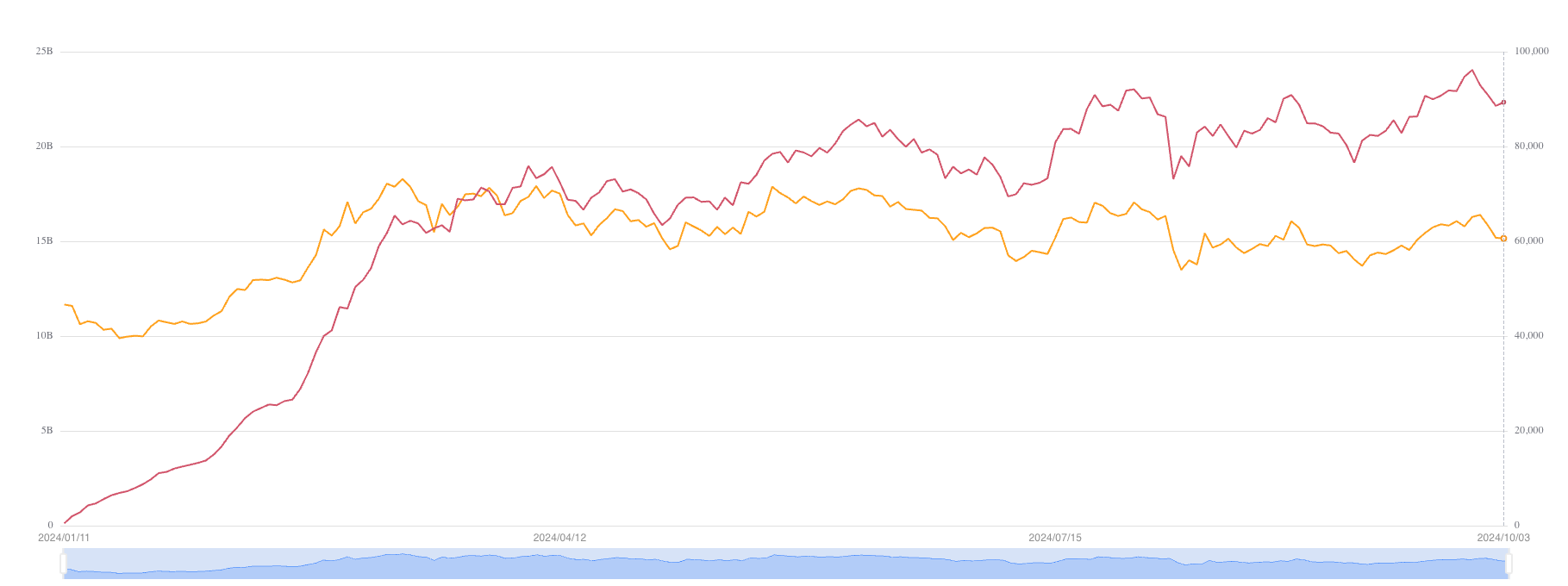
Theo dữ liệu mới nhất từ ​​SoSoValue, lượng Bitcoin của iShare Bitcoin Trust (IBIT) thuộc BlackRock có giá trị 22,33 tỷ đô la.
Định giá Bitcoin của BlackRock | Nguồn: SoSoValue
Khi được hỏi về đợt tăng giá của BTC, Jacobs không thể trả lời. Tuy nhiên, anh tin rằng việc đa dạng hóa các khoản đầu tư bằng tiền điện tử có giá trị nhất trên thị trường là một chiến lược quyết đoán.

“Thật khó để vẽ nên một bức tranh cho từng danh mục đầu tư. Điều chúng tôi nhận thấy là thực quan trọng hơn khi xem xét một số loại nhà đầu tư có thể chịu được sự biến động, sụt giảm và có tầm nhìn dài hạn”, Jacobs cho biết.

Hơn nữa, Jacobs chỉ ra rằng BlackRock cũng tập trung vào giáo dục về Bitcoin.

“Chúng tôi muốn làm cho nó dễ tiếp cận và giúp mọi người hiểu về Bitcoin trước tiên”, Jacobs tuyên bố.

Đối với Jacobs, Bitcoin là một giải pháp tiền tệ thay thế, trong khi Ethereum là một khoản cược lớn hơn vào việc chấp nhận blockchain. Nhà điều hành cho biết một trong những xu hướng đang thay đổi thế giới ngày nay là sự phân mảnh địa chính trị. Hiện tại, điều này đang thay đổi chuỗi cung ứng.

“Chúng tôi cũng thấy sự xuất hiện của AI để phát triển công nghệ hơn nữa, chấp nhận công nghệ nhiều hơn và tăng cường số hóa. Chúng tôi thấy những thay đổi về nhân khẩu học trên toàn thế giới. Chúng tôi thấy dân số già đi ở một số quốc gia, một số khác rất trẻ ở các thị trường mới nổi. Tôi nghĩ rằng đây có thể là một luồng gió thuận lợi khác cho tài sản kỹ thuật số. Các thị trường mà tài sản kỹ thuật số có thể có liên quan nhất cũng có phần lớn thế hệ Millennial và Gen Z là những người gốc kỹ thuật số nhất”.


Minh Anh

Theo Beincrypto

Ngành khai thác Bitcoin của Nga có thể vượt qua Hoa Kỳ trong 2 năm tới: CEO Bitriver

Trong khi cả hai ứng cử viên tổng thống Hoa Kỳ đều nhấn mạnh rằng sự phát triển của ngành khai thác Bitcoin trong nước có thể báo hiệu sự khởi đầu của một cuộc chiến hash quốc tế, Igor Runets, chủ sở hữu và giám đốc điều hành của Bitriver, nhận định rằng ngành khai thác Bitcoin của Nga có khả năng sẽ đạt được vị thế tương đương với Hoa Kỳ trong vòng hai đến ba năm tới sau khi luật khai thác được phê duyệt.

Trong khi Nga hiện đang xây dựng một khung pháp lý thuận lợi cho hoạt động khai thác Bitcoin, Runets cho rằng việc Donald Trump và Kamala Harris đưa vấn đề tiền điện tử vào chương trình nghị sự của họ phản ánh nỗi lo về việc mất vị thế này trong ngành.

Igor Runets – Chủ sở hữu kiêm CEO Bitriver

Theo CEO của nhà cung cấp dịch vụ trung tâm dữ liệu hàng đầu thế giới cho hoạt động khai thác bền vững, luật khai thác mới vừa được ban hành tạo ra những điều kiện thuận lợi cho sự phát triển của ngành công nghiệp này tại Nga, mở ra cơ hội để nước này trở thành một trong những người dẫn đầu trong lĩnh vực khai thác Bitcoin.

“Năm ngoái, chúng tôi đã bắt kịp Hoa Kỳ về tốc độ tăng trưởng, và khoảng cách về giá trị tuyệt đối đang dần thu hẹp”.

Các quy định mới khuyến khích sự hợp tác giữa các công ty dầu khí và thợ đào Bitcoin, mang lại lợi ích từ việc sử dụng khí tự nhiên trong hoạt động khai thác.

“Hiện tại, hoạt động khai thác ở Nga tiêu thụ hơn 2,5 GW, trong khi con số này ở Hoa Kỳ là hơn 7 GW. Trong hai đến ba năm tới, nhờ vào nguồn năng lượng tự sản xuất và việc sử dụng khí tự nhiên, các thợ đào ở Nga có khả năng trở thành những người dẫn đầu”.

Vào tháng 9, Tổng thống Putin đã thừa nhận quy mô và tầm quan trọng của hoạt động khai thác tiền điện tử, liên kết hoạt động này với thặng dư năng lực năng lượng của Siberia. Tuy nhiên, ông cũng nhấn mạnh rằng mặc dù sự phát triển của ngành khai thác là cần thiết, nhưng “việc xây dựng nhà ở, cơ sở công nghiệp và xã hội, cũng như cung cấp điện cho các cơ sở sản xuất theo kế hoạch cũng quan trọng không kém, thậm chí có thể còn quan trọng hơn.”


Annie

Theo Newsbitcoin

Airdrop: Con dao hai lưỡi trong việc phân phối token

Airdrop đã trở thành một phương pháp phân phối token phổ biến, đặc biệt là từ năm 2017, nhưng đến năm 2024, xu hướng này đã trở nên bão hòa, dẫn đến kết quả trái chiều. Mặc dù một số dự án tạo ra sự phấn khích ban đầu, nhiều dự án lại gặp khó khăn trong việc duy trì người dùng lâu dài và nhanh chóng bị giảm giá trị sau khi ra mắt. Hãy cùng xem xét bối cảnh airdrop trong năm 2024, đánh giá hiệu suất của 62 dự án trên sáu blockchain khác nhau để xác định điều gì tạo nên sự khác biệt giữa các dự án thành công và những dự án kém hiệu quả.

Hiệu suất airdrop trong năm 2024

Xu hướng chung cho thấy hầu hết các airdrop phải chịu áp lực bán lớn ngay sau khi phân phối. Người dùng thường chỉ tham gia vào airdrop để kiếm lợi nhuận ngắn hạn, điều này góp phần làm giảm giá trị token nhanh chóng. Dữ liệu cho thấy nhiều dự án không duy trì được sự quan tâm sau giai đoạn thưởng ban đầu, với mức độ tham gia của cộng đồng giảm đáng kể trong vòng hai tuần đầu tiên.

Nguồn: Keyrock

Nghiên cứu cho thấy hầu hết các token airdrop mất giá trong khoảng thời gian từ 15 đến 90 ngày, phản ánh việc thiếu khả năng tồn tại lâu dài. Mặc dù thị trường tiền điện tử nói chung đã không hoạt động tốt trong giai đoạn này, các đợt airdrop lại đặc biệt dễ bị tổn thương.

Nguồn: Keyrock

Trong số 62 đợt airdrop được phân tích, chỉ có 8 đợt tạo ra lợi nhuận dương sau 90 ngày, với EthereumSolana là những blockchain có kết quả tốt nhất. Các airdrop trên Solana có tỷ lệ thành công 25%, trong khi Ethereum là 14,8%. Các giải pháp Layer 2 như BNB, Starknet, Arbitrum, Merlin, Blast, Mode và ZkSync không có kết quả tích cực sau 90 ngày.

Nguồn: Keyrock

Khi kết quả airdrop được bình thường hóa so với hiệu suất của token hệ sinh thái (ví dụ: so sánh một airdrop trên Polygon với giá của MATIC), một xu hướng tiêu cực tương tự vẫn tồn tại. Mặc dù thị trường tổng thể suy giảm, các đợt airdrop lại cho thấy mức giảm sâu hơn so với token của chuỗi gốc.

Nguồn: Keyrock

Ảnh hưởng của quy mô airdrop lên giá token

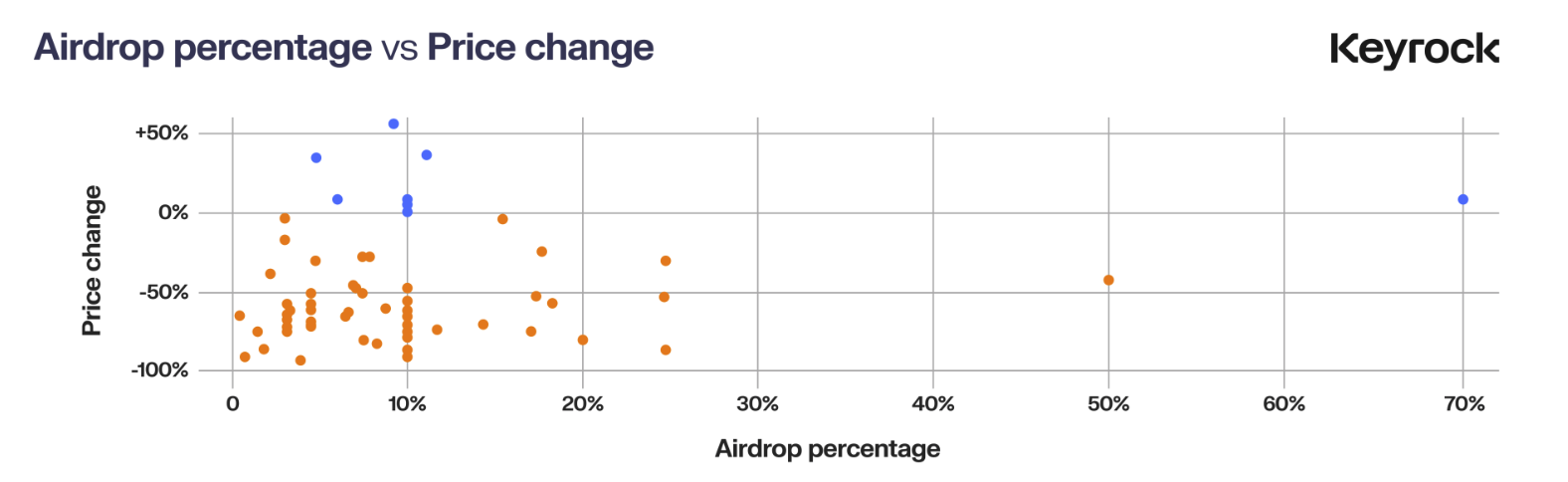
Một yếu tố quan trọng khác ảnh hưởng đến hiệu suất của airdrop là sự phân phối tổng nguồn cung token. Lượng token mà một giao thức quyết định phân phối có thể ảnh hưởng đáng kể đến hiệu suất giá của nó. Việc trao quyền cho người dùng nhiều token hơn có dẫn đến hành động giá tốt hơn không, hay nó tạo ra rủi ro bằng cách cho đi quá nhiều quá nhanh?

Có 3 nhóm quy mô airdrop và tác động của chúng đến giá token như sau:

Nguồn: Keyrock

Các đợt airdrop hào phóng hơn tạo ra sự đầu tư cao hơn từ phía người dùng, dẫn đến sự ổn định giá và tính bền vững tốt hơn theo thời gian. Trong khi đó, các airdrop nhỏ hơn có thể mang lại lợi nhuận ngắn hạn nhưng lại không giữ chân được người dùng. Các dự án có cộng đồng hoạt động trên các nền tảng như Discord và các tính năng đổi mới thường duy trì được đà phát triển tốt hơn.

Nguồn: Keyrock

Ảnh hưởng của giá trị pha loãng hoàn toàn (FDV)

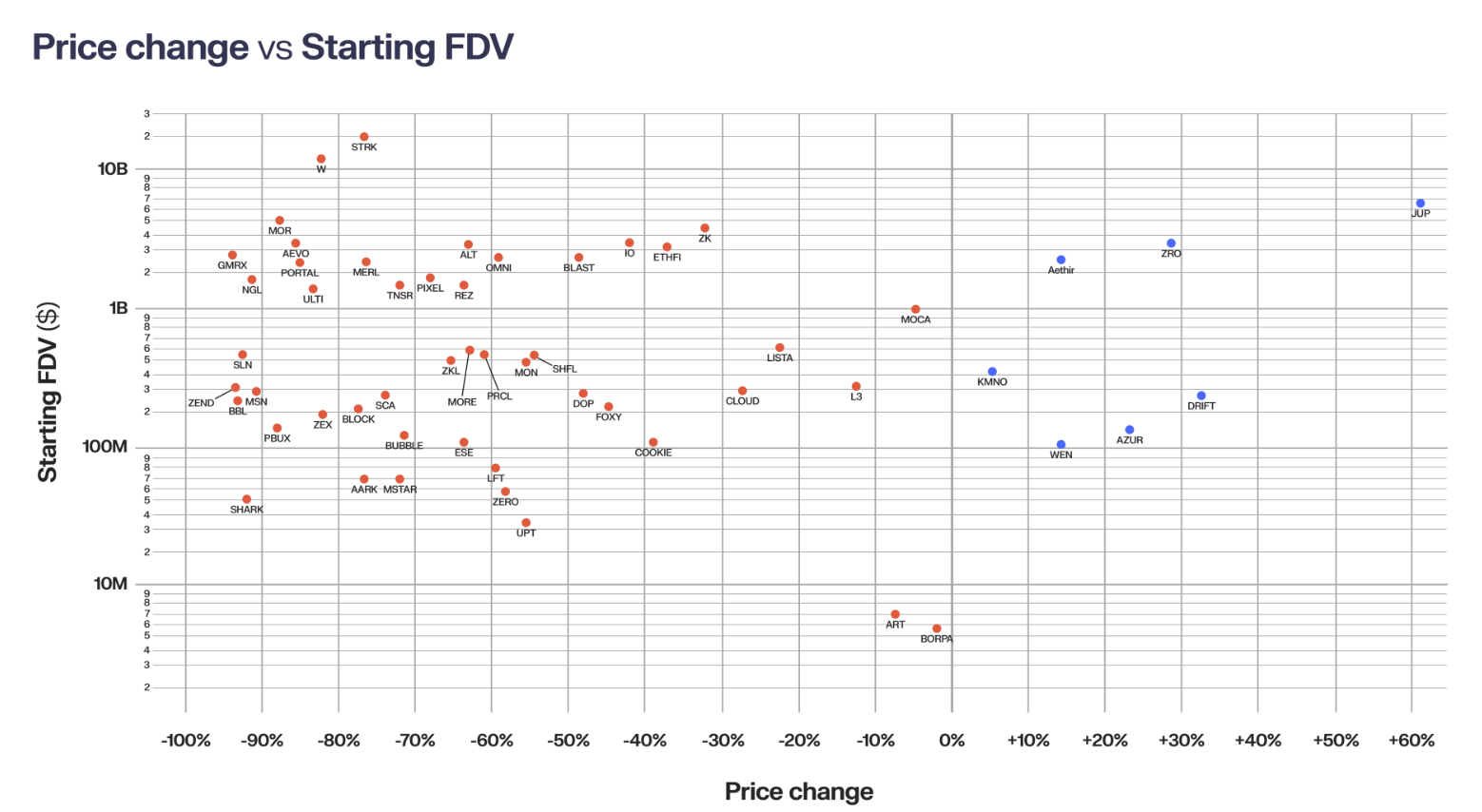
FDV cũng là một yếu tố quan trọng ảnh hưởng đến hiệu suất sau airdrop. Các token có FDV lớn thường gặp khó khăn trong việc duy trì giá trị, vì các nhà đầu tư có xu hướng ưa thích các dự án có tiềm năng tăng trưởng nhiều hơn. Các dự án với FDV cao thường thiếu thanh khoản cần thiết để duy trì giá trị thị trường, dẫn đến áp lực bán ra lớn và hiệu suất dài hạn kém. Các dự án có FDV thấp hơn, ngược lại, cho thấy sự sụt giảm giá ít hơn.

Nguồn: Keyrock

Kết luận

Airdrop trong năm 2024 vẫn là con dao hai lưỡi – dù có thể tạo ra sự phấn khích ban đầu, phần lớn không tạo ra giá trị lâu dài. Tuy nhiên, các dự án phân phối token hào phóng, gắn kết cộng đồng và ra mắt với FDV vừa phải có nhiều khả năng thành công lâu dài hơn.


Itadori

Theo Keyrock

Việc ra mắt các quỹ tài sản kỹ thuật số sẽ tăng vọt trong 12 tháng tới: Khảo sát

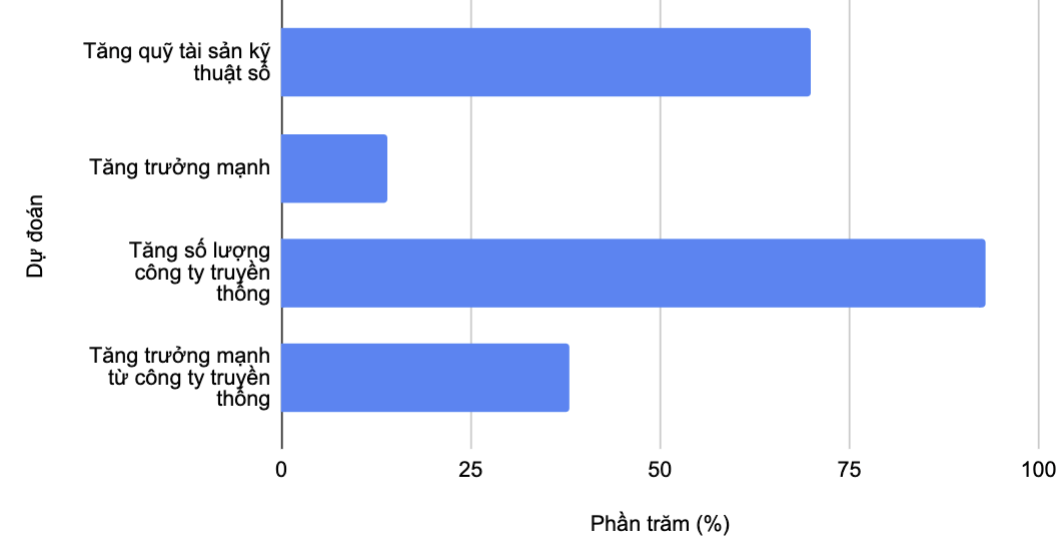
Các nhà đầu tư tổ chức và quản lý tài sản đang dự đoán một sự gia tăng đáng kể trong việc ra mắt các quỹ tài sản kỹ thuật số, với 70% số người được khảo sát kỳ vọng vào xu hướng này trong 12 tháng tới, trong đó 14% dự đoán sự tăng trưởng mạnh mẽ, theo nghiên cứu mới nhất từ Nickel Digital Asset Management.

Đáng chú ý, 92% người tham gia cũng tin rằng các tổ chức tài chính truyền thống sẽ tham gia vào lĩnh vực này bằng cách triển khai nguồn vốn của riêng họ.

Nguồn: Nickel Digital Asset Management

Nghiên cứu, được thực hiện với các nhà đầu tư tổ chức và quản lý tài sản tại Hoa Kỳ, Vương quốc Anh, Đức, Thụy Sĩ, Singapore, Brazil và Các Tiểu vương quốc Ả Rập Thống nhất, với tổng giá trị tài sản lên tới khoảng 1,7 nghìn tỷ đô la, nhấn mạnh rằng sự gia tăng này sẽ diễn ra đồng thời với sự tham gia ngày càng cao của các tổ chức tài chính truyền thống vào lĩnh vực tài sản kỹ thuật số.

Một yếu tố quan trọng thúc đẩy sự gia tăng này là thành công của quỹ BUIDL từ BlackRock.

“Đến 93% người được hỏi tin rằng số lượng công ty truyền thống ra mắt quỹ trong lĩnh vực này sẽ gia tăng trong ba năm tới, trong đó 38% dự đoán sẽ có sự tăng trưởng mạnh.”

Quỹ BUIDL, ra mắt trên mạng Ethereum vào tháng 3, đã thu hút được 500 triệu đô la tài sản được quản lý (AUM), và những người tham gia khảo sát dự đoán rằng quỹ này sẽ tăng trưởng đáng kể, với 95% kỳ vọng đạt 10 tỷ đô la vào năm 2025.

Anatoly Crachilov, Tổng giám đốc điều hành của Nickel Digital, nhận định:

“Khi lĩnh vực tài sản kỹ thuật số phát triển và các quỹ mới xuất hiện, rõ ràng là các nhà đầu tư tổ chức đang thúc đẩy sự mở rộng này.”


Annie

Theo Newsbitcoin

Crypto VC funding: SecondLive bags $12m, RD Technologies raises $7.8m

SecondLive and RD Technologies are the top two startups with the largest volume of fundraising for the week, the latest data shows.

While the amount of disclosed venture rounds this week was comparatively less than what was announced in recent weeks, crypto venture capital activity for the year is on pace to dethrone 2023’s total of $2.6 billion, according to PitchBook.

Some $2.2 billion had been raised as of July 30. The amount, raised across 24 funds, is still far behind 2022’s total of $22.7 billion.

Crypto.news compiled the data from Sept. 29 to Oct. 5 from Crypto Fundraising. Here’s what we found.

SecondLive, $12 million

  • SecondLive is a metaverse platform that lets users create their own avatars.
  • The firm has raised a total of $15 million so far.
  • The latest $12 million raised was in a private round led by Crypto.com.

RD Technologies, $7.8 million

  • RD Technologies is a fintech firm that has a primary focus on payments and commerce.
  • The firm has raised $7.8 million in a Series A round led by HongShan, HIVEMIND and Aptos Labs.

LAYER, $6 million

  • LAYER is an Ethereum (ETH) scaling solution that allows developers to write blockchain applications in various languages.
  • The firm recently raised $6 million in a seed funding round, which was led by 1Kx.

Synnax Technologies, $1.55 million

  • Synnax is a platform that introduced AI credit intelligence for privacy-focused credit analysis.
  • The firm has raised a total of $2.55 million so far.
  • The latest fund raised was $1.55 million in a round led by WINTERMUTE and Ton Ventures.

Sophon, not disclosed yet

  • Sophon provides an architecture for seamless handling of applications like gaming and socialfi.
  • The firm has raised a total of $70 million so far.
  • The latest amount invested by Binance Labs hasn’t been disclosed yet.

Read last week’s column here.

Tổng hợp và chỉnh sửa: ThS Phạm Mạnh Cường
Theo Crypto News

Popcat leads weekly gains with a 35% surge, open interest up 344%

Popcat emerged as the top gainer this week, driven by improved trader sentiment and a sharp rise in its futures open interest.

Popcat (POPCAT) rose over 35% in the last seven days, hitting a new all-time high of $1.26 on Oct. 5. Most of these gains came within the last 24 hours. the token rose 20.6% from its intraday low of $0.98. 

The Solana-based token was also up 112% over the past month, making it the second-largest gainer among the top 100 cryptocurrencies, boasting a market cap exceeding $1.2 billion, according to CoinGecko.

One of the key bullish arguments for Popcat is its widely distributed ownership, with large holders controlling just 17% of the total supply per CoinCarp data.

The same cannot be said for its competitors like Bonk (BONK) and Shiba Inu (SHIB), which are far more concentrated, with the top 10 wallets holding 52% and 61% of the supply, respectively.

This makes Popcat less vulnerable to “whale” manipulation and offers a more stable, balanced trading environment.

Bulls remain in control

The coin’s futures open interest is up 344% to a record $191.11 million, signaling that traders are heavily positioning for further price gains.

On the 1D POPCAT/USDT chart, the recent price action has pushed the token above the upper Bollinger Band, currently at $1.865, confirming the strong upward momentum. 

However, this also means that the token has reached an overbought zone. This is reinforced by the Commodity Channel Index spiking to 222.2, well above the 100 threshold that indicates overbought conditions.

POPCAT price, Bollinger Bands and CCI chart | Source: crypto.news

Although these technical signals suggest the potential for a market correction, the token’s successful retest of the upper Bollinger Band earlier today reinforces the idea that bulls remain in control.

This could point to continued upward momentum in the short term, although traders should still exercise caution due to the overbought indicators.

Price predictions

Trader sentiment on X aligned with the technical outlook as market observers pointed out that Popcat was in price discovery, meaning the token could print new highs soon.

According to analyst Altcoin Sherpa, Popcat has broken out of a key trading range, adding that as long as the price of Bitcoin remains stable, the upward trend could continue, potentially targeting the $2 mark. See below.

Another observer, Murad, offered an even more bullish outlook, predicting the meme coin could reach a price target of $5, a 300% surge from its current level of $1.24.

Meanwhile, another pseudonymous analyst, ‘TraderSz,’ noted that POPCAT breached a key resistance level of around $1.20 and is now heading towards the next major resistance at $1.50.

At the time of writing, Popcat was trading at $1.24. While it remains to be seen if the meme coin can hold this level, community sentiment appears optimistic, with data from CoinMarketCap showing that 69% of traders, out of 4,473 votes, are bullish on its future prospects.

As previously reported by crypto.news, crypto analysis firm Cryptonary predicted that Popcat could reach a price target of $40 during the current bull run, driven by strong community support, the so-called “meme coin supercycle,” and its growing prominence in the Solana ecosystem.

The creator of the Popcat meme coin hasn’t been explicitly named. The token’s popularity stems from a meme of a cat named Oatmeal chirping at a bug. The video, featuring alternating images of Oatmeal with its mouth open and closed, quickly turned into a GIF.

It eventually went viral. Students from the University of Sheffield in England created a Popcat-inspired game that revolves around clicking an image of Oatmeal to generate points.

Tổng hợp và chỉnh sửa: ThS Phạm Mạnh Cường
Theo Crypto News

Bitcoin ETF outflows surpass $300m, analysts warn of key price levels

Spot Bitcoin exchange-traded funds in the U.S. recorded outflows of over $300 million this week as global macroeconomic events sparked uncertainty over short-term direction.

After closing the historically bearish September with over $1.1 billion in inflows, roughly $388.4 million moved out of the 12-spot Bitcoin ETF funds between Oct. 1 and Oct. 3 coinciding with the escalating Iran-Israel conflict, which pushed Bitcoin’s price to a weekly low of $60,047.

On Oct. 4, better-than-expected U.S. payroll data brought some relief to the market, allowing Bitcoin to reclaim the $62,000 level, while ETF products saw $25.59 million in inflows. 

However, this recovery wasn’t enough to fully offset the impact of the three-day outflow streak. 

Since Sept. 13, three consecutive weeks of inflows brought in about $1.91 billion into spot Bitcoin ETFs, but this week’s outflows caused these funds to end the first week of October in negative territory, with $301.54 million flowing out, according to SoSoValue data.

Underlining the last trading day’s activity, Bitwise’s BITB saw the most inflows, while seven out of the twelve Bitcoin ETF products, including BlackRock’s IBIT, saw no movement.

  • Bitwise’s BITB led with inflows of $15.29 million.
  • Fidelity’s FBTC, $13.63 million.
  • ARK and 21Shares’ ARKB saw its first inflow this week, bringing in $5.29 million.
  • VanEck’s BTCW, $5.29 million.
  • Grayscale’s GBTC recorded outflows of $13.91.

Analysts point to key levels

Besides the ETF market, some selling pressure also came from Bitcoin miners, who, according to crypto analyst Ali, have offloaded approximately $143 million worth of Bitcoin (BTC) since Sept. 29. See below:

The selling activity could intensify, according to Ali, who pointed out in a subsequent X post that Bitcoin had been trading below the short-term holders’ realized price, which currently stands at $63,000.

This price represents the average cost at which short-term investors acquired their Bitcoin, and when the market dips below it, these holders are more inclined to sell in an attempt to minimize losses—risking a “cascading sell-off” that could exert further selling pressure.

As such, Ali advised investors to watch the $63,000 mark as the next key level that BTC needs to conquer to avoid further losses.

On the other hand, Crypto analyst Immortal pointed to a slightly higher short-term target of $64,000, adding that if the flagship cryptocurrency manages to break above this key resistance level, it could signal the beginning of a strong bullish move.

However, on a longer time frame, experts remain optimistic, citing Bitcoin’s historical Q4 performance and expectations of U.S. rate cuts, which could drive prices toward the $72,000 range despite short-term volatility.

BTC price chart | Source: crypto.news

At the time of writing, Bitcoin was hovering just above $62,200, marking a drop of over 5% in the past week.

Meanwhile, market sentiment appears to be picking up, with the Fear and Greed Index nudging back to a neutral 49, up from a more cautious 41 the previous day, per data from Alternative

Tổng hợp và chỉnh sửa: ThS Phạm Mạnh Cường
Theo Crypto News

TradFi, DeFi are like ‘two worlds’ converging: Zignaly co-founder

Abdul Rafay Gadit made a move that is still seldom done in the banking world: He jumped from traditional finance, or TradFi, to decentralized finance, or DeFi.

TradFi is highly regulated and emphasizes protecting consumers. Yet, it can be slow, costly, and restricted to money movers with access to banking services. With DeFi, anyone with internet access can participate. And while it’s generally faster and more accessible, it carries risks such as smart contract bugs, hacking, and little to no regulation.

“I believe we’re at a pivotal moment where the two worlds are beginning to converge,” Gadit tells crypto.news.

After spending six years in corporate banking at Standard Chartered, Gadit launched Zignaly (ZIG) in 2018. Since then, the platform amassed over 500,000 users and 150-plus portfolio managers. It also has a decentralized blockchain called ZIGChain in the works.

Read on for Gadit’s thoughts about the latest trends in social trading and how it can bridge the divide between TradFi and DeFi.

How have your experiences in TradFi influenced your approach to ZIGChain?

Gadit: My transition from corporate banking to blockchain was driven by a desire to innovate and challenge the traditional financial systems I had been part of for six years. Working at Standard Chartered gave me deep insight into the inefficiencies and limitations within traditional finance, especially regarding accessibility, transparency, and opportunities for wealth generation.

Blockchain presented an entirely new paradigm — one that empowers individuals to control their assets, make decentralized decisions, and participate in open financial ecosystems. Co-founding Zignaly allowed me to bring my banking background into action, focusing on creating a platform where everyone, regardless of their background, could invest alongside experienced traders and benefit from the opportunities in web3.

My experiences in traditional finance significantly influenced our approach. We aimed to take the best practices from the banking world — like risk management, compliance, and user protection — and merge them with the innovation and openness of blockchain. Our goal was to create an infrastructure that enables wealth generation in a more democratized, transparent, and accessible way for all users.

What is your long-term vision for ZIGChain?

Our long-term vision is to create a robust, scalable Layer 1 blockchain that powers a truly decentralized wealth generation ecosystem — a platform where builders, fund managers, and users can collaborate to create and utilize next-generation DeFi tools, dApps, and infrastructure that promote financial inclusion and wealth creation.

Our goal is to not only drive adoption but also establish ZIGChain as a cornerstone of the web3 financial landscape — where builders, fund managers, and users alike can thrive in a transparent, secure, and high-performance environment. With the backing of industry leaders and a clear focus on sustainability and innovation, we’re well-positioned to make this vision a reality.

ZIGChain launched a $100-million ecosystem development fund in August. Where will that capital go?

The $100 Million Ecosystem Fund — backed by DWF Labs, UDHC Finance, and Disrupt — is critical to realizing our vision. We plan to deploy these funds to attract top-tier developers and projects, offering them the resources and support needed to build innovative tools natively on ZIGChain. This funding will help accelerate the growth of our ecosystem by fostering innovation, expanding our infrastructure, and creating incentives for key participants.

What are the most significant challenges in managing such a large social investment platform?

One of the key challenges we’ve faced with Zignaly is the limited access to asset classes. As of now, fund managers on our platform can only invest in tokens listed on centralized exchanges, which restricts the investment opportunities available to our users. However, with ZIGChain, we’re opening the doors to a much broader range of assets, including DeFi, real-world assets, NFTs, perpetual contracts, and tokens across multiple chains. This flexibility not only offers fund managers more options but also creates more diverse and profitable investment strategies for our users, ultimately increasing yield potential.

We’ve also encountered limitations within centralized finance, or CeFi, such as mandatory KYC processes and restricted access based on users’ nationality. These requirements can limit the participation of global users and create scalability concerns. ZIGChain, being a decentralized blockchain, circumvents many of these barriers. It enables a more inclusive and scalable system that allows users to participate without the stringent restrictions often imposed by centralized platforms. This makes ZIGChain accessible to a broader audience, ensuring that we can scale the platform to meet the growing demand.

Another limitation we’ve faced on Zignaly is the reliance on CeFi traders. Currently, we’re limited to fund managers and traders within centralized exchanges, but with ZIGChain, we unlock a whole new realm of DeFi traders. This opens up access to innovative DeFi strategies and products that weren’t previously available on Zignaly. By tapping into the DeFi space, we can significantly improve yield potential for our users, increase overall profitability, and diversify revenue streams for the business. This not only enhances the user experience but positions ZIGChain as a more dynamic and adaptable platform in the ever-evolving web3 landscape.

Given your background in corporate banking, how do you see the intersection of TradFi and DeFi evolving?

My background in corporate banking has given me a unique perspective on the potential synergy between traditional finance and decentralized finance. I believe we’re at a pivotal moment where the two worlds are beginning to converge, and this intersection presents immense opportunities for innovation and financial inclusion.

TradFi has long been the backbone of the global economy, with established frameworks for risk management, compliance, and trust. However, it also comes with limitations—restricted access to wealth-generating opportunities, high barriers to entry, and slow innovation. DeFi, on the other hand, offers openness, inclusivity, and decentralization, providing users with direct control over their assets and access to a broader array of financial products like staking, lending, and tokenized real-world assets.

As this synergy evolves, I see traditional institutions increasingly integrating DeFi solutions to improve efficiency and offer new services to their clients. This could include everything from tokenized assets and decentralized lending to programmable smart contracts for automating complex financial processes.

By building an ecosystem that combines the security and regulatory rigor of TradFi with the innovation and transparency of DeFi, we can create a more accessible and flexible financial system. I envision a future where users seamlessly move between traditional and decentralized financial products, unlocking new opportunities for wealth creation and financial empowerment on a global scale.

Does Zignaly compete with other social investing platforms?

At Zignaly, we don’t see ourselves in direct competition with other social investing platforms. Instead, we focus on competing with our vision to continually evolve and expand access to fund management for everyone. Our goal is to democratize wealth generation, ensuring that anyone, regardless of their financial background, can connect with professional fund managers and access a broad range of asset classes.

While other platforms may limit themselves to centralized systems or traditional investment assets, we’re pushing the boundaries by integrating DeFi, RWAs, NFTs, and more through ZIGChain. Our mission is to break down the barriers that have long excluded people from managing their wealth and open up a world of opportunity where access to financial growth is no longer a privilege, but a right for all.

So, in essence, our biggest competition is our own ambition to redefine what’s possible in the world of decentralized finance and fund management

What trends do you foresee in social investing?

Over the years, we’ve seen a strong demand for transparency, performance-driven strategies, and diversified asset classes. The key trend we’re observing in social investing is a shift toward decentralized platforms and more innovative investment opportunities, especially as users become increasingly aware of the benefits of DeFi and tokenized assets.

In the coming years, I foresee a growing demand for personalized investment strategies, where users won’t just follow a portfolio manager based on their past performance but will have access to real-time, dynamic strategies tailored to individual risk profiles, preferences, and goals. We also expect more integration with decentralized asset classes offering users an unprecedented level of diversification.

How does one stay ahead of the web3 curve?

To stay ahead in the web3 space, we’re constantly innovating. With ZIGChain, we’re creating a platform that not only offers access to a much wider range of assets beyond centralized exchanges but also introduces features like automated, trustless smart contract-based fund management, which significantly enhances security and transparency. We’re also building our infrastructure to accommodate more DeFi portfolio managers, allowing them to bring strategies and tools to our users. This will not only improve profitability for our users but also attract a new generation of traders to the platform.

Our goal is to lead the way in the evolution of social investing by staying decentralized, offering access to new and diverse asset classes, and continuing to prioritize security, transparency, and user experience.

Tổng hợp và chỉnh sửa: ThS Phạm Mạnh Cường
Theo Crypto News

Exit mobile version