Gần 1/3 tổng số Ethereum (ETH) đã được stake khi các holder thể hiện sự quan tâm lâu dài đối với tiền điện tử này và phần thưởng mà họ có thể nhận được.
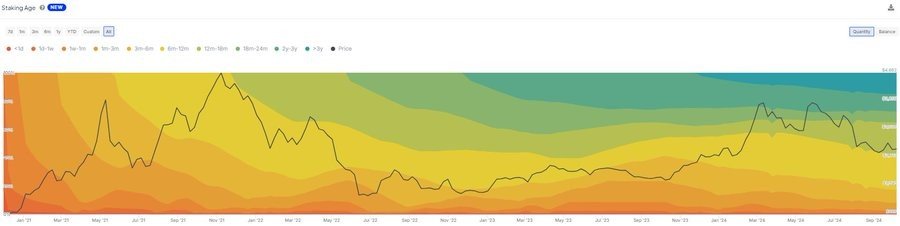
Vào ngày 8/10, nhà cung cấp dữ liệu on-chain IntoTheBlock đã chia sẻ rằng 28,9% trong tổng số ETH hiện đã được stake. Nền tảng dữ liệu này nhấn mạnh tỷ lệ stake ETH vào tháng 1 là 23,8%. Như vậy, có thêm 5,1% trong tổng số ETH đã được stake trong 10 tháng qua.
Theo IntoTheBlock, 15,3% ETH đã được stake trong hơn 3 năm. Nhà cung cấp dữ liệu tin rằng đây là tín hiệu mạnh mẽ về “niềm tin dài hạn” vào tương lai của Ethereum.
Giá ETH giảm mặc dù số lượng staking tăng
Bất kể hoạt động staking ETH được quan tâm nhiều hơn, giá của coin này không cho thấy tín hiệu lạc quan. Mặc dù ETH thể hiện sức mạnh to lớn trong nửa đầu năm 2024, giá phải đối mặt với một số thách thức vào tháng 10.
Vào ngày 12/3, ETH đã đạt mức cao nhất trong năm, giao dịch trên 4.000 đô la. Tuy nhiên, tài sản này giảm 40% kể từ tháng 3, khi dao động quanh mức 2.440 đô la tại thời điểm viết bài.
Biểu đồ giá ETH 1 ngày | Nguồn: Tradingview
Các nhà phân tích tin rằng áp lực bán từ những người tham gia ICO và thiếu nhu cầu đối với các quỹ Ethereum ETF giao ngay có lẽ đã góp phần gây giảm giá gần đây.
Từ ngày 1/10 đến ngày 3/10, giá ETH đã giảm 12% sau khi không vượt qua được mức 2.650 đô la. Tâm lý bi quan đã xóa sạch lợi nhuận của tài sản này trong hai tuần qua.
Hạ thấp yêu cầu staking solo
Trong khi đó, đồng sáng lập Ethereum Vitalik Buterin gần đây đã ủng hộ ý tưởng hạ thấp yêu cầu cho staking solo.
Vào ngày 3/10, Buterin đã tham gia một cuộc thảo luận trên X về staking solo. Đồng sáng lập Ethereum nhận ra tầm quan trọng của việc hạ thấp yêu cầu ETH tối thiểu để các nhà đầu tư kiếm được tiền bằng cách staking đơn lẻ.
Trong khi những người dùng có ít tiền có thể tìm đến staking pool, những người nắm giữ muốn staking riêng sẽ cần 32 ETH, trị giá gần 80.000 đô la. Trong một bài đăng, Buterin thừa nhận rằng điều này có thể là rào cản đối với việc tham gia staking rộng rãi hơn.
Tether, công ty đứng sau stablecoin USDT, thông báo đã vượt mốc 350 triệu người dùng vào ngày 7/10, chỉ 10 năm sau khi ra mắt vào năm 2014.
Số lượng người dùng USDT tăng 24% trong 12 tháng qua, cho thấy họ có khoảng 282 triệu người dùng vào tháng 10/2023. Trước đó, vào năm 2022, số lượng người dùng chỉ là khoảng 141 triệu.
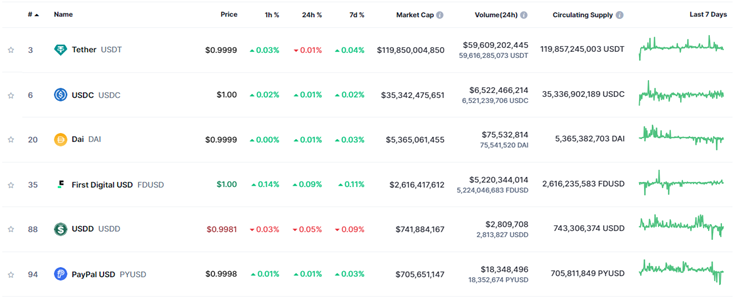
Tuy Tether không phải là stablecoin đầu tiên (danh hiệu đó thuộc về BitUSD và NuBits) nhưng hiện nắm giữ vốn hóa thị trường cao nhất trong số tất cả các stablecoin với biên độ lớn.
Theo CoinMarketCap, vốn hóa thị trường của USDT là 119,8 tỷ đô la.
Các stablecoin hàng đầu theo vốn hóa thị trường | Nguồn: CoinMarketCap
Theo Tether, vị thế của công ty trên thị trường stablecoin mang lại lợi ích cho các tài sản kỹ thuật số cũng như đô la Mỹ.
Công ty cho biết “lượng trái phiếu kho bạc Hoa Kỳ đáng kể mà công ty nắm giữ càng củng cố thêm ảnh hưởng toàn cầu của đồng đô la, củng cố USDT như một đại diện kỹ thuật số đáng tin cậy của tiền dự trữ thế giới”.
“Tính đến Bản chứng thực quý 2/2024, Tether đã mua trực tiếp và gián tiếp hơn 97 tỷ đô la trái phiếu kho bạc Hoa Kỳ. Điều này khiến Tether trở thành một trong 20 người mua trái phiếu kho bạc Hoa Kỳ lớn nhất, vượt qua lượng nắm giữ của các quốc gia như Đức, Các Tiểu vương quốc Ả Rập Thống nhất và Úc”.
Như đã đưa tin gần đây, công ty đang kỷ niệm 10 năm thành lập và sẽ sớm ra mắt một bộ phim tài liệu về hành trình của mình trong thập kỷ qua, trong đó có các cuộc phỏng vấn với những người được cho là cuộc sống của họ thay đổi nhờ stablecoin này.
Phần lớn trong số 350 triệu người dùng của công ty dường như đạt được trong vài năm qua, cho thấy tỷ lệ chấp nhận có khả năng đang tăng tốc.
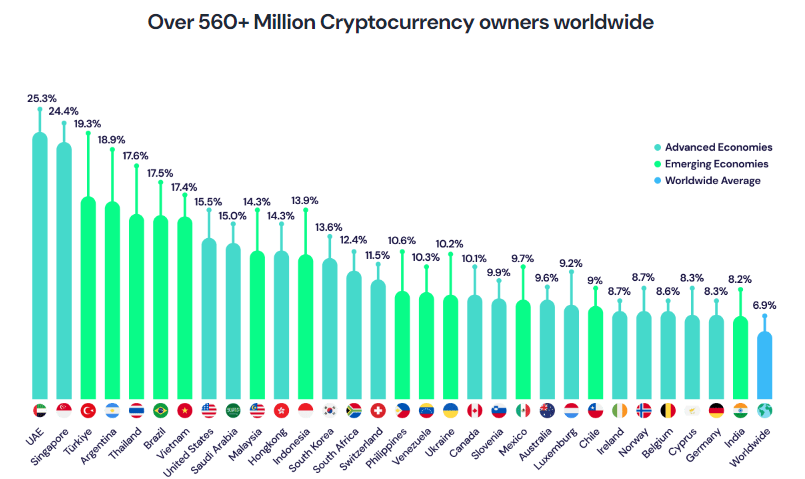
Một nghiên cứu của AAA trong năm nay ước tính có hơn 560 triệu người dùng tiền điện tử trên toàn thế giới trong khi báo cáo của AAA từ năm 2023 cho thấy có khoảng 420 triệu người dùng toàn cầu.
Các nhà phân tích của JPMorgan đã xác định một số yếu tố quan trọng ảnh hưởng đến thị trường tiền điện tử trong những tháng tới, trích dẫn các sự kiện kỹ thuật, địa chính trị và cấu trúc có thể thúc đẩy biến động giá.
Trong một báo cáo nghiên cứu được công bố vào thứ 2, các nhà phân tích đã thảo luận về tác động của xu hướng “Uptober” theo mùa, việc cắt giảm lãi suất của Cục Dự trữ Liên bang Hoa Kỳ (Fed), quyết định chấp thuận Bitcoin options ETF và bản nâng cấp Pectra sắp tới của Ethereum.
Tháng 10 có xu hướng là tháng tăng giá đối với tiền điện tử
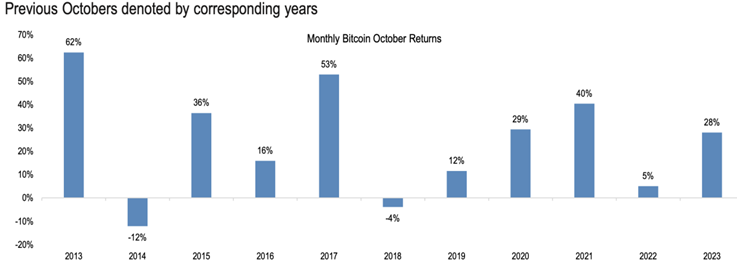
Một trong những điểm chính của báo cáo là xu hướng lịch sử về hiệu suất mạnh mẽ của tháng 10, thường được gọi là “Uptober”. Các nhà phân tích nhấn mạnh hơn 70% trong số tất cả các tháng 10 đã mang lại lợi nhuận tích cực cho Bitcoin.
Các nhà phân tích viết:
“Mặc dù hiệu suất trước đó không phải là yếu tố dự báo hiệu suất trong tương lai, nhưng chúng tôi cho rằng sự phổ biến của Uptober có thể ảnh hưởng đến hành vi và tạo ra một tháng tích cực cho Bitcoin vào tháng 10 này”.
Xu hướng giá Bitcoin trong tháng 10 của thập kỷ qua | Nguồn: Bloomberg Finance
Chu kỳ cắt giảm lãi suất của Fed vẫn chưa ảnh hưởng đến vốn hóa thị trường tiền điện tử
Bất chấp việc Fed cắt giảm lãi suất gần đây, các nhà phân tích của JPMorgan lưu ý thị trường tiền điện tử nói chung vẫn chưa thấy tác động tích cực như mong đợi. Trong khi môi trường lãi suất giảm thường hỗ trợ các tài sản rủi ro, thì mối tương quan giữa tổng vốn hóa thị trường crypto và lãi suất Quỹ Liên bang vẫn yếu ở mức 0,46.
“Giá vẫn chưa tăng giá như dự kiến của chúng tôi kể từ khi Fed cắt giảm lãi suất vào ngày 18 tháng 9”, họ viết, đồng thời nói thêm rằng thị trường có thể đang chờ sự ổn định bền vững hơn trước khi thay đổi dứt khoát.
Hơn nữa, các nhà phân tích thừa nhận thiếu dữ liệu lịch sử làm phức tạp thêm việc đưa ra dự đoán chắc chắn về cách tiền điện tử phản ứng với các chu kỳ lãi suất.
“Tiền kỹ thuật số thực sự chỉ mới xuất hiện từ đầu đến giữa những năm 2010 và lãi suất gần bằng 0 trong hầu hết thời gian tồn tại của chúng. Có khả năng lãi suất ổn định, thay vì chỉ lãi suất thấp, sẽ mang lại lợi ích nhiều nhất cho các thị trường này”.
Quyền chọn Bitcoin ETF có thể làm tăng thanh khoản của thị trường
Một chất xúc tác tiềm năng khác là chấp thuận giao dịch quyền chọn trên Bitcoin ETF giao ngay gần đây. Các nhà phân tích kỳ vọng điều này có thể làm tăng thanh khoản và thu hút những người tham gia mới vào thị trường.
“Với quyền chọn, nhà đầu tư hiện có cách năng động hơn để tham gia vào ETF và thúc đẩy thanh khoản cho tài sản cơ bản”.
Họ nói thêm rằng sự phát triển này có thể khởi đầu một vòng phản hồi tích cực, nâng cao cấu trúc thị trường và giúp các nhà đầu tư tổ chức dễ tiếp cận hơn với tài sản kỹ thuật số.
Vào giữa tháng 9, Ủy ban Chứng khoán và Giao dịch Hoa Kỳ (SEC) đã chấp thuận niêm yết và giao dịch các quyền chọn cho ETF giao ngay iShares Bitcoin Trust của BlackRock trên Nasdaq. Tuy nhiên, việc chấp thuận cuối cùng vẫn phụ thuộc vào Options Clearing Corporation (OCC) và Ủy ban Giao dịch Hàng hóa Tương lai Hoa Kỳ (CFTC).
Bản nâng cấp Pectra có thể có tác động lâu dài đến Ethereum
Bản nâng cấp Ethereum sắp tới, được gọi là “Pectra“, cũng là một phát triển lớn. Pectra kết hợp các bản cập nhật Prague và Electra, sẽ triển khai hơn 30 Đề xuất cải tiến Ethereum (EIP) để cải thiện hiệu quả mạng, hoạt động xác thực và mở rộng trừu tượng hóa tài khoản.
“Mặc dù Pectra được kỳ vọng sẽ mang tính chuyển đổi cho chức năng của Ethereum, chúng tôi coi bản nâng cấp này mang tính cấu trúc hơn là chất xúc tác giá tức thời”, các nhà phân tích cho biết. Họ thấy tác động dài hạn của Pectra là thúc đẩy hiệu quả hoạt động của Ethereum và khả năng chấp nhận nhưng không có khả năng kích hoạt tăng giá ETH trong ngắn hạn.
Nhìn chung, các nhà phân tích của JPMorgan kết luận rằng thị trường tiền điện tử đang trong giai đoạn giữ nguyên, chờ đợi chất xúc tác kinh tế vĩ mô hoặc cấu trúc rõ ràng hơn để thúc đẩy tăng trưởng bền vững.
“Chúng tôi tiếp tục thấy hệ sinh thái crypto ngày càng nhạy cảm hơn với các yếu tố vĩ mô, vì vậy, chúng tôi chờ đợi chất xúc tác lớn tiếp theo để phát triển và tăng cường sự tham gia của nhà bán lẻ nhằm mang lại sự tăng trưởng lâu dài cho hệ sinh thái”, họ cho biết.
QCP Capital: Uptober trở lại đúng hướng
Câu chuyện “Uptober” lạc quan của tháng 10 dường như đang lấy lại động lực, với Bitcoin đạt mức cao nhất trong ngày gần 64.000 đô la trong 24 giờ qua trước khi giảm trở lại và hiện ở quanh mức 62.400 đô la, theo các nhà phân tích.
“Sau khởi đầu bất ổn, Uptober dường như đã trở lại đúng hướng, với Bitcoin giữ vững ở mức tương tự như mức bắt đầu vào thứ 2 tuần trước. Do sẽ có thêm các đợt cắt giảm lãi suất khác và mối tương quan mạnh mẽ của Bitcoin với cổ phiếu, chúng tôi vẫn lạc quan về tháng 10 mạnh mẽ”, các nhà phân tích từ QCP Capital cho biết.
Câu chuyện Uptober hình thành từ việc tháng 10 thường là tháng mạnh mẽ đối với BTC, đạt mức tăng trung bình gần 30% trong tháng trong 8 trên 9 năm qua.
Các nhà phân tích cũng chỉ ra các động lực vĩ mô tiềm năng bắt nguồn từ dữ liệu Bảng lương phi nông nghiệp (NFP) mạnh mẽ gần đây tại Hoa Kỳ.
“Các số liệu việc làm đã giúp Bitcoin tìm thấy mức hỗ trợ mạnh mẽ trên 60.000 đô la”.
NFP của Hoa Kỳ đã vượt ước tính của các nhà phân tích với biên độ đáng kể, đạt mức cao nhất trong bốn tháng là 254.000, so với ước tính 147.000. Dữ liệu từ tháng trước cũng được điều chỉnh tăng 17.000, đưa lên 159.000. Ngoài ra, tỷ lệ thất nghiệp đã giảm xuống 4,1%, thấp hơn mức dự kiến 4,2%.
Theo QCP Capital, các nhà đầu tư hiện sẽ theo dõi chặt chẽ dữ liệu Chỉ số giá tiêu dùng của Hoa Kỳ sẽ được công bố vào thứ 5 này. Với số liệu việc làm và tiền lương mạnh mẽ gần đây của Hoa Kỳ từ tuần trước, các nhà phân tích cho biết thị trường sẽ chú ý đến số liệu của thứ 5 để nhận biết bất kỳ dấu hiệu nào cho thấy lạm phát đang hạ nhiệt.
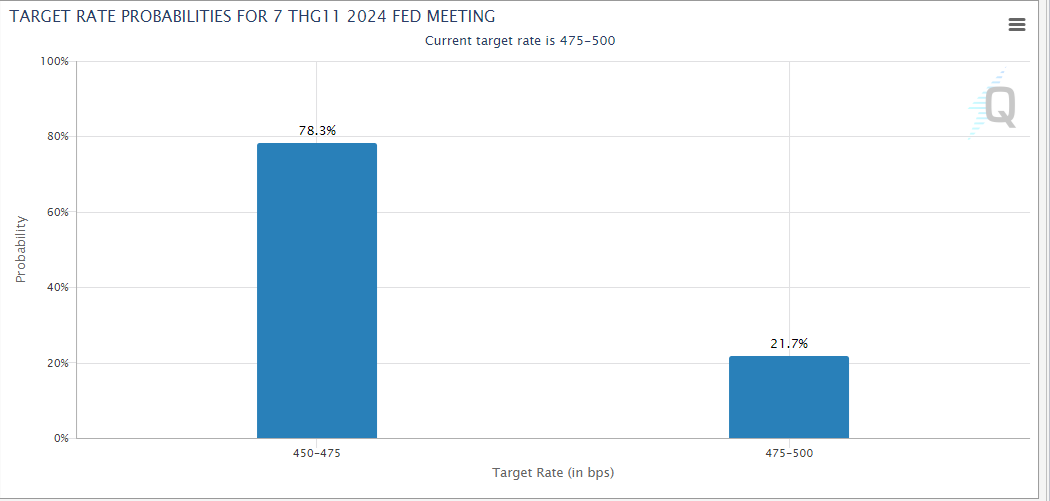
Dữ liệu kinh tế vĩ mô tích cực gần đây có thể đã làm thay đổi kỳ vọng của các trader lãi suất về quy mô cắt giảm lãi suất tiềm năng của ngân hàng trung ương Hoa Kỳ tại cuộc họp tiếp theo của Ủy ban Thị trường Mở Liên bang Hoa Kỳ (FOMO) vào ngày 7/11. Theo công cụ FedWatch của CME, các trader lãi suất hiện đang ủng hộ khả năng cắt giảm 50 điểm cơ bản là 78,3%, so với khả năng cắt giảm 25 điểm cơ bản là 21,7% tại cuộc họp chính sách vào tháng tới.
Nguồn: FedWatch
Trên thị trường phái sinh, các nhà phân tích của QCP Capital lưu ý rằng việc phân phối các quyền chọn vẫn cho thấy triển vọng tăng giá trong quý 4.
“Bất chấp khởi đầu khó khăn vào tuần trước, dòng quyền chọn vẫn đang hướng đến quý 4 tăng giá, vì chúng tôi tiếp tục thấy người mua chênh lệch giá thực tháng 12 là 75.000 đô la và 95.000 đô la”.
Theo các nhà phân tích của Bernstein, cổ phiếu của Microstrategy dự kiến sẽ tăng vọt 64%, được thúc đẩy bởi chiến lược đầu tư Bitcoin táo bạo của công ty. Cách thức lãnh đạo của Michael Saylor và lượng BTC khổng lồ mà công ty nắm giữ (trị giá 16 tỷ đô la) đóng vai trò quan trọng trong hiệu suất của công ty. Tuy nhiên, những thách thức như lỗ ròng và biến động của Bitcoin có thể làm phức tạp thêm dự báo này, mặc dù mục tiêu dài hạn là 1 triệu đô la cho mỗi BTC vào năm 2033.
Dự báo cổ phiếu của Microstrategy: Một vụ cá cược Bitcoin với rủi ro lớn
Công ty nghiên cứu và tư vấn đầu tư toàn cầu Bernstein dự đoán cổ phiếu của công ty cung cấp phần mềm Microstrategy (Nasdaq: MSTR) sẽ tăng 64% lên 290 đô la, nhờ chiến lược Bitcoin mạnh mẽ của công ty. Tính đến thời điểm viết bài, MSTR đang giao dịch ở mức 191,09 đô la.
Các nhà phân tích của Bernstein là Gautam Chhugani, Mahika Sapra và Sanskar Chindalia chỉ ra rằng sự lãnh đạo của Michael Saylor đóng vai trò quan trọng đối với hiệu suất của công ty. Họ đã viết trong một báo cáo được công bố vào thứ 2:
“Michael Saylor là người tiên phong trong mô hình kho bạc Bitcoin dành cho các công ty”.
Microstrategy đã tích lũy được khoảng 252.220 BTC. Công ty bắt đầu mua vào năm 2020 và tiếp tục mở rộng lượng nắm giữ, thu hút sự chú ý của những người theo dõi thị trường.
Dự báo lạc quan của Bernstein dựa trên giả định BTC sẽ đạt 1 triệu đô la vào năm 2033 và Microstrategy tiếp tục chiến lược tích lũy của mình. Vào tháng 6, các nhà phân tích của Bernstein đã cập nhật dự đoán giá của họ, nâng cao kỳ vọng. Họ dự đoán Bitcoin có thể đạt 200.000 đô la vào năm 2025, 500.000 đô la vào năm 2029 và 1 triệu đô la vào năm 2033.
Các nhà phân tích đã lưu ý trong báo cáo hôm thứ 2:
“Kể từ khi áp dụng chiến lược Bitcoin vào tháng 8/2020, cổ phiếu của MSTR đã tăng khoảng 13 lần, vượt trội hơn Bitcoin, vàng, S&P, Nasdaq, phần mềm vốn hóa nhỏ”.
Kết quả tài chính của Microstrategy trong quý 2/2024 cho thấy tổng lợi nhuận là 80,5 triệu đô la, giảm so với mức 93,3 triệu đô la kiếm được trong quý 2/2023. Chi phí hoạt động tăng vọt lên 280,8 triệu đô la, chủ yếu do khoản lỗ suy giảm giá trị đáng kể 180,1 triệu đô la từ các khoản đầu tư Bitcoin. Do đó, công ty báo cáo khoản lỗ ròng là 102,6 triệu đô la.
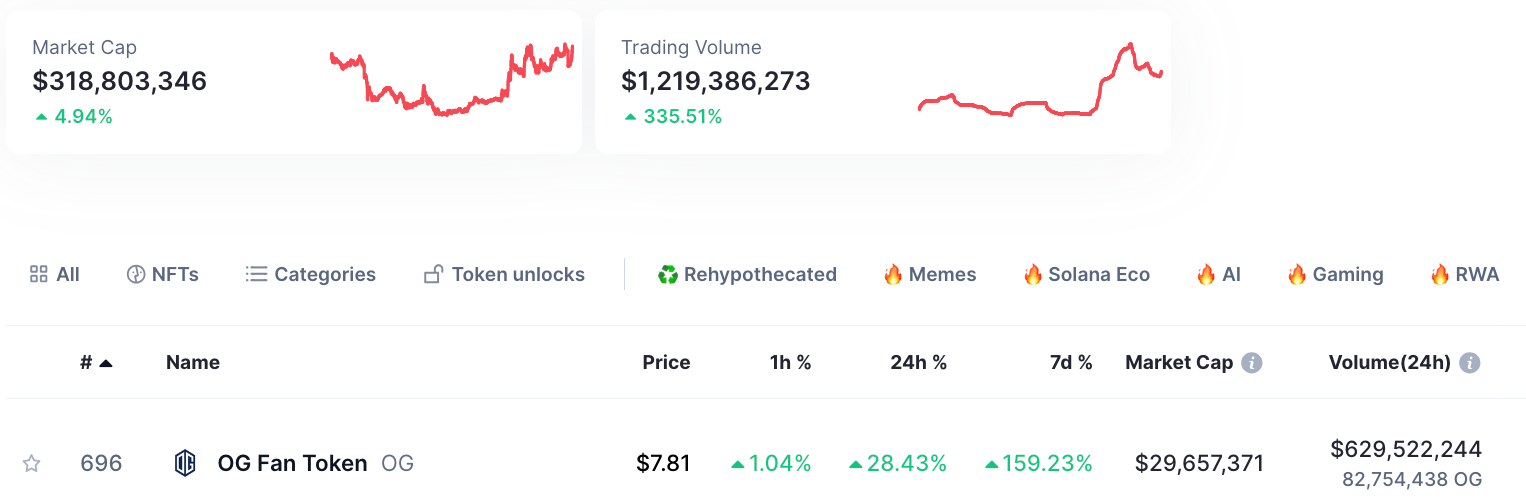
Khối lượng giao dịch trong 24 giờ của các token tiền điện tử dành cho người hâm mộ đã vượt qua ngưỡng 1 tỷ đô la, trong đó token của OG Esports trên Chiliz chiếm hơn một nửa tổng khối lượng.
Theo dữ liệu từ CoinMarketCap, khối lượng giao dịch của các fan token này đã tăng vọt hơn 335% trong ngày qua, đạt 1,21 tỷ đô la, trong khi vốn hóa thị trường của phân khúc cũng tăng 4,9% lên 318,8 triệu đô la.
OG Fan Token, dành riêng cho người hâm mộ đội thể thao điện tử chuyên nghiệp có trụ sở tại Châu Âu OG, là yếu tố chính góp phần vào đà tăng trưởng này. Trong 24 giờ qua, hơn 82 triệu token OG đã được giao dịch, tương đương với khối lượng khoảng 629 triệu đô la.
Nguồn: Coinmarketcap
Trên sàn giao dịch Binance, cặp giao dịch OG-USDT ghi nhận khối lượng khoảng 282,33 triệu đô la, vượt qua khối lượng giao dịch của các token lớn như Toncoin và Cardano.
Giá của token OG cũng đã tăng 28% trong 24 giờ qua và đạt mức tăng tổng cộng khoảng 159% trong vòng một tuần, hiện giao dịch ở mức 7,8 đô la. Một số fan token khác cũng ghi nhận mức tăng trưởng đáng kể, như token của Santos FC với mức tăng 35% lên 4 đô la, và token của Alpine F1 tăng 10%, giao dịch ở mức 1,4 đô la.
Fan token là loại tiền điện tử cho phép người hâm mộ tham gia vào quá trình ra quyết định của đội thể thao hoặc giải đấu yêu thích. Những tài sản kỹ thuật số này thường mang lại các lợi ích độc quyền, chẳng hạn như quyền bỏ phiếu cho hàng hóa của đội hoặc tham gia vào các sự kiện đặc biệt.
Cross-chain interoperability protocol deBridge has launched deBridge Hooks to enable real-time, multi-chain data transfer across the decentralized finance ecosystem.
DdeBridge introduced the new feature in an Oct. 8 announcement, noting that the deBridge Hooks rollout will benefit developers and protocols seeking cross-chain communication.
What are deBridge Hooks?
With deBridge Hooks, users such as market makers can now benefit from near-instant distribution of assets, user registration, onboarding processes, and experiences. Hooks will also boost efficiency across decentralized finance applications.
Applications running on one chain can receive deposits from another network — for instance, from Solana (SOL) based lending protocol Kamino to Ethereum (ETH). DeBridge Hooks allows these transfers to occur within a single transaction, improving protocols’ success-to-bounce ratio, the platform explained in a blog post.
DeBridge Hooks also unlocks use cases in risk management, enabling users to quickly withdraw funds from one protocol and deposit them on another to avoid risks on platforms like (AAVE).
Integration with BNB Chain
On Aug. 28, deBridge announced that it had integrated BNB Smart Chain to allow access to the BNB Chain’s bridge aggregator. The partnership opened up BNB Smart Chain users to real-time value transfers and institutional liquidity.
In September, deBridge hit milestones, including the deBridge Foundation’s introduction of claim-to-centralized exchange flow. This allowed users to queue their claims for centralized exchange platforms such as Bybit, KuCoin, MEXC, and Gate.io.
The platform also reached more than $4 billion in volume and became a market maker for Bitcoin on Solana.
Vào thứ 3, sàn giao dịch Crypto.com tuyên bố đã đệ đơn kiện Ủy ban Chứng khoán và Giao dịch Hoa Kỳ (SEC) sau khi nhận được thông báo về hành động pháp lý sắp tới từ cơ quan quản lý này.
Trong bài đăng chia sẻ tin tức, Crypto.com cho biết họ đã nhận được Wells Notice* từ SEC, thông báo cơ quan có kế hoạch thực hiện hành động pháp lý đối với những gì họ tin là hành vi vi phạm chứng khoán của công ty.
“Quyết định kiện SEC của chúng tôi được đưa ra sau khi chúng tôi nhận được Wells Notice từ nhân viên của Ủy ban. Điều này cho thấy chiến dịch quản lý bằng thực thi trái phép và bất công của SEC vẫn tiếp diễn mặc dù có dấu hiệu từ lưỡng đảng ngụ ý Chính quyền tiếp theo sẽ có cách tiếp cận mang tính xây dựng và hiệu quả hơn để thúc đẩy tiền điện tử tại Hoa Kỳ.
Hiện nay, SEC đang tạo ra quy trình quản lý doanh nghiệp tiền điện tử hợp pháp ở Hoa Kỳ bằng các hành động thực thi. Mặc dù việc kiện một cơ quan liên bang là bước đi chưa từng có đối với công ty chúng tôi, nhưng những hành động của cơ quan này đối với ngành đã buộc chúng tôi phải thực hiện lựa chọn này”.
*Wells Notice là một thông báo từ SEC cho biết họ có kế hoạch khảo sát một cá nhân hoặc tổ chức cụ thể để xác định xem liệu họ có vi phạm luật chứng khoán hay không. Thông thường, Wells Notice được gửi trước khi SEC ra quyết định chính thức về việc khởi tố một cuộc điều tra hay thủ tục pháp lý khác. Wells Notice cung cấp cơ hội cho cá nhân hoặc tổ chức nhận được thông báo trình bày bất kỳ lý do hoặc bằng chứng nào để bảo vệ mình trước khi quyết định cuối cùng được đưa ra.
TON ecosystem tokens recently listed on major crypto exchanges have significantly dropped.
Table of Contents
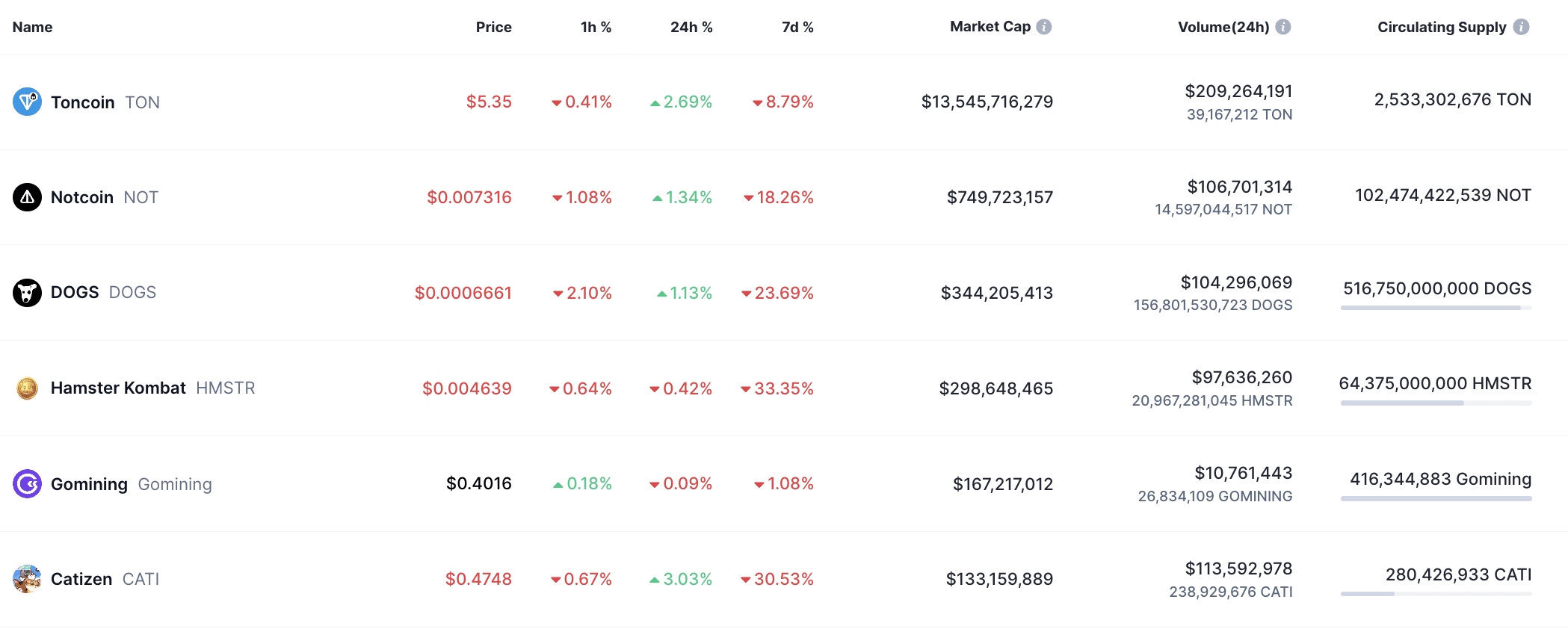
The largest tokens by market capitalization in the TON ecosystem have seen a sharp decline in the past few days. Relative to the all-time high (ATH), the drop has reached 30-50%.
Notably, many of them were recently listed on major crypto exchanges. These include Dogs (DOGS), Hamster Kombat (HMSTR), and Catizen (CATI). The Toncoin (TON) token has also dropped significantly — more than 8% in a week.
Top TON ecosystem tokens by market capitalization | Source: CoinMarketCap
The market capitalization of the TON ecosystem tokens continues to decline — trading volumes fell by more than 27% to $675 million. The ratio of buy and sell orders on the Binance crypto exchange suggests that traders are rushing to get rid of once-coveted tokens.
DOGS plummeted by 58%, but developers have a plan B
Since its listing on Aug. 26, the DOGS token, 81.5% of which was supplied by the community, has plummeted by more than 58% to $0.0006599. It is noteworthy that there is no vesting period, therefore users were able to trade their DOGS immediately after the airdrop and, as a result, sell them immediately after the listing.
Amid the late token price collapse at the end of September, the DOGS team announced an upcoming token burn to reduce the total DOGS. Typically, token burning aims to increase its value — the number of unclaimed coins that need to be removed from circulation will be voted on by the asset holders.
Hamster Kombat did not live up to expectations after the airdrop
The excitement of the Hamster Kombat community turned bearish shortly after the token distribution. Despite the initial interest in the project, the active selling of HMSTR tokens led to their significant depreciation last week.
At the moment of listing, the coin price on some exchanges reached $0.014, but massive sell-offs quickly reduced the token’s value. Since its launch on Sep. 26, the token has lost 50% in value.
The catalyst for the fall was apparently the unsuccessful airdrop and listing. Users repeatedly complained about the unfair distribution of rewards, the postponement of dates and changes in rules, the low starting price of the HMSTR token trades, and the problem with selling HMSTR: the reward for many project participants for tapping the hamster was only a couple of dollars.
Such users needed help selling tokens since many exchanges restrict opening orders.
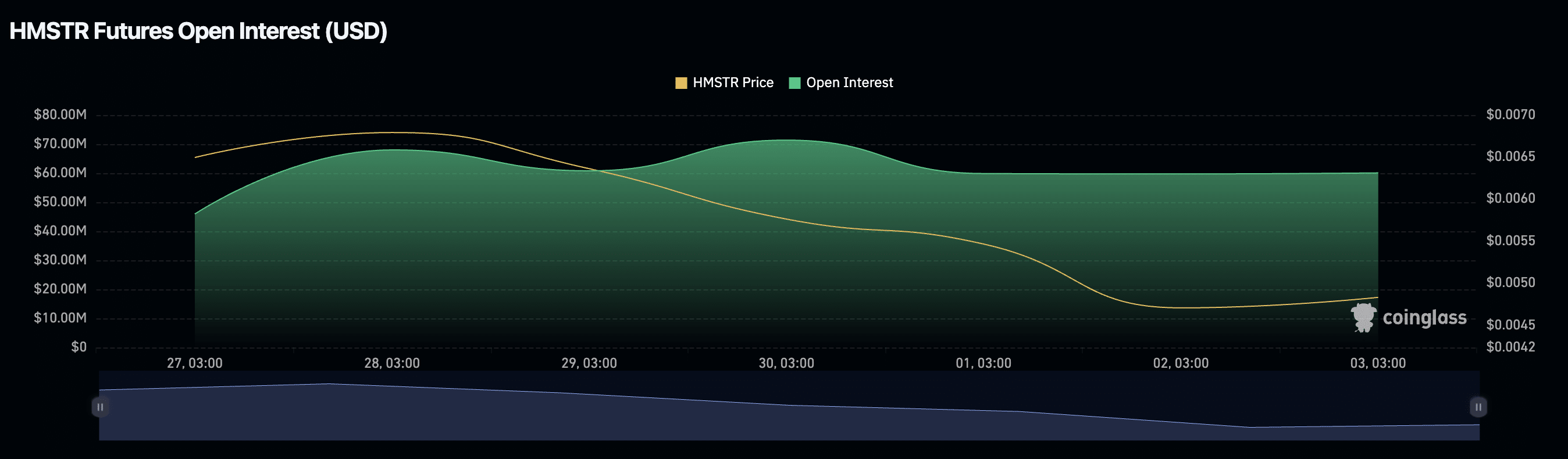
However, despite the rapid fall in the rate, open interest in HMSTR Futures remains stable. According to Coinglass, this figure has been at $60 million since the beginning of October.
HMSTR futures OI | Source: Coinglass
In many ways, Hamster Kombat repeated the story of Catizen — another Telegram-based project that disappointed users after the airdrop.
An unexpected change in the rules of the game or why they started to dump CATI
CATI also announced the rating of the leaders of the fall of tokens in the TON ecosystem: like other similar projects, the coin’s price has fallen by 50% since Sep. 20.
The rise and fall of Catizen are reminiscent of the path of Hamster Kombat. Shortly before the start of the distribution, the team unexpectedly changed the rules of the game.
Initially, 43% of the total supply of CATI tokens was intended for players. However, the developers unexpectedly changed the conditions, so the community got only 30%.
The community’s discontent was not limited to this. Soon after the airdrop, it turned out that user spending in the game influenced the criteria for distributing tokens. Those who invested money in the game, not time, received a significant advantage.
After this, many players shared stories about how they took leading places but received very few rewards. As a result, a wave of discontent with the hashtag #catizenscam swept through social networks.
1 Airdrop is on June/July 2 Most impt criteria is vKitty/s or cat level 3 Claimed tokens will be received before Sep 28 10AM UTC. 4 Airdrop is 43% 5 If you can’t hold you won’t be rich (then token dumps)
Airdrops are considered one of the most popular strategies for attracting users. Many projects launched on the Telegram platform used them.
For example, Dogs, Hamster Kombat, Catizen, and similar projects actively awarded users coins for simple actions. As a result, tokens distributed through airdrops cannot maintain long-term interest or preserve their value.
Airdrops, used to increase project engagement and distribute tokens more widely among users, have probably lost their former influence as users have become oversaturated with such strategies.
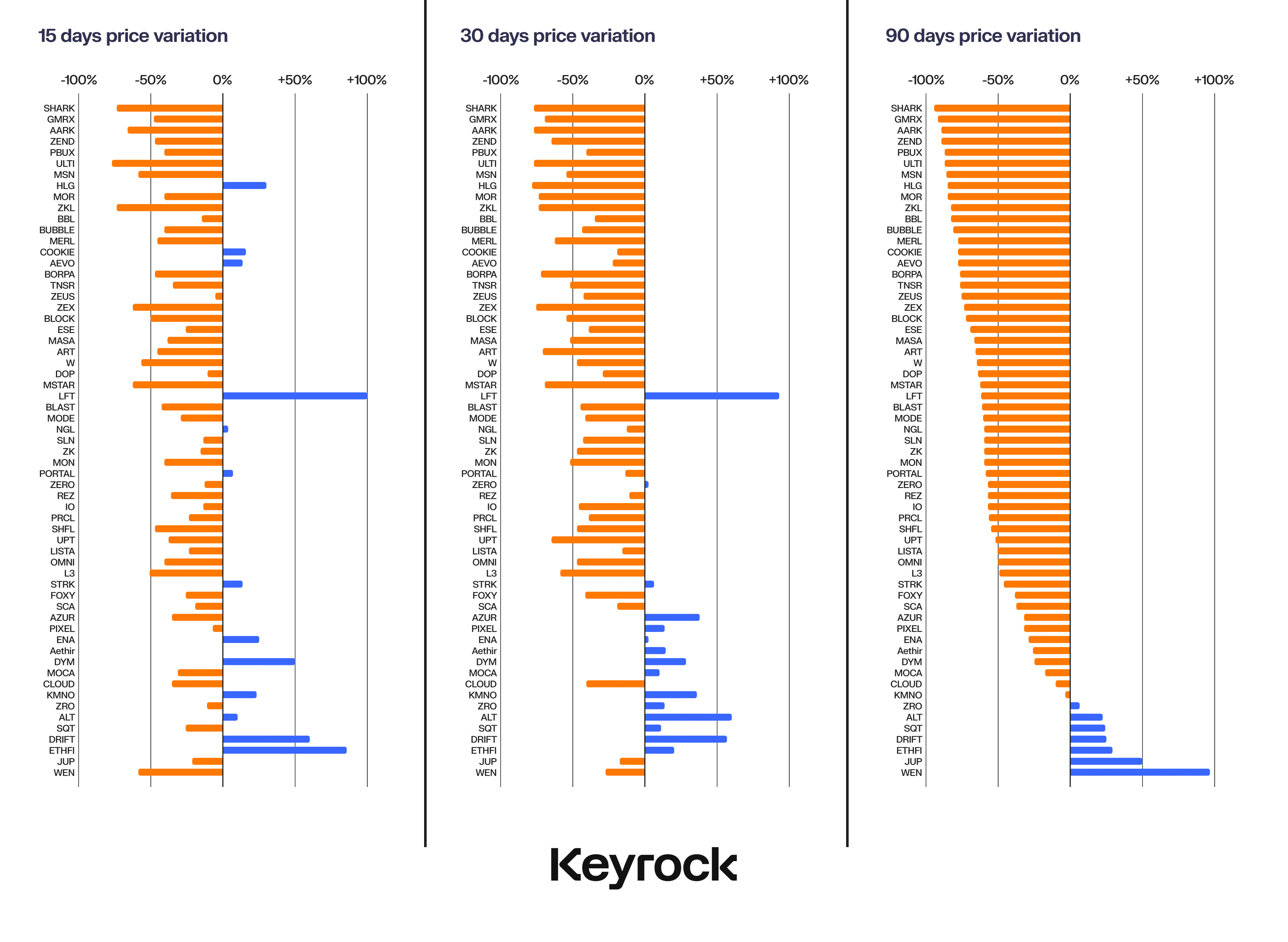
For example, KeyRock experts analyzed 62 airdrops in six blockchains since the beginning of 2024. The data showed that 88.7% of the tokens demonstrated a significant price decline within 90 days after the distribution. Only a few of them showed sustainability.
Token price movements after airdrops | Source: KeyRock
At the same time, small airdrops have shown greater resilience in the short term. This is probably due to the low selling pressure during the token launch. However, in the longer term, tokens still fall over three months.
Moreover, Telegram-based games are still young, and investors may still determine whether the demand for them will last. This also fuels users’ tendency to sell off tokens, which ultimately negatively affects their price.
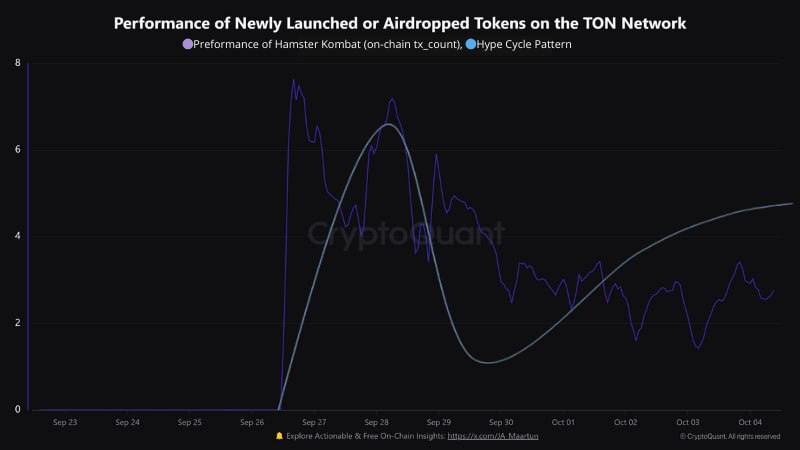
CryptoQuant analyst Maartunn told crypto.news that newly launched tokens in the TON ecosystem often follow a typical hype cycle.
“Initially, short-term expectations tend to be excessively high, while long-term expectations are often underestimated.”
Maartunn, CryptoQuant analyst
He also visualized the number of Hamster Token transactions relative to all TON transactions. The trend line illustrates the classic hype cycle model.
Performance of the HMSTR token. Source: CryptoQuant
Among other recently launched coins, Hamster Kombat is one of the most popular. However, Maartunn noted that many meme coins will eventually fail; only those with good fundamentals and a strong network can survive.
What are the key trends highlighted by the global crypto adoption index, and how do they reflect crypto’s role in global economic shifts?
The global crypto adoption index is an essential tool for understanding how well different countries are adopting crypto. But why is this important?
Well, in a world that’s becoming increasingly digital, knowing where crypto is gaining traction helps us see the bigger picture. Let’s dive deep into what the index is, how it’s calculated, and what it says about the future of crypto adoption worldwide.
Table of Contents
What is the global crypto adoption index?
The global crypto adoption index serves as a comprehensive tool to measure how countries are engaging with crypto assets. Think of it like a report card, evaluating each country’s progress in embracing crypto assets.
The index considers multiple factors, including the number of users, the volume of crypto transactions, and the growth of crypto-related businesses within a country. Experts also assess key indicators such as retail activity, institutional participation, and the role of decentralized finance.
The index’s main goal is to gauge how deeply crypto is integrated into everyday life — whether it’s being used for routine transactions like remittances or online payments or treated as a long-term investment asset.
For instance, a country that ranks high on the index likely has a strong ecosystem of crypto exchanges, widespread business acceptance, and a large population using crypto for savings or sending money abroad.
On the other hand, countries with lower scores may show fewer real-world applications, with crypto mostly held as an investment by a smaller portion of the population.
The index is updated regularly to capture the fast-evolving crypto space, reflecting changes driven by technology, regulations, and economic shifts.
Methodology behind the crypto adoption index
The crypto adoption index goes beyond simply ranking countries by how many people own Bitcoin (BTC) or Ethereum (ETH). It delves deeper, evaluating how crypto is integrated into everyday life.
The index’s methodology focuses on three core areas: transaction volume, peer-to-peer trading, and a weighted analysis to account for economic factors.
First, experts examine transaction volume, which includes how often people use crypto to pay for goods, services, or even bills.
Next, the index tracks peer-to-peer trading volumes. This metric is crucial in areas with limited access to traditional financial services. In such regions, P2P platforms enable users to trade crypto directly, bypassing banks or regulated exchanges. P2P trading is especially prominent in countries facing economic challenges.
The final element of the methodology involves a weighted analysis that adjusts for each country’s population size and economic conditions, ensuring fair comparisons. One key factor in this process is purchasing power parity, which adjusts for differences in the cost of living between countries.
By weighting crypto activity based on a country’s GDP per capita on a PPP-adjusted basis, the index offers a clearer picture of how crypto adoption impacts individuals rather than merely reflecting economic power. This method ensures that smaller nations with less economic output aren’t overshadowed by larger, wealthier countries.
For example, a smaller economy with high crypto usage relative to its size will score higher than a developed nation where crypto is mostly concentrated among investors.
Current global trends in crypto adoption
The crypto adoption across the globe reveals interesting trends that showcase how the world is embracing crypto assets. A critical observation is the widening gap between developing and developed nations regarding crypto adoption.
While early adopters like the U.S., Japan, and South Korea maintain strong positions, the most substantial growth in crypto usage is occurring in emerging markets.
For instance, Latin American countries such as Argentina and Brazil have seen a surge in crypto adoption, primarily driven by economic instability and high inflation rates.
Argentina, battling hyperinflation for years, had over one-third of its population engaging with crypto in 2023, according to the Crypto Council for Innovation’s report. Citizens are using digital assets as a hedge against their rapidly devaluing national currency.
Similarly, Brazil has experienced a noticeable rise in crypto users as it seeks alternatives to its weakening real.
Africa is another region demonstrating high levels of adoption, particularly in countries like Nigeria and Kenya. In Nigeria, where a large portion of the population is unbanked, over 45% of citizens have engaged with cryptocurrency in some form.
Meanwhile, Southeast Asian countries such as Vietnam and the Philippines continue to lead in adoption rates. In these regions, the rise of blockchain-based gaming and play-to-earn models, where users earn crypto by playing online games, has captivated young populations seeking new income opportunities in a region with relatively lower wages.
In contrast, developed nations like the U.S., Germany, and Japan exhibit a more investment-focused trend in crypto adoption. Investors in these countries are turning to cryptocurrencies to diversify their portfolios and as a hedge against traditional markets.
Data also highlights that institutional investments have also fueled adoption in wealthier countries, with major financial firms incorporating crypto into their offerings.
For example, in the U.S., investment giants like BlackRock and Fidelity have launched crypto funds aimed at both retail and institutional investors.
The global trend is clear: in developing countries, crypto is becoming a vital tool for financial survival and accessibility, while in developed nations, it serves primarily as an investment vehicle.
Crypto adoption by country: 2024
Crypto adoption continues to vary largely across different countries, with some regions experiencing remarkable growth over the past year.
According to Chainalysis’ 2024 global crypto adoption report, between Q4 2023 and Q1 2024, global crypto activity surged, surpassing levels seen during the 2021 bull market.
When examining data from 151 countries, it’s evident that while some nations are leading the charge, the landscape is evolving in diverse ways.
Country
Region
Overall index ranking
Centralized service value received ranking
Retail centralized service value received ranking
DeFi value received ranking
Retail DeFi value received ranking
India
CSAO
1
1
1
3
2
Nigeria
Sub-Saharan Africa
2
5
2
2
3
Indonesia
CSAO
3
6
6
1
1
United States
North America
4
2
12
4
4
Vietnam
CSAO
5
3
3
6
5
Ukraine
Eastern Europe
6
7
5
5
6
Russia
Eastern Europe
7
11
7
7
7
Philippines
CSAO
8
9
8
14
9
Pakistan
CSAO
9
4
4
18
13
Brazil
LATAM
10
8
10
10
14
Türkiye
Middle East & North Africa
11
14
11
15
11
United Kingdom
Central, Northern & Western Europe
12
12
21
9
8
Venezuela
LATAM
13
17
16
11
12
Mexico
LATAM
14
18
17
13
10
Argentina
LATAM
15
13
13
17
20
Thailand
CSAO
16
16
15
19
16
Cambodia
CSAO
17
10
9
35
23
Canada
North America
18
22
26
16
15
South Korea
Eastern Asia
19
15
14
33
33
China
Eastern Asia
20
20
18
24
22
2024 global crypto adoption index top 20 | Source: Chainanalysis
One of the most surprising trends in the crypto adoption index is that last year’s growth was primarily driven by lower-middle-income countries.
Nations like Nigeria, India, and Vietnam experienced substantial increases in crypto usage, as people turned to crypto as an alternative to their national currencies, which were often weakened by inflation or economic instability.
However, the first quarter of 2024 also revealed an increase in crypto activity across all income brackets, with a slight pullback in high-income countries like the U.S. and Germany.
A major driver of increased crypto adoption in wealthier nations was the launch of spot Bitcoin ETFs in the U.S., which sparked a surge in Bitcoin activity, particularly in North America and Western Europe.
Institutional-sized Bitcoin transfers saw strong year-over-year growth, indicating that large companies and financial institutions are becoming more involved in the crypto market, further fueling adoption among high-income countries.
Meanwhile, regions such as Sub-Saharan Africa and Latin America are seeing a different type of growth. In these areas, stablecoins are increasingly used for real-world applications, like remittances and everyday transactions, particularly among retail users and smaller businesses.
Another notable development is the rise in DeFi activity, especially in regions like Sub-Saharan Africa, Latin America, and Eastern Europe. This surge in DeFi has also led to increased altcoin activity, as many platforms operate on altcoins beyond Bitcoin and Ethereum.
Factors influencing crypto adoption
Several key factors influence crypto adoption across different countries, each playing a crucial role in how people interact with crypto.
One of the most important factors is economic instability. In nations experiencing rampant inflation or a devaluation of their national currency, people often turn to crypto as a safer way to store and transfer wealth.
Another critical factor is access to traditional financial services. In many developing countries, large portions of the population are unbanked, meaning they lack access to banks or financial institutions.
Crypto offers these individuals a gateway to the global economy, enabling them to make transactions, save money, and even invest without needing a bank account.
Government regulations also play a key role in shaping crypto adoption. Countries with clear, favorable crypto regulations tend to experience higher adoption rates, as people feel more secure engaging with digital currencies when there’s a stable legal framework in place.
Lastly, technological infrastructure, such as internet and smartphone access, plays a crucial role. Countries with widespread internet availability and affordable mobile devices are better equipped to adopt crypto on a large scale, as digital transactions and wallets depend heavily on technology.
Benefits of high crypto adoption
Countries with high crypto adoption often experience several benefits for their economies.
One of the most immediate advantages is financial inclusion. Through crypto, people can conduct transactions, save, and invest without the need for a physical bank account or paying steep fees for cross-border payments.
Another major benefit is the democratization of finance. Crypto empowers individuals to manage their finances independently, without relying on governments or intermediaries, allowing users to borrow, lend, and trade assets without traditional institutions.
High crypto adoption also stimulates economic growth by attracting investment and fostering innovation. For example, countries like El Salvador, which made Bitcoin legal tender, have seen a surge in foreign investment and tourism.
Additionally, widespread crypto use can help stabilize economies facing currency volatility. In nations with high inflation, crypto serves as a store of value, offering citizens an alternative to their depreciating national currency.
Future of the global crypto adoption index
One key driver for global crypto adoption could be the development of central bank digital currencies. Governments in China, India, and the European Union are either exploring or actively developing their own digital currencies.
While CBDCs differ from cryptocurrencies, their introduction could further legitimize digital assets and accelerate global crypto adoption.
Additionally, as more institutional players enter the crypto space, activity in high-income countries is expected to increase. The launch of products like Bitcoin ETFs has already shown how institutional interest can drive adoption.
In the coming years, traditional financial institutions, including banks and hedge funds, may begin offering more crypto-related services, boosting the crypto adoption index in wealthier regions.
However, challenges remain, particularly in the area of regulation. Some countries may introduce stricter regulations to control the use of cryptocurrencies, potentially slowing down adoption.
On the other hand, nations that maintain crypto-friendly policies are likely to see their crypto adoption index scores continue to rise.
Overall, crypto’s role as both a financial tool and an investment vehicle will keep evolving, shaping global markets in unpredictable ways.